Tsukumogami
The famous rule says an old tool comes alive after a hundred years. Nobody has found where that rule comes from. And the word itself first meant an old woman's white hair.
What are tsukumogami?
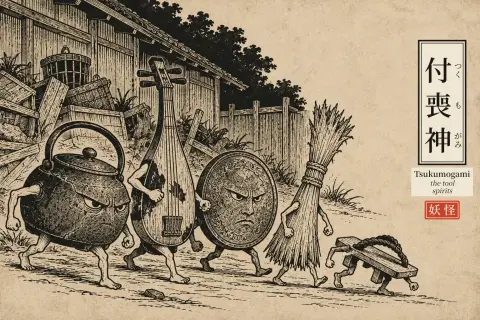
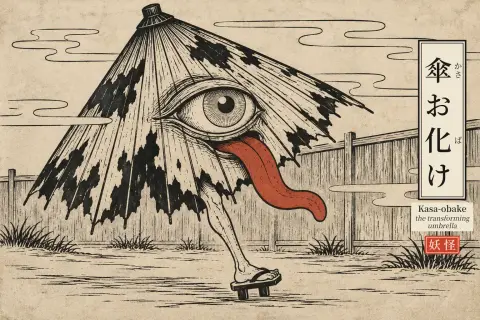
Tsukumogami are things that come alive. An old umbrella hops on one leg. A paper lantern splits open into a mouth. A worn-out futon grows eyes, with rags for arms and legs.
The oldest text with their rule is a Muromachi-period picture scroll, the Tsukumogami-ki. It says a tool gains a spirit after a hundred years. It says it is quoting an older book. Nobody has ever found that book.
The name is stranger still. Tsukumo, written 九十九, means ninety-nine: one short of a hundred. In a 10th-century poem in the Ise Monogatari, it described an old woman's white hair. The scroll kept the sound and gave it new characters: 付喪神. A word about hair became a word about haunted furniture.
And the creatures you picture are far younger than the scroll. Twelve of the seventeen below first appear in one book, printed in 1784. Its artist, Toriyama Sekien, seems to have invented most of them. Even its title, Hyakki Tsurezure Bukuro, is a joke on Tsurezuregusa, an essay collection from around 1330.
Each page below lists its sources.
Why would an old tool have a soul?
People usually give one of three answers. Each has some evidence. Each also has a problem.
The first answer is that Japan sees spirits in everything. It is the answer you hear most often. But the scroll does not say that. It gives a soul only to a tool that has served a hundred years. A new bowl is just a bowl.
The second answer is Buddhism. The scroll ends with the tools becoming Buddhas. The scholar Noriko Reider reads it as a sermon for Shingon Buddhism (2009). One Buddhist teaching held that even things without a mind could reach enlightenment. So the monsters were made to be saved.
The third answer is guilt about throwing things away. Read the scroll again. The tools are not angry because they are old. They are angry because a family threw them out, in the year-end cleaning called susuharai.
We think the third answer explains the most. Look at the creatures below. A rice paddle gets up at night after it is thrown out. A koto grows a face to show its grudge at being forgotten. They are not haunted by age. They are haunted by being left behind.
The belief also came and went. The scholar Komatsu Kazuhiko notes that tool spirits were common in the medieval period. The idea faded for much of the Edo period. Then artists like Sekien brought it back, as pictures rather than belief.
So the fear may not be of old things. It may be of old things that nobody cares for any more.
List of tsukumogami
Start here
The idea itself, from a medieval picture scroll.
Around the house
An umbrella, a lantern, a futon and a mirror.
Kasa-obake
傘お化けA one-eyed, one-legged umbrella come to life—an icon of tool-spirits.
playful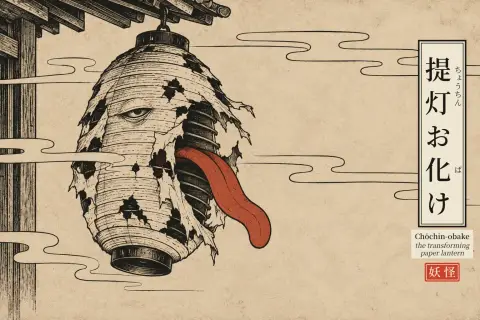
Chochin-obake
提灯お化けA split-mouthed paper lantern spirit with a lolling tongue.
playful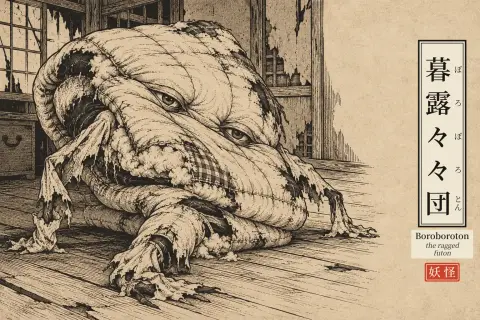
Boroboroton
暮露々々団A worn-out futon that has grown eyes, with scraps of cloth for arms and legs.
vengeful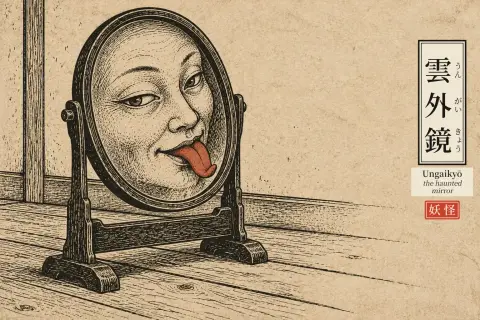
Ungaikyo
雲外鏡A century-old mirror that stops reflecting the room and starts showing whatever it pleases.
mischievousIn the kitchen
A rice paddle, a cloth, the crockery and a water jar.
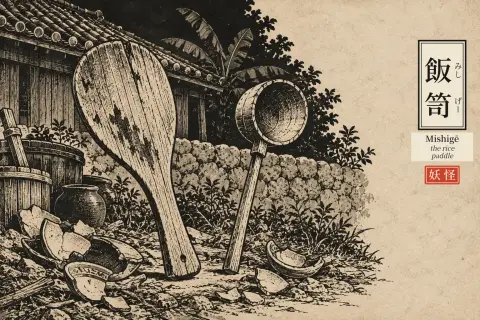
Mishigē
飯笥A rice paddle thrown out after long service, which gets up at night and makes trouble.
playful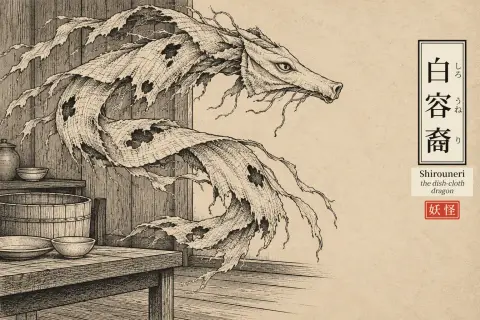
Shirouneri
白容裔An old kitchen cloth that has turned into a ragged, dragon-like spirit.
sinister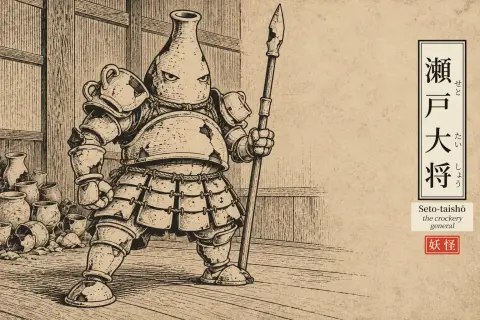
Seto-taisho
瀬戸大将A little general armored in cast-off cups and plates who marshals the household crockery.
playful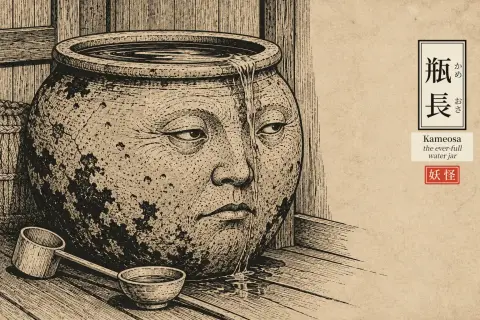
Kameosa
瓶長A water jar with a face that never runs dry—the rare tsukumogami that signals good luck instead of punishing anyone.
benevolentMusic and the stage
A biwa lute, a koto and a stack of old Noh masks.
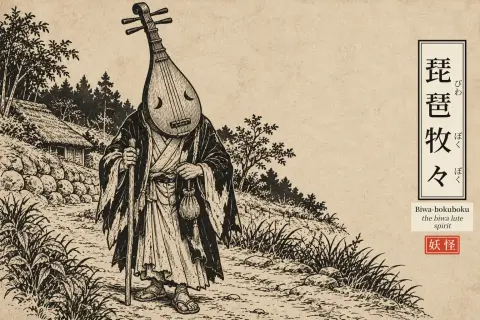
Biwa-bokuboku
琵琶牧々An old biwa lute turned spirit, drawn as a blind biwa priest with the lute for a head.
sorrowful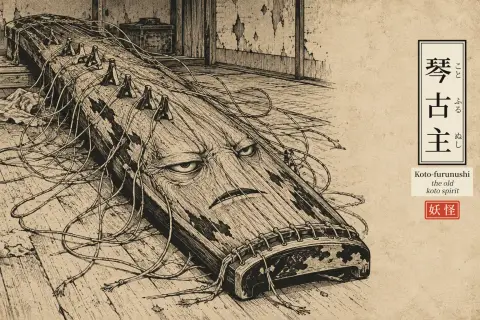
Koto-furunushi
琴古主A forgotten koto that grows a face to show its grudge at being forgotten.
sorrowful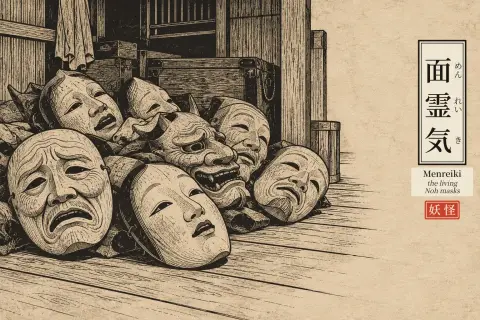
Menreiki
面霊気A stack of retired Noh masks that begins, at night, to work through its whole repertoire.
eerieTemples and shrines
A tea kettle, a cauldron, a shrine bell and a family altar.
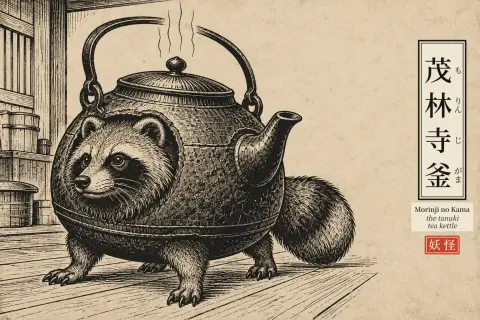
Morinji no Kama
茂林寺釜The temple tea kettle that sprouted a tanuki's head, tail and legs—and would not stop boiling.
playful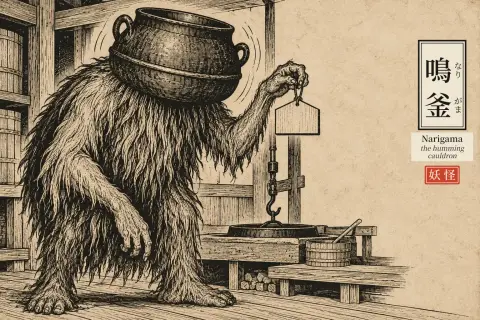
Narigama
鳴釜The cauldron at Kibitsu Shrine whose hum answers yes or no—and whose silence is the worst answer.
mysterious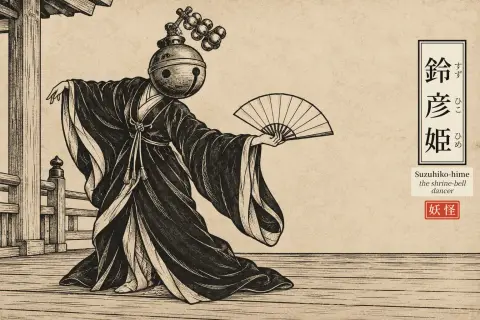
Suzuhiko-hime
鈴彦姫A shrine bell grown into a dancing woman—the sound of kagura, finally given a face.
benevolent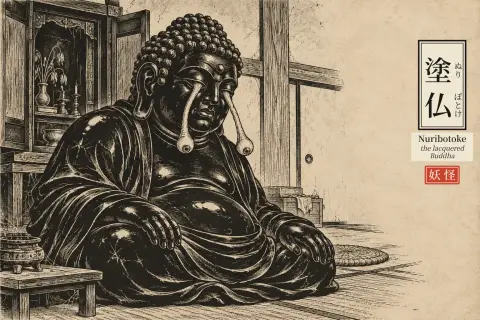
Nuribotoke
塗仏A black, Buddha-like figure climbing out of a family altar, its eyes dangling on their stalks.
eeriePaper and rubbish
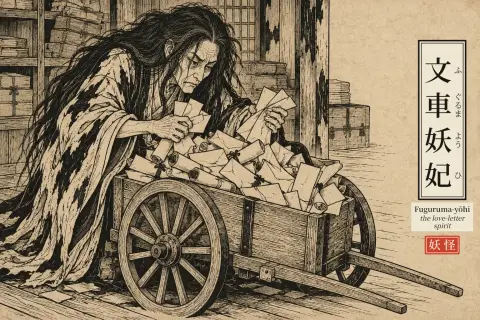
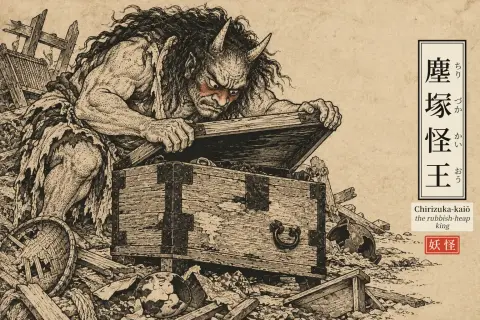
A cart of old letters, and the king of the dust heap.
How Japan still says goodbye to old things
The feeling has not gone away. Japan still holds memorial rites for worn-out things.
On February 8, many shrines and temples hold hari-kuyō, a rite for broken needles. People push old needles into soft tofu or konnyaku, to thank them for their work. Some regions hold it on December 8 instead.
Old dolls get the same care. Awashima Shrine in Kada, Wakayama, is known for it. Thousands of dolls fill its grounds, left by owners who could not throw them away. Each year on March 3, the shrine sets dolls out to sea on small boats.
None of this says a needle or a doll will come back angry. But it shares the feeling of the old scroll. You do not simply throw out a thing that served you.