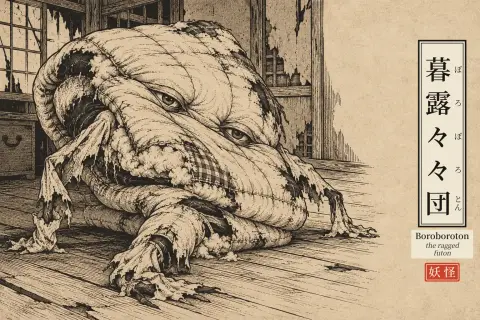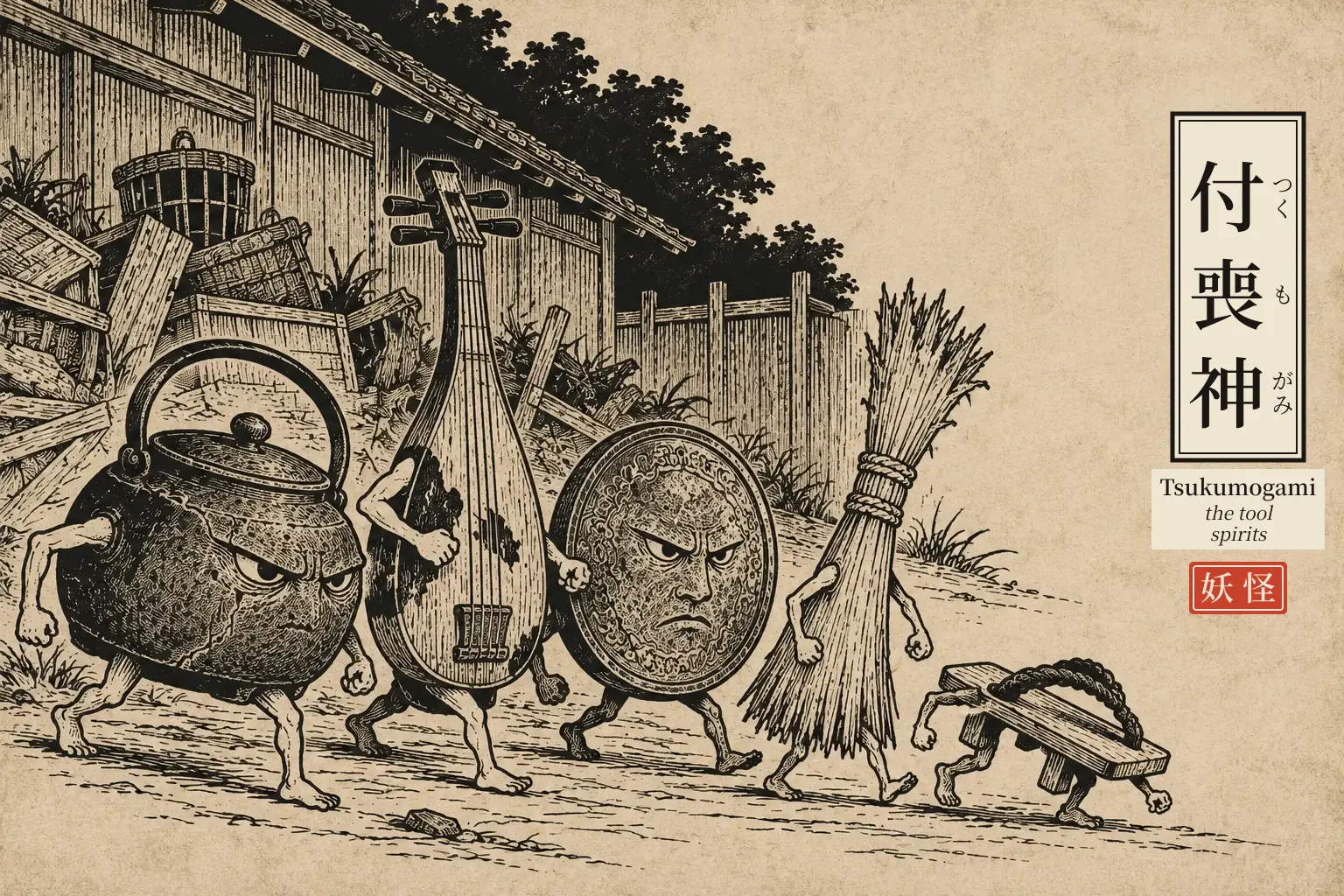
An umbrella grows one leg and hops away. A worn-out futon sprouts arms. A mirror learns to stare back. All of them belong to one class of Japanese spirit: the tsukumogami, things that were once tools and are now something else. The kanji chosen for the name read, roughly, "a god of what was left behind" — 付 (tsuku, "to attach"), 喪 (mo, "mourning"), 神 (gami, "god"). That reading lines up with the grudge the scroll goes on to tell.
What does a tsukumogami look like?
There is no single tsukumogami shape, because the category covers hundreds of individual objects. The oldest text on the subject gives only three general forms. A tool that wakes up takes on a human shape — man or woman, old or young — or a demon's shape, or the shape of a fox, wolf, or jackal. Beyond that, the text leaves the details to the object itself.
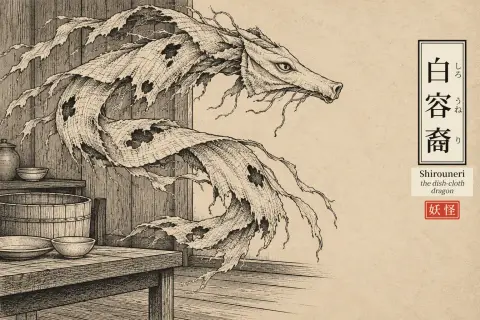
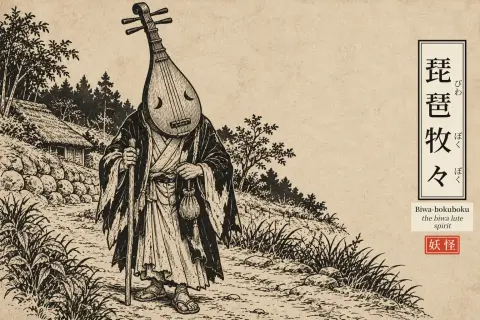
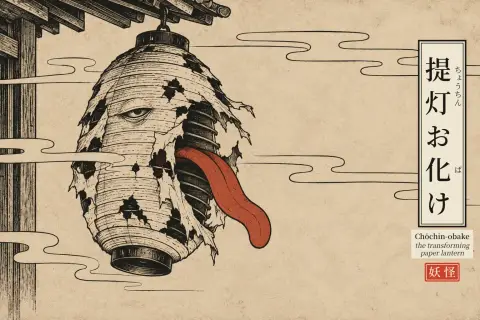
Centuries later, artists filled in those details one tool at a time. An umbrella got one leg and a long tongue. A paper lantern split down the middle into a toothy mouth. A kettle, a mirror, a biwa lute, and a stack of old Noh masks each got their own face. Those individual portraits now carry their own names — kasa-obake, boroboroton, shirouneri, menreiki, and more — and each has its own story worth telling on its own.
The night the tools rebelled
The source for all of this is a Muromachi-period picture scroll called the Tsukumogami Emaki. The oldest surviving copy, from the 1500s, is kept at Sōfuku-ji temple in Gifu. A nobleman's diary already mentions a tsukumogami scroll in 1485, so some version existed earlier still.
Its plot is simple. Around the 960s, households clean house for the new year. This yearly custom, susuharai or "soot-sweeping," means throwing out old tools. The discarded tools are furious. On the night of Setsubun they transform and attack people.
They do not win for long. Child spirits called Goho Dōji, backed by a Buddhist ritual known as the Sonshō Darani, subdue the rebellion. Ashamed of their violence, the tools become monks. They study the Shingon sect and train in the mountains. In the end, all of them reach enlightenment, grouped under four grand Buddha names.
It reads less like a folk memory and more like a sermon — and scholars have guessed a Shingon monk wrote it. It reads like it needed tools nobody could feel too sorry for, so it could show them forgiven.
A name that quietly hides another word
The scroll's opening line claims a source: a lost book called the Onmyō Zakki, which supposedly says a tool gains a spirit after a hundred years. No copy of that book has ever turned up. Nobody can confirm the hundred-year rule beyond this single scroll quoting it.
The word itself hides a second surprise. Written 九十九, tsukumo means "ninety-nine," not a hundred. The scroll borrows this word from a much older poem, in the tenth-century Ise Monogatari, that describes an old woman's white hair as tsukumogami — hair "one year short of a hundred years." The scroll kept that sound and gave it new characters: 付喪神. A word about hair became a word about haunted furniture.
Where it comes from
Tool-shaped monsters predate this scroll, too. An earlier scroll, the Tsuchigumo Sōshi, already drew a trivet worn on a head and a washbasin that grew teeth and a face. None of those pieces used the word tsukumogami. The idea of an object with a face came first; the name came later and gathered it in.
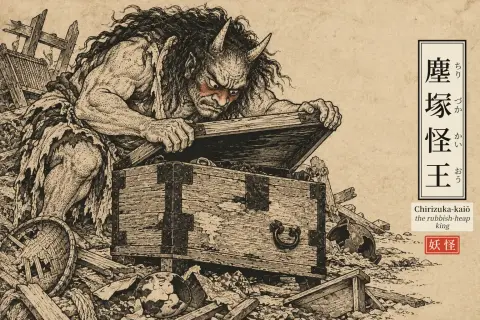
The scholar Komatsu Kazuhiko reads the wider history as a rise and fall. The idea of tool-spirits was common in the medieval period, when the scroll was made. It faded during most of the Edo period. Then, near the end of the Edo era, Toriyama Sekien and other print artists picked the idea back up — not as belief, but as art. Sekien's 1784 book Hyakki Tsurezure Bukuro gave faces to a dozen new objects: jars, kettles, shrine bells, even a pile of household trash. Those pictures, not the old sermon, are what most people now picture when they hear the word.
See the original print
Toriyama Sekien drew Tsukumogami in Hyakki Tsurezure Bukuro (1784). This book has that picture, with its caption in English.
- Japandemonium Illustrated: The Yokai Encyclopedias of Toriyama Sekien →trans. Hiroko Yoda & Matt AltThe complete Edo-period bestiaries that so many of these entries trace back to, in full English translation.
- The Book of Yokai →Michael Dylan FosterThe most readable scholarly introduction to yokai — where they come from, what they mean, and the major creatures.
Some links are affiliate links; if you buy through them we may earn a small commission at no extra cost to you.
Tsukumogami today
The idea of an object with a mind of its own still travels well. Pokémon's Rotom, a spirit that climbs inside electrical appliances and takes on their shape, reads as a modern tsukumogami for a world full of gadgets instead of jars and umbrellas. The creature's name changed, and the spirit swapped a futon for a toaster, but the basic shape of the idea — something you own starts owning itself back — has not aged a day since the Muromachi period.
Sōfuku-ji still holds its scroll in Gifu. The tools inside it are still, technically, waiting to become Buddhas.