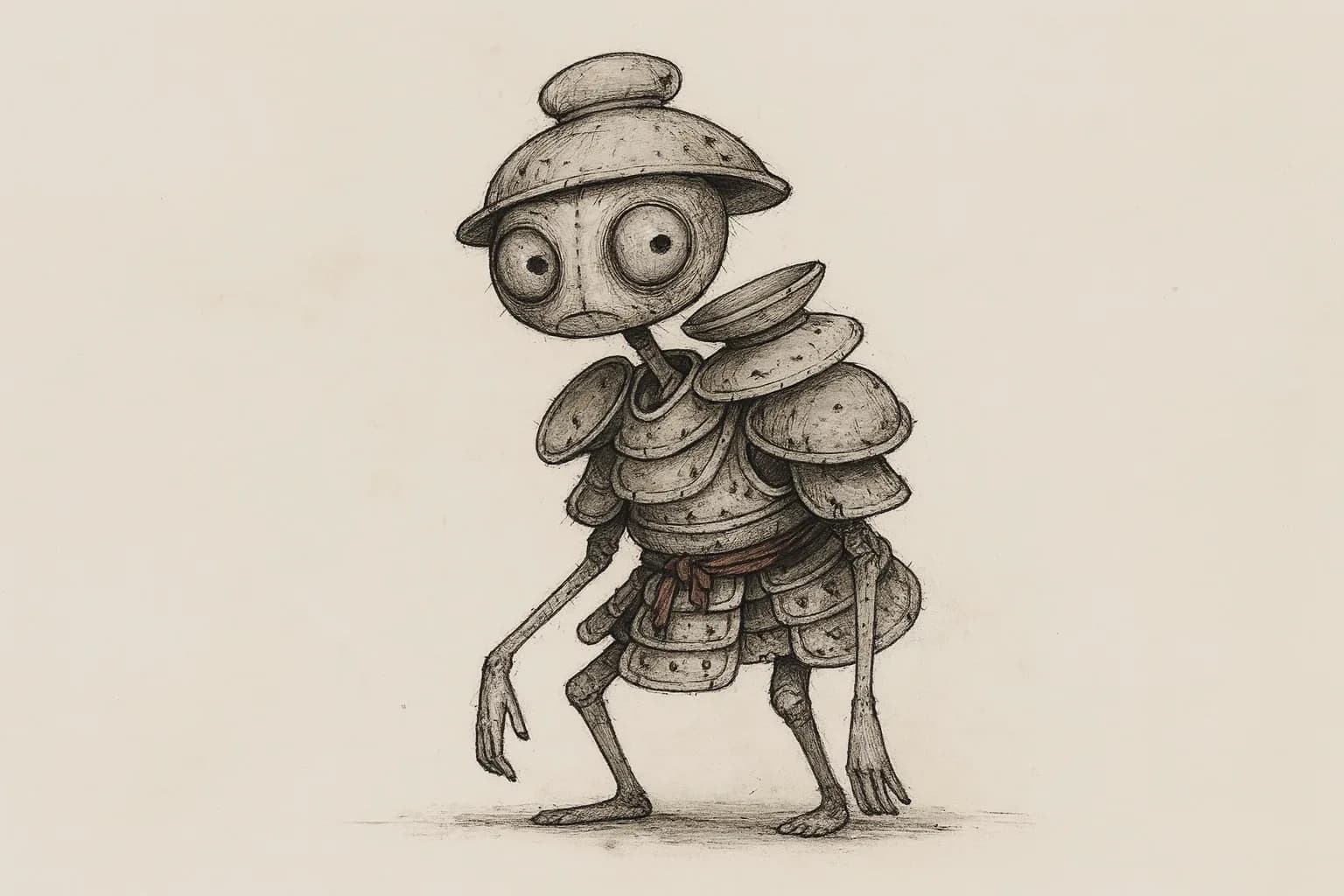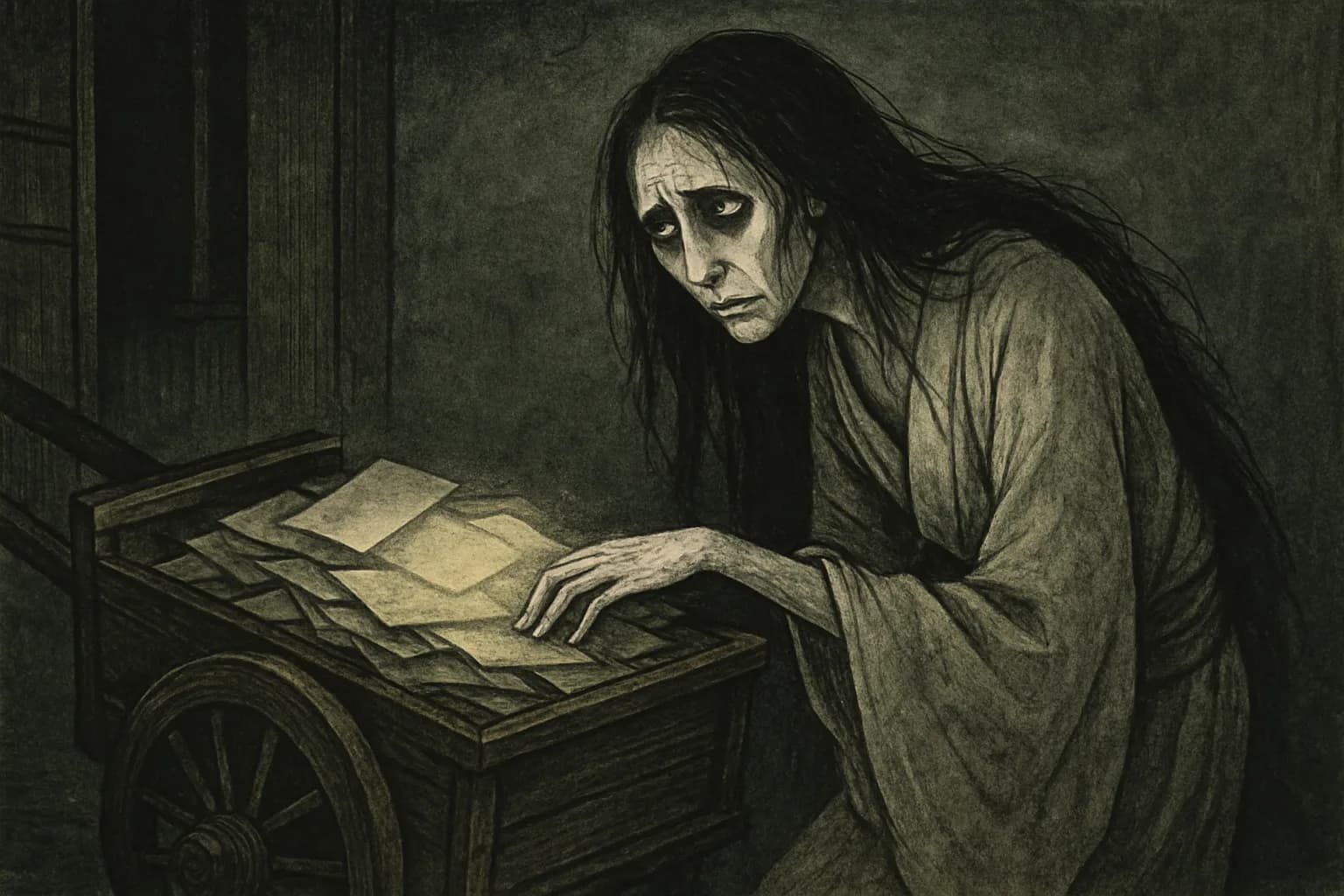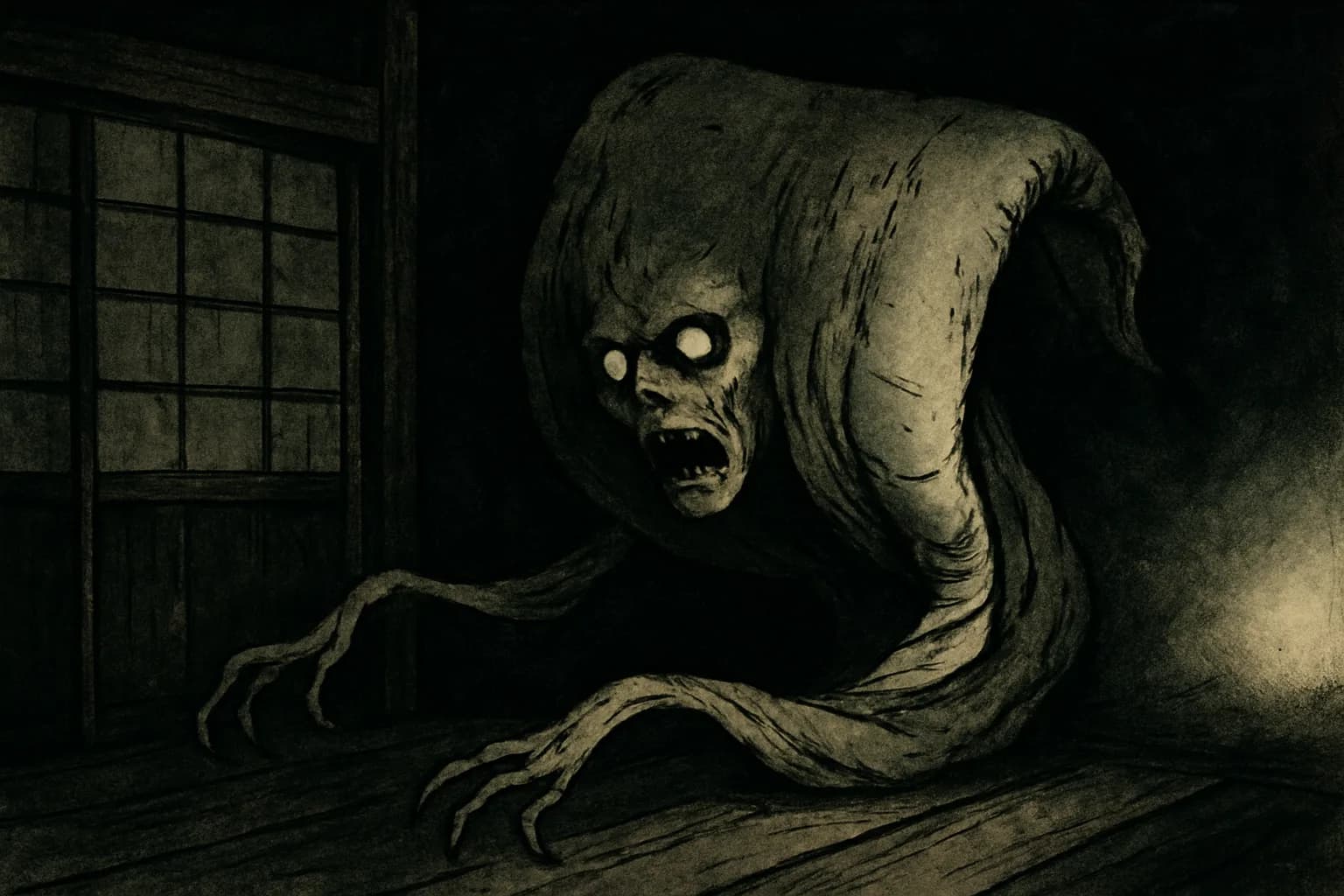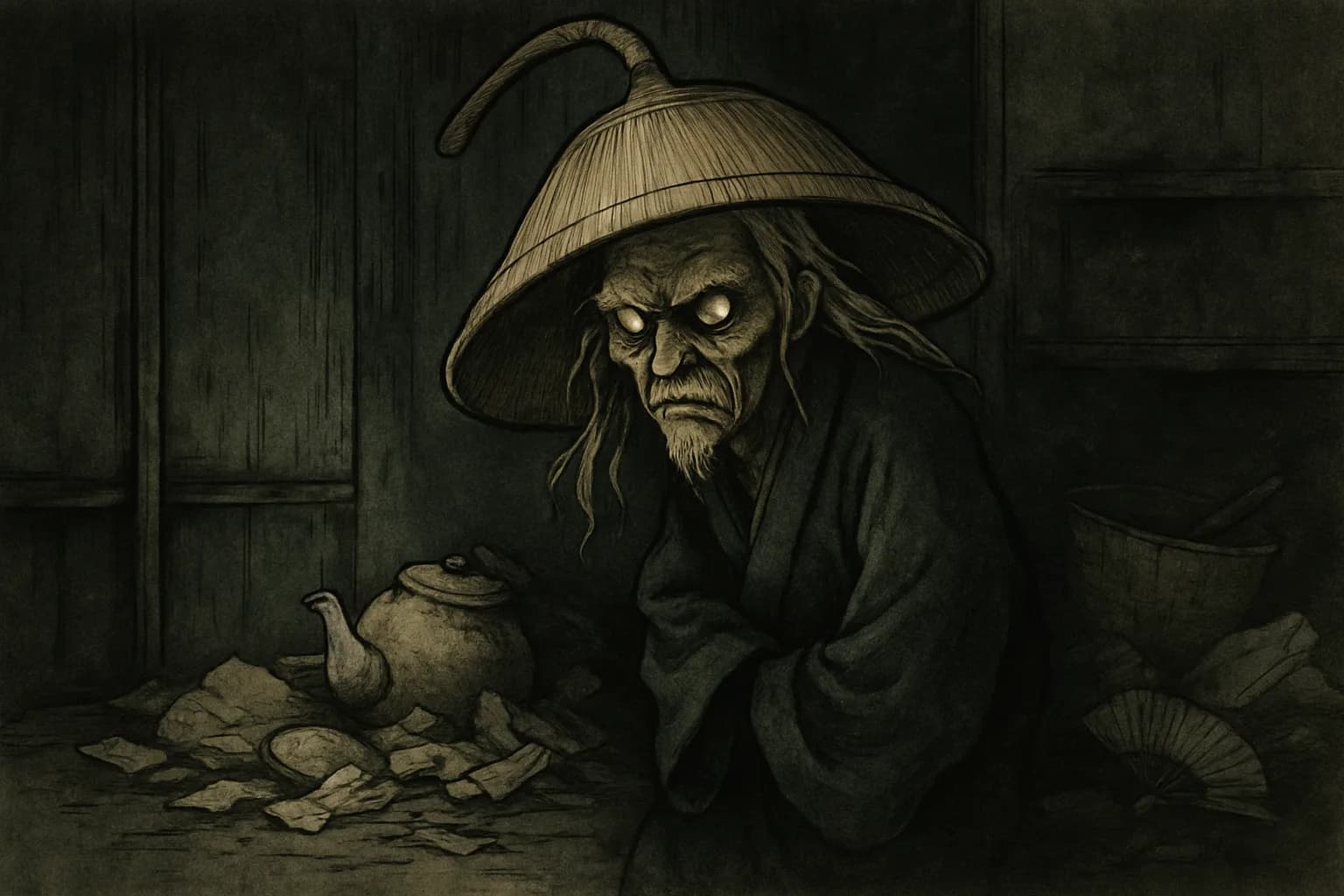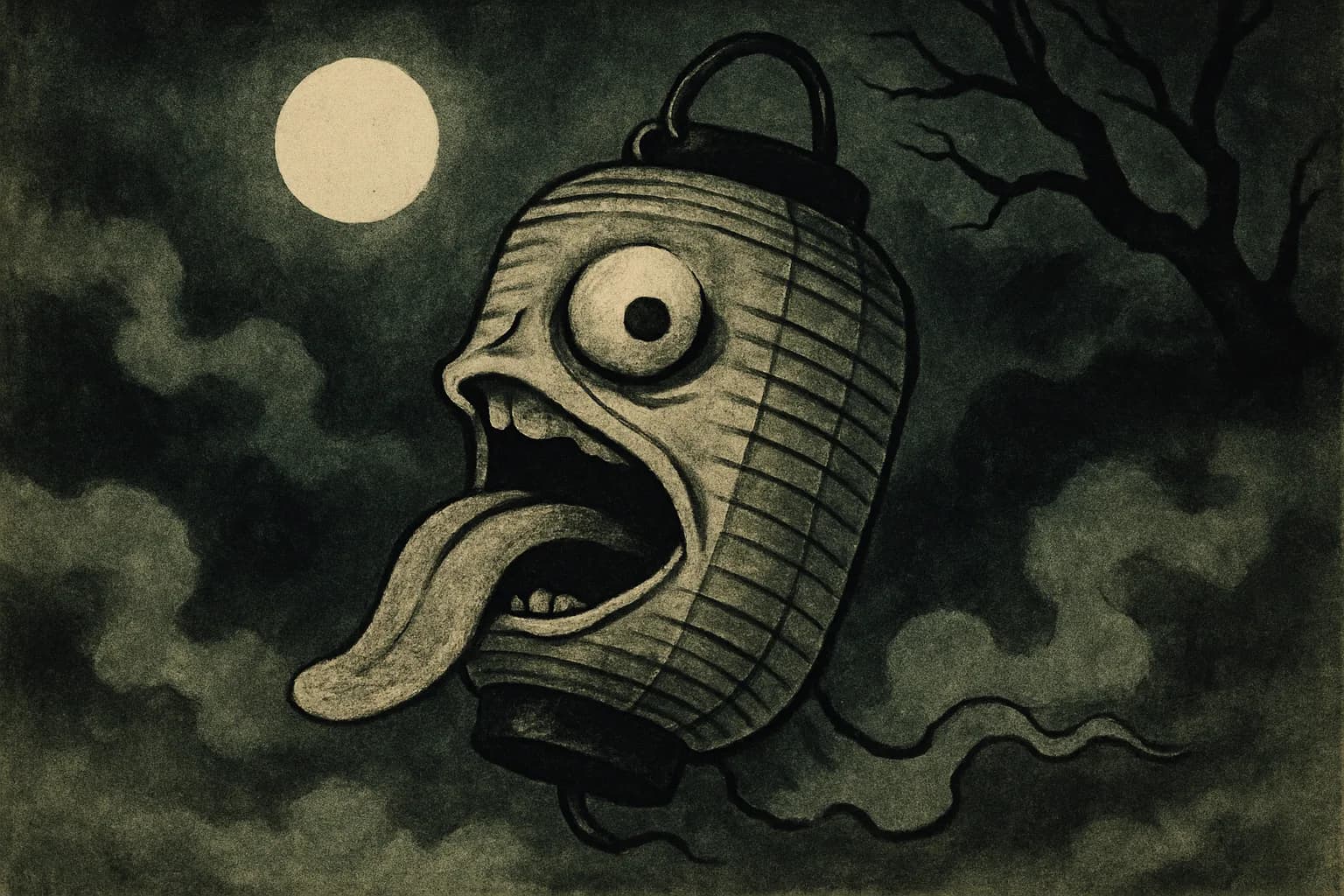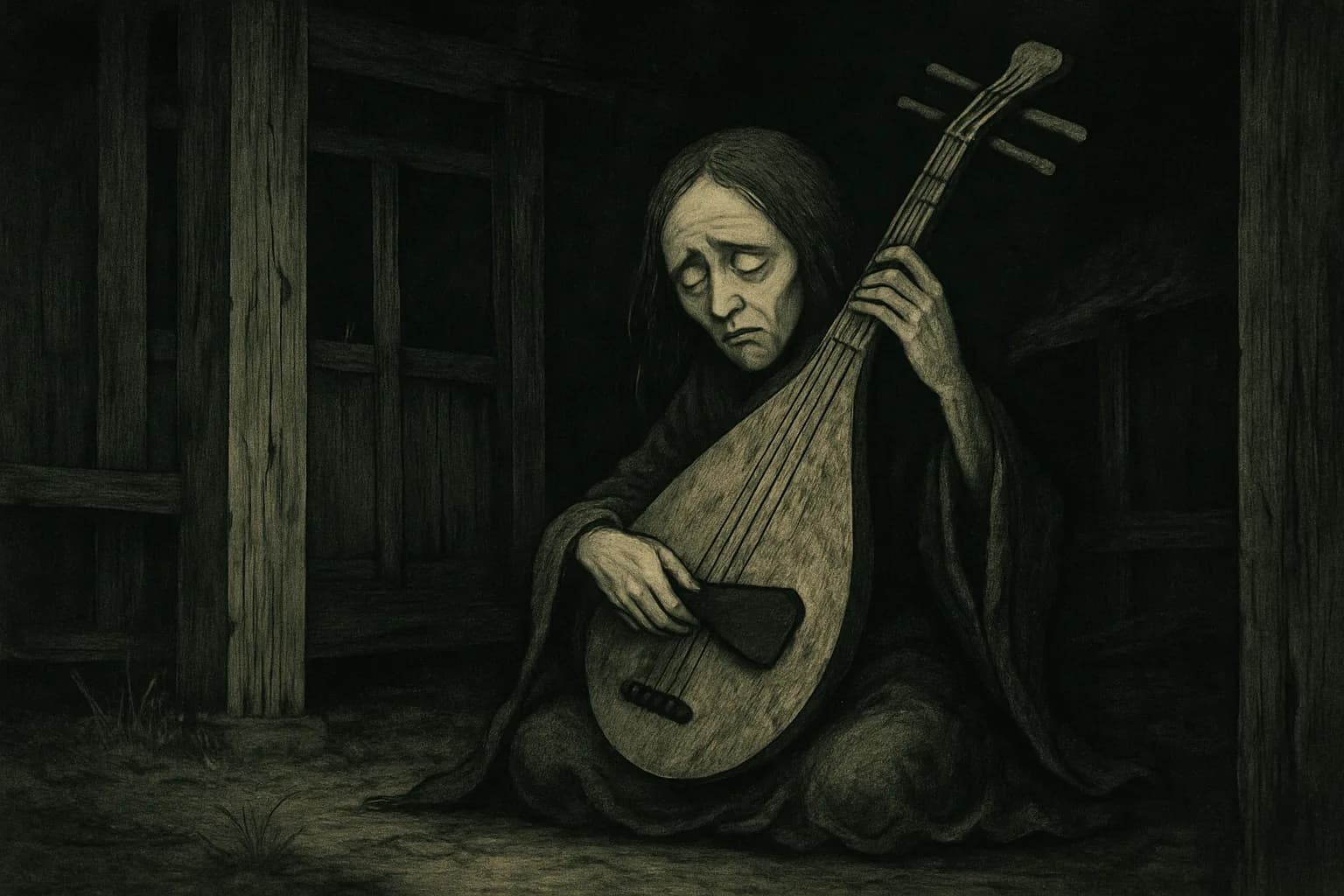
Most tsukumogami — the tool spirits — in Toriyama Sekien's picture books are drawn for a laugh — a general assembled from teacups, an umbrella hopping on one leg. Biwa-bokuboku is the exception. It is a biwa, the pear-shaped lute of the Japanese court, left in a corner long enough to wake up, and what it does with its second life is not mischief. It wanders the dark, plucking its own strings, playing a lament for the owner who set it down and never picked it up again.
What does it look like?
Sekien's print gives the instrument a human shape without ever letting you forget what it used to be. The biwa's curved wooden body becomes a torso and a bowed, downcast head; its four strings hang like unkempt hair or trail from fingers that pluck them unbidden. It is dressed in the plain robes of a traveling musician, a bachi (plectrum) still in hand, as though it walked straight out of a performance no one was left in the room to hear. Where kasa-obake grins with a lolling tongue and Seto-taisho marches like a toy soldier, Biwa-bokuboku's face carries no menace at all — just the sunken, weary look of something that has been waiting a very long time to be wanted again.
An instrument built for mourning
The choice of object is not incidental. The biwa reached Japan by way of the Chinese pipa and settled into two very different lives: a refined role in gagaku court orchestras, and a rougher one on the road, carried by biwa hōshi (琵琶法師) — itinerant, often blind reciters who traveled village to village chanting the Heike Monogatari, the long chronicle of the Taira clan's rise and annihilation, to biwa accompaniment. For centuries the sound of a biwa in Japan was inseparable from the sound of a story about loss. Giving that particular instrument a grief of its own, rather than a grudge, follows the logic of the object rather than working against it.
A tsukumogami without a revenge plot
Most tool-spirits in Edo yokai lore trace back to the Tsukumogami-ki, a Muromachi-period illustrated tale in which household objects, thrown out during the New Year's cleaning after a hundred years of loyal service, turn bitter, come alive, and take revenge on the humans who discarded them — before a Buddhist ending talks them down into peaceful salvation. Biwa-bokuboku skips the vengeance entirely. It doesn't haunt the house that abandoned it or terrorize a traveler on the road. It simply plays, alone, as if finishing a performance that was interrupted decades earlier. That restraint is the whole character: an object too well-made and too well-loved once to turn cruel, even after being forgotten.
Where it comes from
Biwa-bokuboku appears in Hyakki Tsurezure Bukuro (百器徒然袋, 1784), the fourth and final of Toriyama Sekien's illustrated yokai catalogues and the one devoted almost entirely to tsukumogami — Seto-taisho, the umbrella- and lantern-spirits' relatives, and a companion koto-spirit all come from the same volume. Sekien drew on a real, then-recent cultural memory: biwa hōshi were already a fading profession by the eighteenth century, their trade increasingly absorbed into puppet theater and shamisen music, so a biwa nobody plays anymore would have read to Edo audiences as a specific, slightly melancholy image rather than an abstract idea of "an old object."
Biwa-bokuboku since Sekien
The biwa-hōshi tradition Sekien was drawing on left its own, separate mark on Japanese ghost stories, in a tale that has nothing to do with this tsukumogami but shares its instrument: Lafcadio Hearn's Kwaidan (1904) retells "Mimi-nashi Hōichi," in which a blind biwa player is lured nightly to a graveyard to perform the Heike Monogatari for an audience of the dead. Biwa-bokuboku never appears in that story, and the two should not be confused, but the pairing of this instrument with grief, the dead, and things that shouldn't still be listening runs deeper in Japanese storytelling than any single yokai catalogue. Sekien simply gave that association a body of its own — one that plays for no one, because no one is left to ask it to.