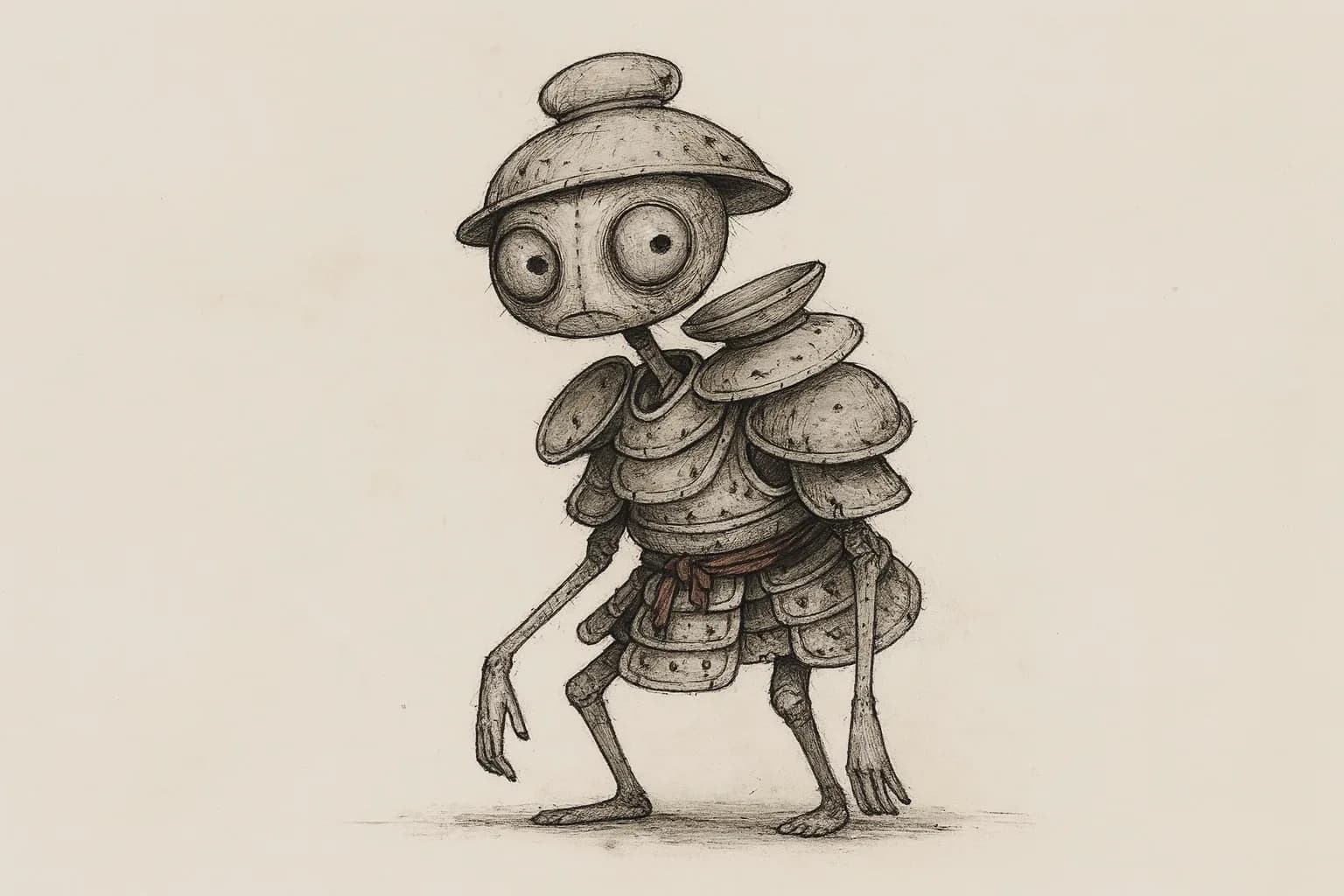
Open a cupboard of chipped teacups, cracked bowls, and mismatched plates that a household has been too fond of to throw away, and Edo-period print culture had a monster ready for you: a stout little general built entirely out of that clutter, armor plated with saucers, a sake flask for a head, marching under a banner of broken chinaware. His name is Seto-taisho, and unlike most yokai he was never whispered about around a fire — he was drawn, captioned, and printed for a reading public in on the joke.
What does it look like?
Toriyama Sekien's original print shows a squat warrior in full armor, but every plate of that armor is recognizably a piece of tableware — teacups for shoulder guards, bowls curved over the chest, small dishes strung together like lamellar. His head is a tokkuri, the narrow-necked flask used for warming sake, a detail Edo-period commentary singled out because a tokkuri floats: drop this general in water and, unlike a man in real armor, he bobs rather than sinks. He carries himself like a battlefield commander, not a ghost — legs planted, weapon in hand, ready to review his troops.
An army built from a pun
Seto-taisho belongs to the tsukumogami (付喪神) family of yokai: everyday objects that wake up and take on a life of their own after long years of use. Most tsukumogami in Sekien's books are solitary and a little pathetic — an umbrella, a lantern, a musical instrument nursing a private grudge at being discarded. Seto-taisho is different. He isn't one abandoned object come to life; he's an entire cupboard's worth of crockery organized into a fighting force, complete with a general to lead it.
The name explains why. Setomono (瀬戸物), literally "Seto things," is the everyday Japanese word for chinaware in general, taken from Seto, the ceramics town in old Owari province (modern Aichi) whose kilns came to dominate the household pottery trade. Sekien took that generic word for "dishes" and gave it a face, a rank, and an army — a joke that only works if you already know Seto ware by name.
The joke Sekien was actually making
The print's real target is a rival ceramics tradition: Karatsu ware, from Karatsu in what is now Saga Prefecture, an older pottery style that had once dominated the market before Seto ware overtook it. Sekien's accompanying text folds this rivalry into a Romance of the Three Kingdoms parody, recasting the generals Guan Yu (given his title 寿亭侯, Marquis of Hanshou) and Cao Cao (styled 曹孟徳) in language borrowed from the kiln — kettles, glazes, firing terms standing in for weapons and honors. The joke reads Seto ware's real historical victory over Karatsu ware as a Three Kingdoms-style campaign, with Seto-taisho as its commanding general. It's a pun on ceramics history dressed up as an epic, aimed at readers who would have caught both references at once.
Where it comes from
Seto-taisho first appears in Hyakki Tsurezure Bukuro (百器徒然袋, 1784), the fourth and last of Toriyama Sekien's four illustrated yokai catalogues. The title itself is a pun: "hyakki," usually written with the characters for "hundred demons," is instead written with characters meaning "hundred vessels," signaling that this volume is devoted almost entirely to tsukumogami. Sekien also borrowed the second half of the title from Tsurezuregusa, the famous 14th-century essay collection by the monk Yoshida Kenko, giving his monster book a literary, slightly mocking pedigree.
Unlike the kappa or the oni, Seto-taisho has no independent life in oral folklore — no village elder ever claimed to have seen him by a river. He is, by every account, Sekien's own invention: a scholar-artist's visual pun on a real economic fact of his time, that Seto ware had become so ubiquitous it swallowed the generic word for "dishes" whole.
Seto-taisho since Sekien
The design proved durable enough to outlive its original joke. The ukiyo-e artist Tsukioka Yoshitoshi returned to it nearly a century later, adapting Sekien's crockery general for his own 1865 print series on the Night Parade of a Hundred Demons — evidence that later print artists still recognized the figure and thought it worth redrawing, even after most viewers had likely forgotten the Karatsu-versus-Seto trade rivalry that inspired him. Today he survives mostly in yokai reference books and print collections rather than popular culture, a footnote from an artist who found a whole army hiding in a stack of dirty dishes.