In Tatebayashi, a market town in Gunma, the temple Morin-ji keeps an old iron kettle on display near its main hall. A visitor who doesn't know the story sees a plain donated pot, blackened with age. A visitor who does know it sees something else. This is the kettle that sprouted a tanuki's head, tail and four legs, and then refused to behave. It is one of Japan's best-loved folktales.
The temple's own name for it is plain: morinji no kama (茂林寺釜), "Morin-ji's kettle." Everyone else knows it by the story's name instead.
What does it look like?
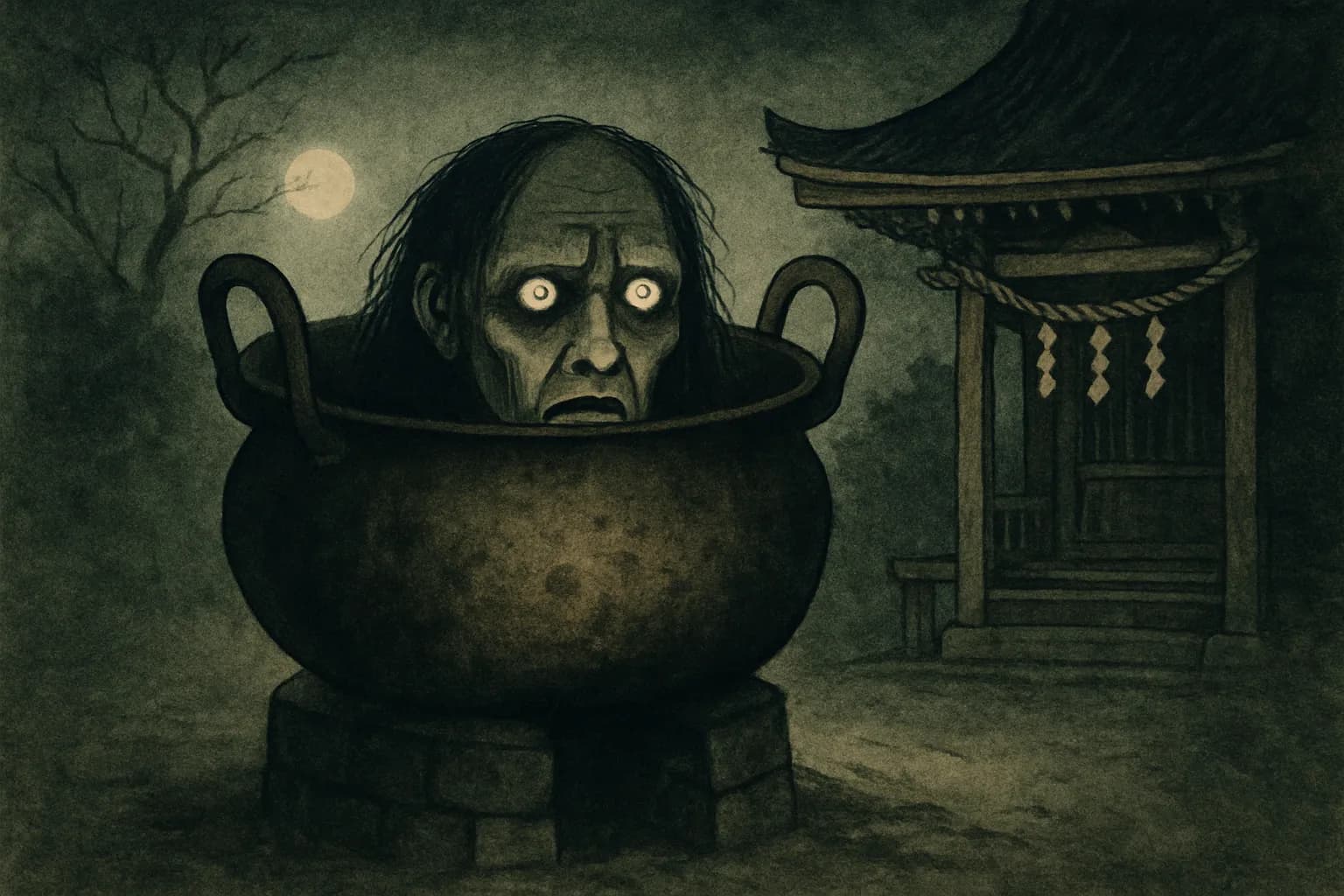
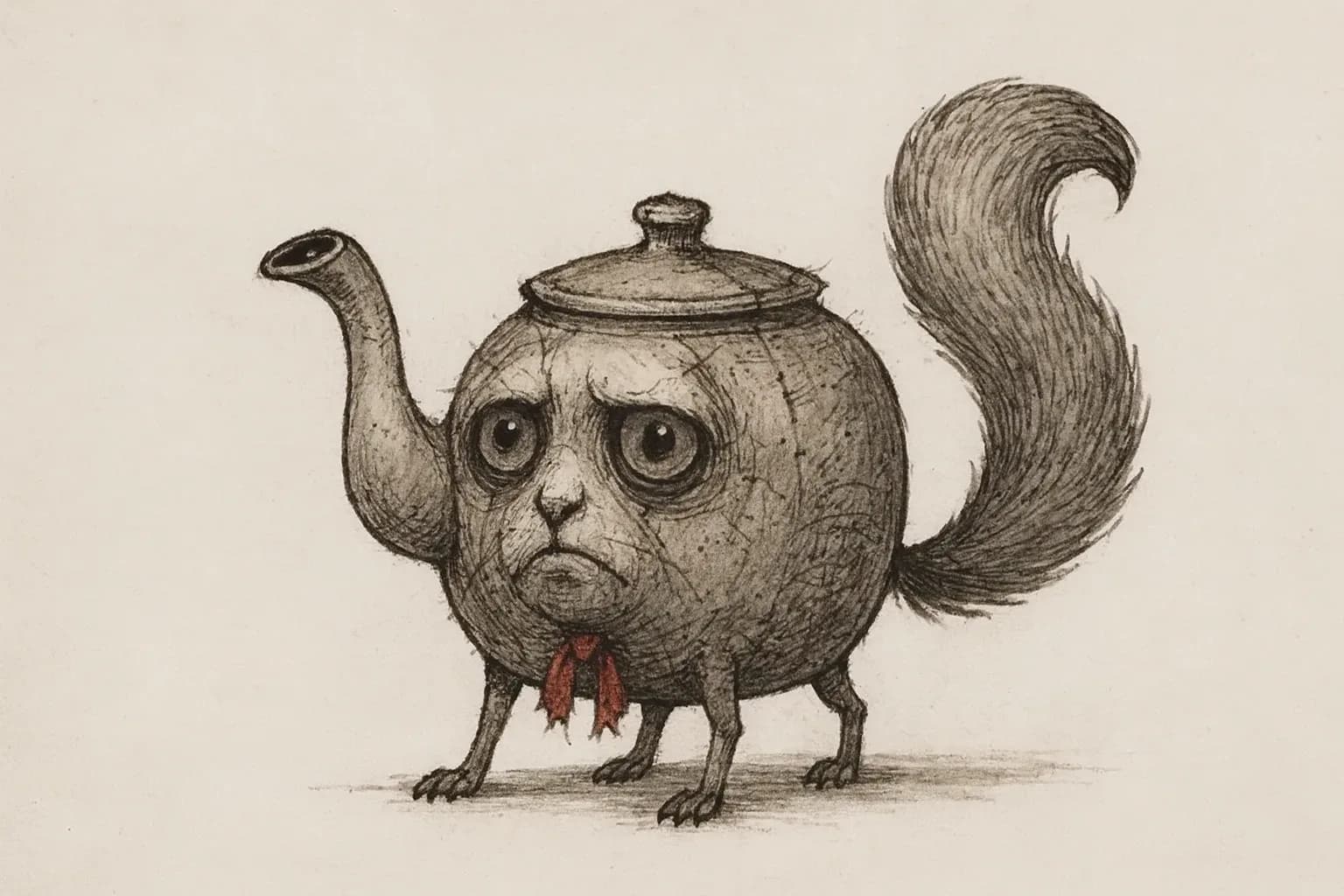
A round-bodied iron tea kettle with a tanuki's masked face pushing out through the metal on one side. A bushy tail curls out the back. Four short clawed legs are planted underneath, as if the pot had just decided to stand up.
Toriyama Sekien drew it that way in his 1781 collection Konjaku Hyakki Shūi (今昔百鬼拾遺), at exactly the moment the tale describes. Nothing about the print exaggerates the scene. It is a kettle first and an animal second, caught at the point where one was turning into the other. That is both the joke and the unease of the image.
Two names for one object
The temple's name, 茂林寺釜, is a label. It is the temple, plus kama (釜), the thick-walled cauldron a household tea kettle is modeled on.
The tale everyone actually tells goes by a different name: Bunbuku Chagama (分福茶釜). That is 分 (bun, "to share") plus 福 (fuku, "good fortune") plus 茶釜 (chagama, "tea kettle") — a kettle that hands out luck. Older English retellings sometimes spell it Bumbuku, a transliteration quirk rather than a different word.
The name puns as well. Buku buku is the sound of water coming to a boil. So the kettle is named after the noise it makes right before things go wrong.
One name belongs to the temple's inventory. The other belongs to two centuries of storytellers.
The kettle that wouldn't behave
In the most common version, a tanuki repays a kindness by turning itself into a tea kettle to be sold. The buyer is a poor priest, or in some tellings a traveling junk dealer.
The trouble starts once the kettle is put to use. Set over a fire to boil water, it grows too hot for the tanuki inside to bear. A face, a tail and four legs push out through the metal, exactly as Sekien drew them.
The best-loved ending does not send it fleeing in disgrace. The tanuki turns the accident into an act. It performs as a tightrope-walking, drum-beating kettle-creature in a traveling show, makes its owner's fortune, and the two part as friends. It is one of the few yokai stories where the monster leaves the page smiling.
Morin-ji ties the legend to its own history. Temple tradition holds that a tanuki disguised itself as a novice priest and took the name Shukaku. It served there for years, until its tail gave it away while it slept. The temple dates the discovery to the spring of 1587. In that version the inexhaustible kettle was a parting gift, left behind when the priest went back to being a tanuki.
Where it comes from
Most tsukumogami stories run on neglect. A tool is used for a hundred years, thrown out, and comes back resentful to haunt the household that discarded it.
This story runs the other way. A living animal chooses to become an object, and does it out of gratitude rather than grievance. Nobody wore this kettle out or threw it away.
Sekien filed it in the same print series as the tool-spirits narigama and kameosa anyway. The finished image is an object with an animal still pushing back out of it, and that belongs to the same visual family however it got there.
The practical lesson is a familiar one in temple folklore. A small kindness to a stranger, animal or otherwise, tends to come back multiplied. That is exactly what a kettle built to distribute fortune is there to illustrate.
Morinji no Kama today
The kettle is still there, on display near the main hall. Morin-ji's approach and grounds are lined with tanuki statues, put there for visitors who come for the story rather than for Zen practice.
The tale crossed into English early. Yei Theodora Ozaki's 1908 collection Japanese Fairy Tales retold it as "The Wonderful Tea-Kettle." That gave Western readers a shapeshifting kettle decades before most other yokai had an English name at all.