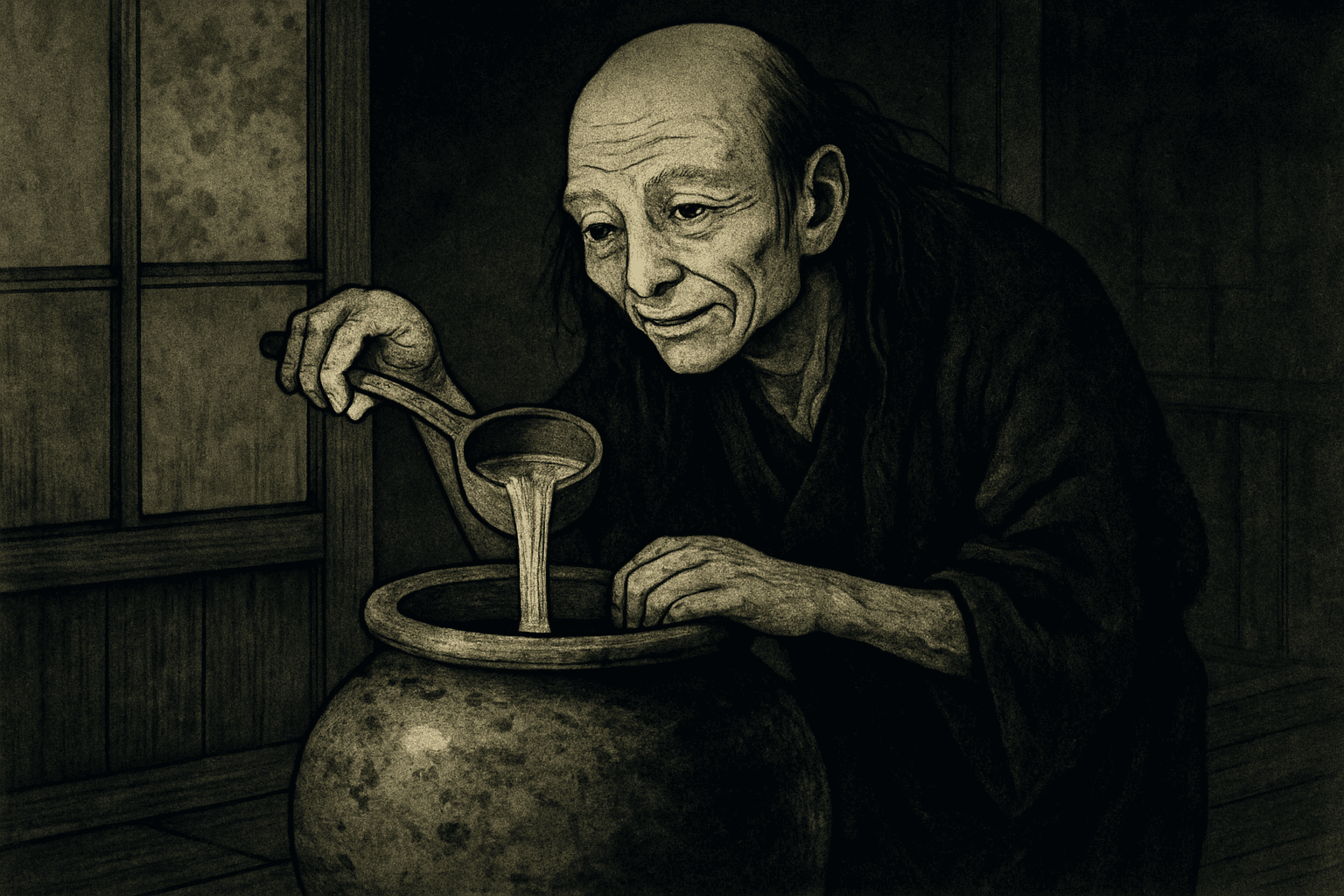
Most tsukumogami stories are grudge stories: a tool thrown out before its time comes back to frighten or punish the household that discarded it. Kameosa breaks the pattern. It is an old earthenware water jar, kept and used for so many decades that it becomes a spirit in its own right — and the spirit it becomes is a generous one. Where an umbrella or a kettle wakes up angry, the kameosa wakes up loyal, and the water inside it simply stops running out.
What does it look like?
Toriyama Sekien drew the kameosa in his 1784 print collection Hyakki Tsurezure Bukuro (百器徒然袋) as exactly what its name promises: a large, plain earthenware jar of the kind every household kept in the kitchen or by the well, given just enough life to register as a creature rather than a container. There is no elaborate transformation here, no sprouted limbs or rows of teeth. The jar itself is the whole of the yokai — squat, heavy-bellied, glazed dark with age, and sitting exactly where a water jar would sit, except that it is quietly, permanently full.
A name built from wordplay
The name is a compact joke in the way many of Sekien's tsukumogami names are. 瓶 (kame) is the ordinary word for a jar or urn. 長 (osa) means an elder or a chief — the head of a household or a guild. Put together, kameosa reads as "elder jar" or "chief among jars," a title earned the same way a village elder earns one: by simply outlasting everyone else and being trusted for it. The pun also leans on kareru, "to run dry," which is precisely the fate this jar has escaped. A jar that should have run dry decades ago, and never did, has earned the right to be called its household's osa.
The tool that doesn't turn on you
The broader tsukumogami idea comes from the Muromachi-period picture scroll Tsukumogami-ki (付喪神記), in which household tools thrown out during New Year's housecleaning grow resentful at being discarded after years of loyal service, animate themselves, and take revenge before eventually seeking Buddhist redemption. That text set the template for centuries of Edo-period tool-spirits, including the umbrella and lantern yokai every print shop sold to city children.
Kameosa sits outside that template on purpose. Sekien's tsukumogami books are full of visual and verbal jokes, and this entry's joke is that neglect is not the trigger here — care is. A jar kept in daily use, filled and refilled without complaint for a hundred years, does not wait for the indignity of being thrown away to wake up. It wakes up already grateful, and it answers that gratitude by never letting its owners run short of water again.
Where it comes from
Jars and pots that never empty are an old motif in East Asian folklore, usually attached to a poor but honest household that is rewarded for its virtue with a container of food, sake, or coin that refills itself overnight. Sekien, who read widely in Chinese classical literature and folded those references into his yokai catalogues, was working in that same tradition when he gave a plain water jar its own entry in the tsukumogami canon. The kameosa's benevolence marks it as kin to a cluster of household-luck spirits recorded in the same period — lucky kettles, humming pots, and small fireball spirits said to bring a family fortune rather than take it away. Unlike the kappa or the tengu, the kameosa has no wider oral folk tradition behind it outside of Sekien's book; it survives almost entirely as a piece of Edo print culture, a single artist's addition to the tsukumogami family that nonetheless captured something people already believed about long-used, well-cared-for things.
Kameosa today
The kameosa has never become a household name the way the kasa-obake or the kappa has, but it keeps a quiet foothold among people who collect and study Sekien's four yokai print books, which remain in print in facsimile editions and are held by institutions such as the Kokusho Kankokai and international museum collections that have digitized their ukiyo-e holdings. Modern yokai encyclopedias and folklore compendia use it as the standard example of a "good" tsukumogami — proof that Edo audiences did not imagine every animated tool as a threat. A jar that keeps giving, quietly, in the corner of a kitchen, is still a fairly easy idea to want to believe in.