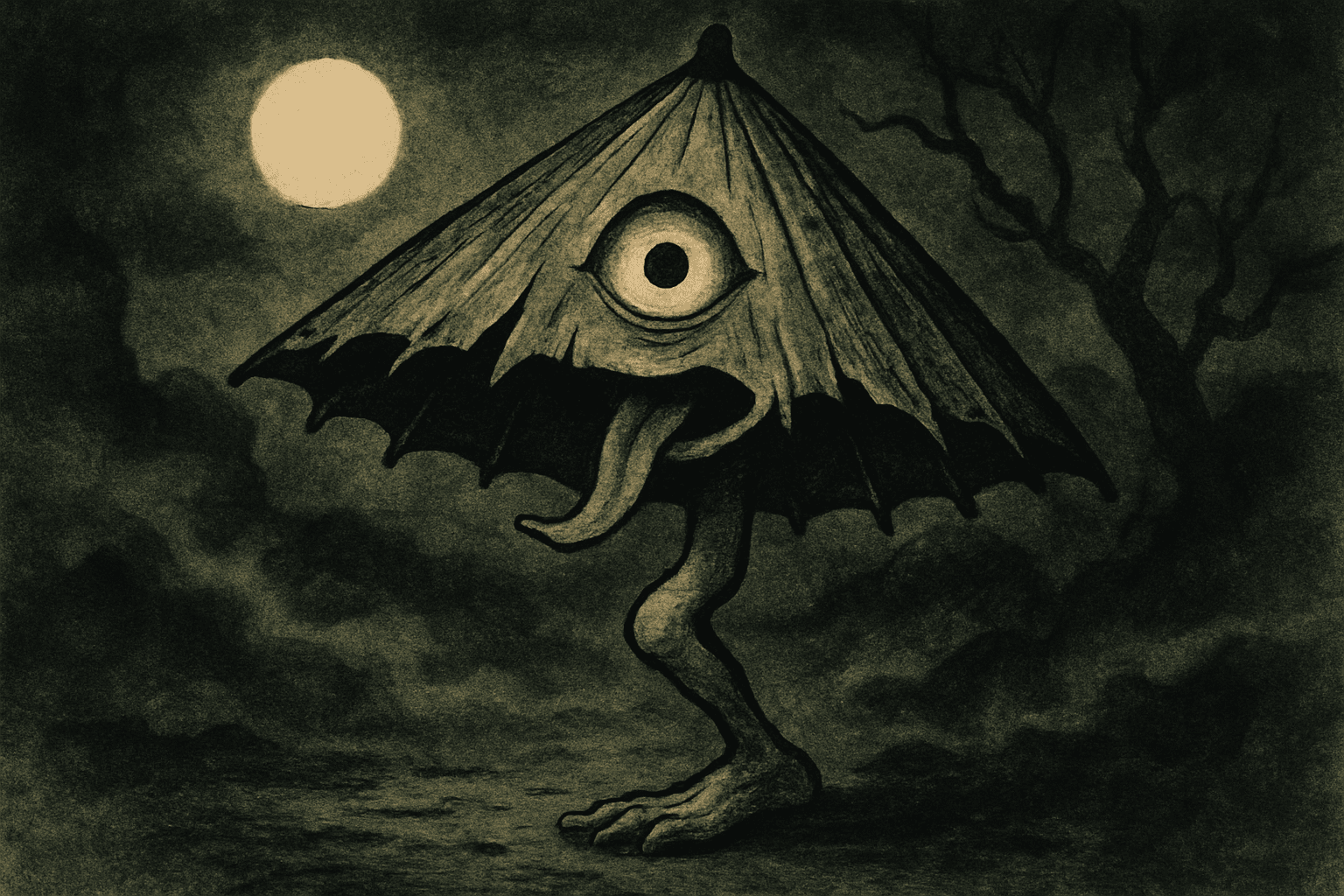
Picture an ordinary paper umbrella, the kind every Edo-period household owned by the dozen, standing propped in a corner of a storeroom for years past its use. One night it sprouts a single wide eye where the ribs meet the shaft, a long tongue lolls out from under the canopy, and it hops off on one bare leg wearing a single geta sandal. This is kasa-obake — literally "umbrella that transforms" — and it is one of the most recognizable members of a whole category of Japanese monster: objects that come alive.
What does it look like?
The design is simple enough that children could copy it, which is part of why it spread so widely in Edo print culture. A kasa-obake keeps the shape of a folded or half-open paper-and-bamboo umbrella (kasa), but the wooden shaft grows a single stubby leg and foot, the canopy opens just enough to reveal one round staring eye, and a long red tongue hangs out below it. Some versions add a pair of thin arms sprouting from the ribs. It has no fixed size — old prints show it anywhere from knee-high to taller than a person — and it moves by hopping, since it only has the one leg to stand on.
An object with a grudge
Kasa-obake belongs to a class of yokai called tsukumogami (付喪神), "tool spirits": everyday household objects — umbrellas, lanterns, sandals, koto, tea kettles — that are said to awaken after long years of use, or of neglect. The idea has a real textual root in the Tsukumogami-ki (付喪神記), a Muromachi-period illustrated tale in which tools discarded by their owners during the New Year's housecleaning grow resentful at being thrown out after loyal service, come to life, and take revenge on the household before eventually finding Buddhist salvation. An umbrella left leaning in the same corner for a hundred years, unused and unloved, was exactly the kind of object folk belief expected to stir.
Unlike a hungry ghost or a river-drowner, a kasa-obake is rarely violent. Village and city tales alike treat it as a nuisance rather than a killer: it startles late-night walkers by hopping out of an alley, sticks out its tongue, and vanishes, or it simply turns up somewhere it has no business being — standing open in a hallway with no one holding it. The fright is the whole point.
Part of the night parade
Tsukumogami were traditionally imagined moving as a group, not alone. On certain nights, old and mistreated household objects were said to join the Hyakki Yagyo (百鬼夜行), the "Night Parade of a Hundred Demons," a procession of yokai that surged through the streets of Kyoto after dark. Illustrated hyakki yagyo scrolls, copied and recopied from the medieval period onward, place walking umbrellas, animated lanterns, and other reanimated tools shoulder to shoulder with kappa, tengu, and oni. A kasa-obake caught alone on a back road was, by this logic, a straggler from that larger parade — one worn-out tool that had wandered off and grown a leg of its own.
An Edo-period celebrity
However old the tsukumogami idea is, the specific one-eyed, one-legged umbrella design belongs to a later moment. It became a stock figure through Edo-period toy prints (omocha-e) and yokai-themed playing cards sold cheaply to city children, the same commercial print culture that mass-produced kappa and rokurokubi as recognizable characters. Because it was cheap, funny, and easy to draw, kasa-obake spread fast — arguably faster than folk stories ever could on their own — and by the nineteenth century it had become shorthand for the entire tsukumogami idea, the one everyone could picture even if they had forgotten what a tsukumogami technically was.
Kasa-obake today
The one-eyed umbrella has held onto its place better than almost any tsukumogami. It is a stock figure at Japanese haunted-house attractions and Obon-season ghost festivals, printed on merchandise aimed at children, and used as an instantly readable "old Japanese ghost" icon in illustration and design well beyond its original context. Its cousin in the same tool-spirit family, the walking paper lantern chochin-obake, is often paired with it in art and toy sets — two neglected household objects, still making the rounds together.