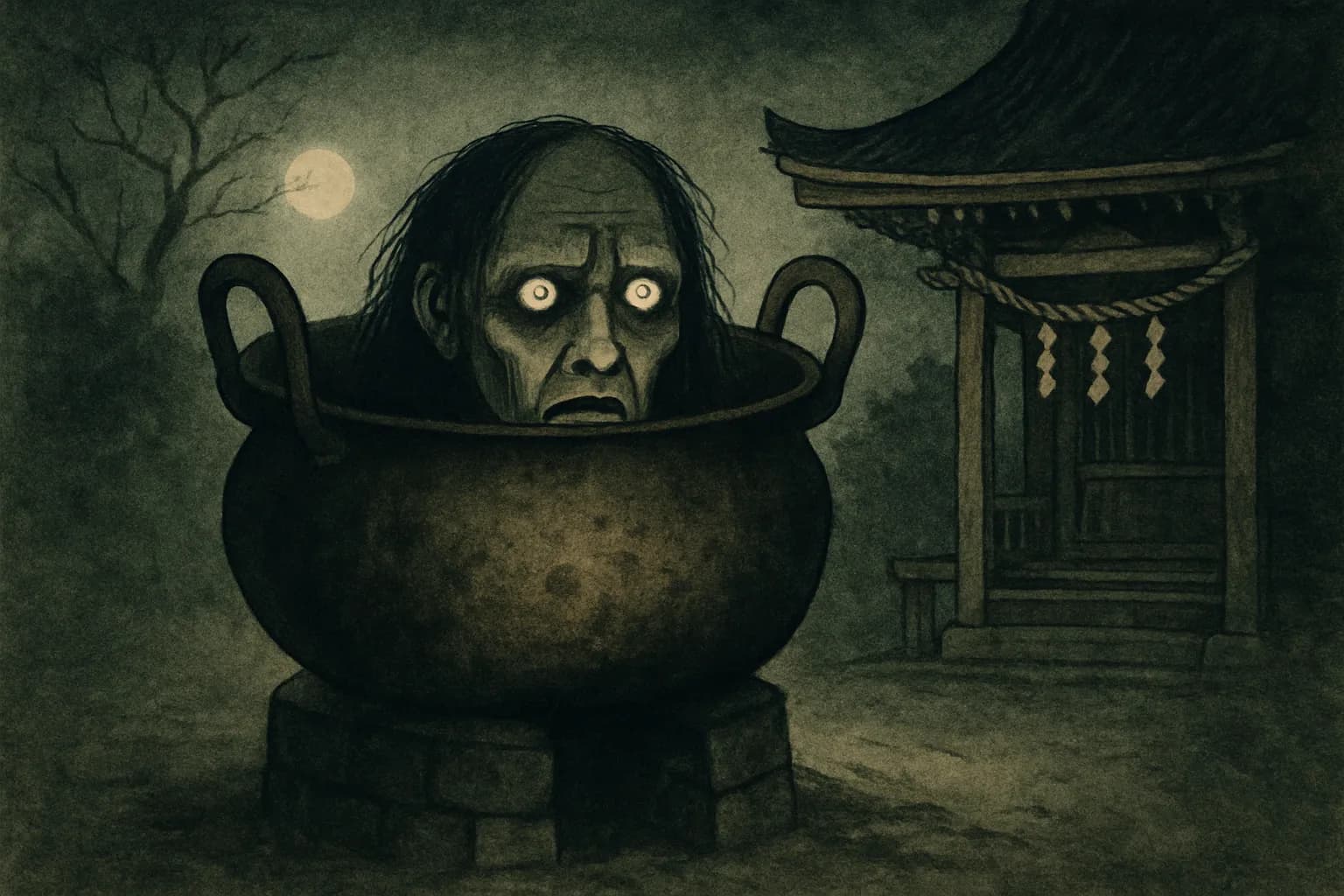
At Kibitsu Shrine in Okayama, there is a kitchen building set apart from the main hall, and inside it an iron cauldron that has been boiling rice for prayers for centuries. Ask it a question — about a marriage, a journey, an illness — and it answers by how loudly it roars while the rice steams. A long, resonant boom is good news. A weak murmur, or nothing at all, is the worst thing it can tell you. The narigama (鳴釜), the "sounding cauldron," is less a monster than an oracle, and unlike almost everything else in this almanac, you can still go and consult it today.
What does it look like?
Toriyama Sekien drew the narigama in his 1784 print collection Hyakki Tsurezure Bukuro (百器徒然袋) as a large iron kettle set over a hearth, steam curling upward, with no added limbs or face grafted onto the metal. The cauldron itself is the whole of the yokai, the way it is for several entries in that book — an object that needs no monstrous redesign because the strangeness is entirely in what it does, not how it looks.
The demon buried under the kitchen
Shrine tradition traces the cauldron's voice back to a defeated enemy. Kibitsu Shrine enshrines Ōkibitsuhiko-no-Mikoto, a prince the Yamato court is said to have sent to subdue an invader named Ura (温羅), who had settled in the region and ruled from a mountain stronghold known as Kinojō, "Demon Castle." The legend describes a running battle of transformations — Ura turning into a pheasant, Kibitsuhiko into a hawk to chase it; Ura diving into a river as a carp, Kibitsuhiko becoming a cormorant to catch him there. Ura was beheaded, and according to the shrine's account his severed head was buried beneath the floor of the kitchen building — yet it kept groaning for years afterward, refusing to go silent even in defeat.
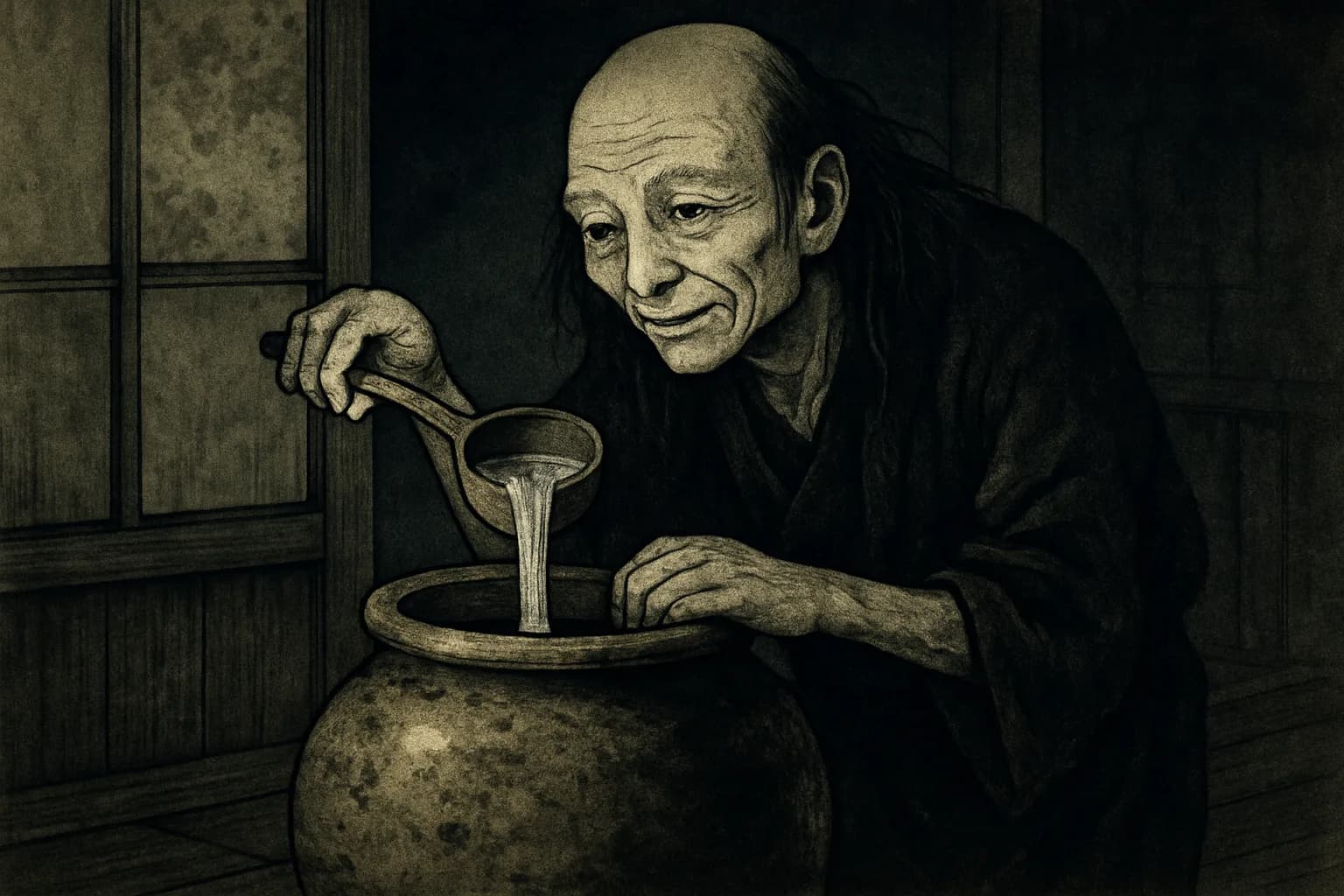
The groaning stopped, tradition says, only after Ura appeared in a dream and gave instructions: have rice offerings steamed in a cauldron set over his buried skull, and he would answer through its sound from then on — a boom for fortune, a hush for misfortune. What had been a conquered enemy's dying complaint became, by that arrangement, the shrine's method of divination.
Consulting the cauldron
The ritual built on that legend, known as the narigama shinji (鳴釜神事), is still performed in the shrine's Okamaden hall. A priest recites prayers while rice and beans are set to steam in the cauldron, and the resulting sound — its pitch, its length, whether it comes at all — is read as the oracle's answer to whatever question the visitor has brought. It is one of the few yokai-adjacent traditions in Japan that has never stopped being a live religious practice rather than a story people merely tell.
Where it comes from
Read plainly, the narigama legend is a familiar move in Japanese religious history: a local power defeated by the Yamato state is not erased but absorbed, its voice repurposed into the winning side's rituals. A rival prince's dying groan becomes a shrine's most valuable asset — proof, in the logic of the story, that even a subdued enemy's strength doesn't disappear so much as get put to new use. Local tradition also connects the Ura legend to the roots of the Momotarō story, with Kibitsuhiko's monster-subduing campaign in the region cited as one of the folk models behind Okayama's enduring identity as the peach-boy's hometown.
Narigama today
The oracle appears in literature as well as ritual. Ueda Akinari's 1776 story collection Ugetsu Monogatari (雨月物語) includes a tale titled "Kibitsu no Kama" (吉備津の釜), in which the shrine's cauldron is consulted before a wedding and refuses to make a sound — an omen the story's characters ignore, to their cost. The Okamaden still stands, the ritual still runs on request, and the cauldron, in its own slow way, is still answering.