In the hills outside Okayama stand the ruined walls of Kinojō, an ancient stone fortress. Local legend says a giant once ruled from inside it. His name was Ura, and for years he raided the farms below, terrorizing the region called Kibi. The Yamato court, Japan's early central government, sent a prince to end the raids. Their fight became the story historians link to Momotaro, Japan's best-known folktale.
What does Ura look like?
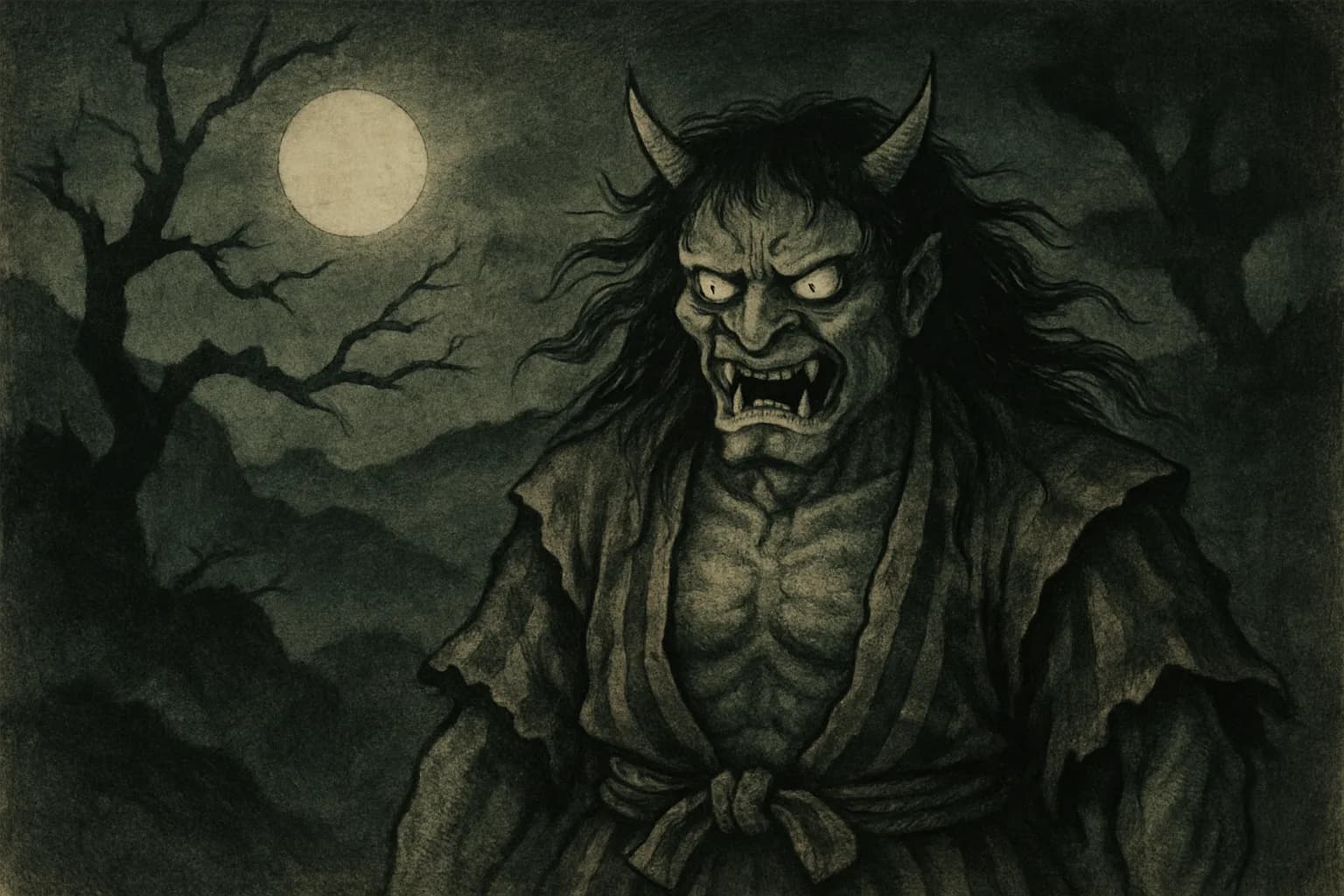
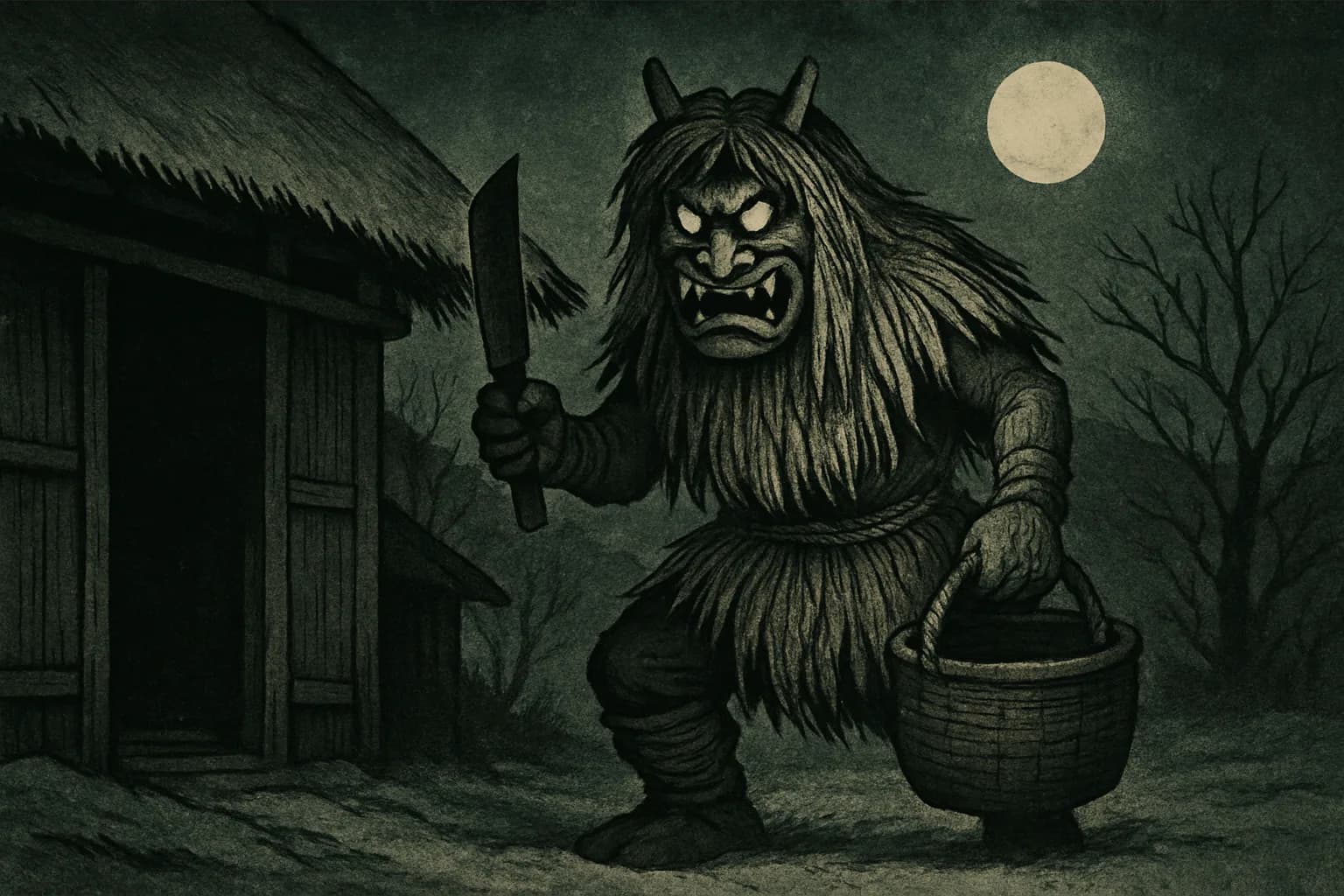
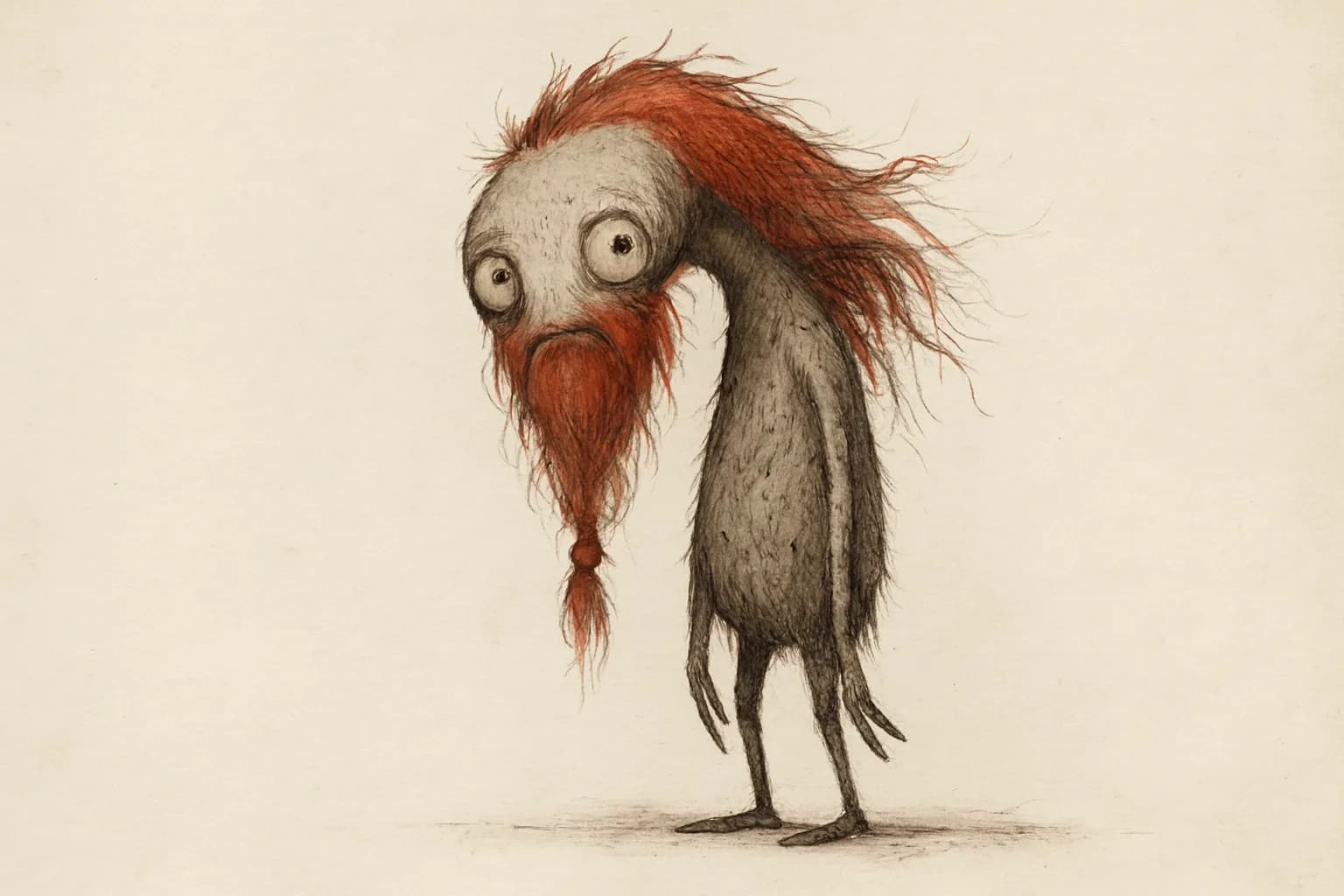
Accounts agree on the shape more than the face. Ura stood far taller than an ordinary man. His hair and beard were red, red enough that people said they glowed like fire. His eyes were compared to a wolf's — sharp, yellow, and always watching. Some tellings give him horns. Others leave him human in outline but monstrous in size and strength.
The kanji for his name, 温羅, are ateji — characters chosen for sound, not meaning. Read for meaning, they say something like "warm silk," which has nothing to do with a giant. Most yokai names build meaning into their kanji, the way kappa's 河童 spells out "river child." Ura's name does not work that way. The sound mattered more than the sense.
A giant on the mountain
Ura ruled Kinojō like his own kingdom. He raided the villages of the Kibi plain below, taking rice, cloth, and captives. Boats carrying tribute toward the capital went missing off the coast. Fires burned on his mountain so often that people renamed it 鬼城, "Demon Castle." Kinojō still carries that name. Some accounts call him Ura-ō (温羅王), "King Ura," a title that treats him as more than a bandit.
One version of the legend says Ura was not born in Japan. It holds he sailed from Baekje, an old kingdom on the Korean peninsula. He brought ironworking skill the region had not seen before. Other versions drop the origin story and leave him a raider from across the sea, nothing more. Archaeologists have found iron-working sites near Kinojō from around the same centuries. That may be why the foreign-king version has stuck.
The fight with Kibitsuhiko
The court answered by sending Kibitsuhiko no Mikoto, a Yamato prince, to end the raids. He camped on a hill across the valley and fired arrows at Ura's fortress. The story says his first arrows struck Ura's own arrows in mid-air and fell uselessly to the ground. So Kibitsuhiko changed tactics. He fired two arrows at once. One collided with Ura's arrow, same as before. The second flew through and struck him.
Wounded, Ura turned into a carp and dove into a river to escape. Kibitsuhiko became a cormorant, a diving waterbird, and caught him there. Beaten, Ura surrendered his fortress and his life.
The head under the kitchen
Kibitsuhiko cut off Ura's head and had it put on display as a warning. It did not stay quiet. People said the skull kept groaning for years, loud enough to unsettle the whole province. Kibitsuhiko finally had it buried beneath the kitchen of what is now Kibitsu Shrine. Even buried, the sound did not stop.
Shrine chronicles say Kibitsuhiko later appeared in a dream and gave the fix himself. He told a shrine priestess to set an iron cauldron over the buried skull and boil rice in it. Read the sound the steam makes, he said, and you will know if a fortune is good or bad. The ritual is called Naruko Shinji, a cauldron divination rite. Kibitsu Shrine still performs it for visitors.
Where it comes from
Historians read the Ura legend as folk memory turned into scripture for the winning side. Kinojō is a real fortress, first built in the 7th century as part of Japan's ancient border defenses. Kibi itself was once a strong regional power. It was absorbed into a unified Japan only after years of resisting the Yamato court. Turning a rival into a demon does real work for a court. It turns a conquest into a rescue. The prince who defeats the demon can be worshipped as a god afterward. Kibitsuhiko was enshrined as a protective deity at what became Kibitsu Shrine. Ura was buried under its kitchen floor.
Ura today
Okayama has built its modern identity on this old fight. The city calls itself the "Land of Momotaro," and a statue of the peach boy stands outside Okayama Station. Kibi dango, a rice-flour dumpling named for the region, is sold as the treat Momotaro carried on his quest. Regional tradition connects the fairy tale's dog, monkey, and pheasant to three clans said to have fought beside Kibitsuhiko.
At Kibitsu Shrine, priests still perform the Naruko Shinji for visitors who want a fortune read. The cauldron sits, by tradition, directly over the ground where Ura's skull was buried. The giant of Kinojō lost his kingdom, his head, and his name to a fairy tale. He is still the one making the sound.