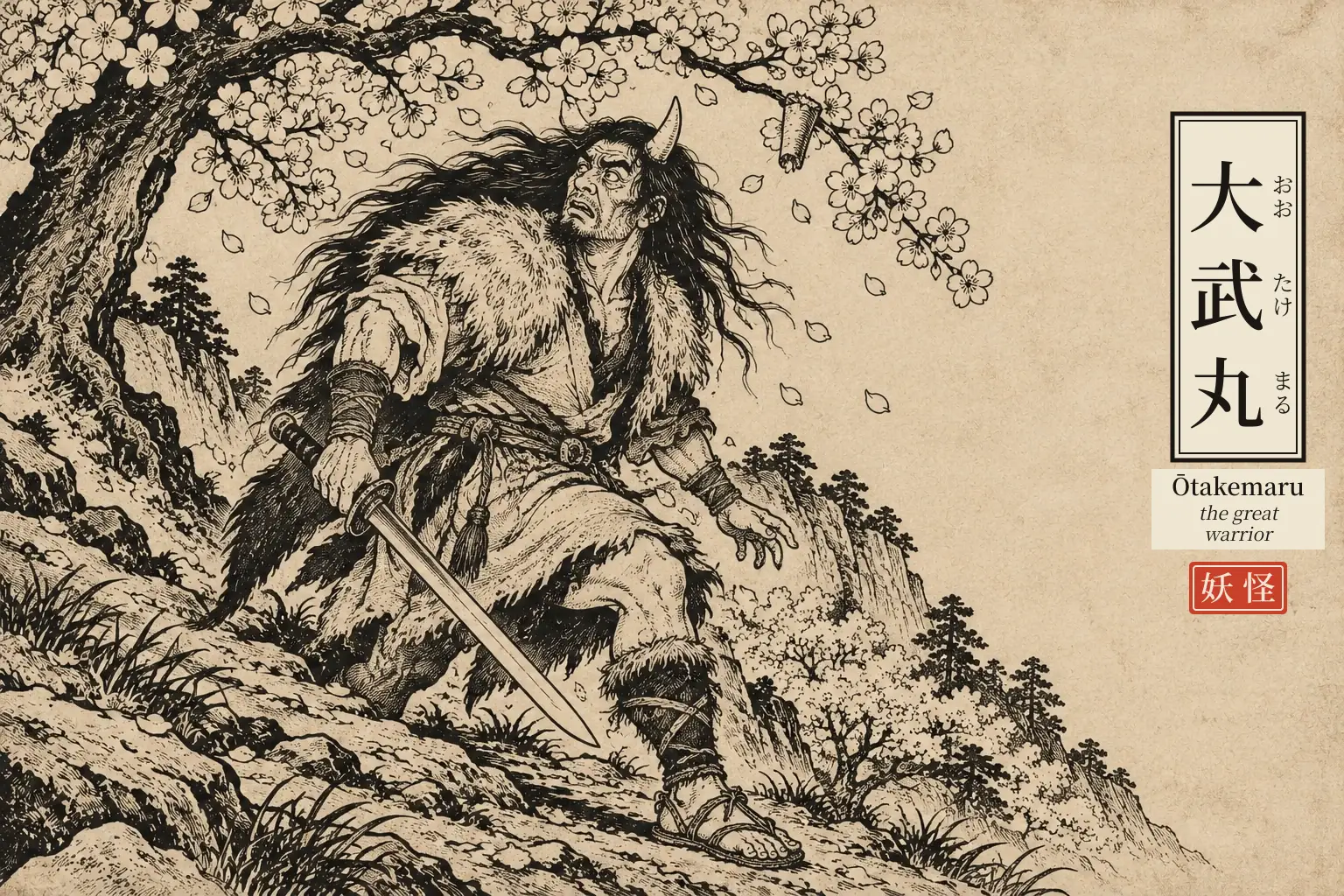
Mount Iwate is a solitary volcano that watches over Morioka. Near its summit sits a crater called Onigajō — the Demon Castle. Tradition says a chief named Ōtakemaru once ruled from it. Depending on who tells the story, he was different things. He was either a leader of the Emishi, or he was simply an oni. The Emishi held this land before the Yamato court arrived. Japanese Wikipedia itself will not pick one version. His name, 大武丸, reads ō (great) + take (warrior) + maru, a common name ending.
What does it look like?
One old legend gives Ōtakemaru a single physical feature: horns. Fleeing Tamuramaro near Mount Ōdake, in what is now Tome, one horn caught on a cherry branch and snapped off. Having lost it, he lost his will to fight. He surrendered on the spot. Locals still call that tree the Tsunokake-zakura, the "horn-catching cherry." His stronghold was Onigajō, the Demon Castle, at the summit of Mount Iwate. A separate demon in an Akita legend shares the same sound as his name. It is written 大長丸, not 大武丸, but both read "Ōtakemaru." That Akita demon is said to stand one jō, three shaku, five sun tall. That is about 4.1 meters.
Other names, same chief
Across Tōhoku, the name shifts spelling from village to village: 大嶽丸, 大竹丸, 大武丸, 大猛丸. All are read the same way. Several tellings merge him outright with Akuro-ō. Akuro-ō is another figure defeated by Tamuramaro in the same legend cycle. Other tellings merge him with the demon of Mount Suzuka, who shares the kanji 大嶽丸. In 1922, the folklorist Ino Kanori made a bold claim. He argued all these names are corruptions of one original figure. He traced a chain: from "Ōtakamaru," to "Akuji no Takamaru," to Akuro-ō. Writing in 1993, Negishi Hideyuki offered two readings of the name. It could mean "a great, fierce man." Or it could mean "a man who dwells on a towering peak."
The fall of the mountain chief
In the standard version, the Yamato court sends a general to Mount Iwate. His name is Sakanoue no Tamuramaro. His mission is to put down Ōtakemaru. A medieval record, preserved in Iwate-san-ki, names three targets at Mount Kiri: Takamaru, Ōtakemaru, and Fukiotoshi. After subduing them, Tamuramaro installs three Buddhist images there instead, carved by the monk Gyōki: Amida, Yakushi, and Kannon. After the chief falls, the mountain itself changes sides. Iwate-san becomes a holy site, worshipped as the god Ganjusan Daigongen — a divine form of Tamuramaro. Nearby peaks fill out the new mythology too. His wife, Tate-eboshi Shinjo, is said to appear at Mount Nyūtō. Their two daughters appear at Mount Himekami.
Accounts differ on how he died
Tōhoku keeps at least four separate endings for Ōtakemaru, tied to four real places:
| Ichinoseki, Iwate | Ōsaki, Miyagi | Tome, Miyagi | Ōshū, Iwate | |
|---|---|---|---|---|
| What is said | Defeated by Tamuramaro, who buried the body here, in 801 | Killed in the mountains of Kurihara; his head flew here afterward | His consort, Suzuka Gozen, drugged him with poisoned sake so Tamuramaro could take his head | His son, Hitokōbemaru, fled here and kept fighting until he too was killed |
| Local trace today | Oni-ishi ("demon stone") and Abara-ishi ("rib stone") at Kashima Shrine, said founded in 801 | The hot-spring town of Onikōbe, "demon head" | Kōfuku-ji temple, built over the burial spot | The place name Hitokabe, 人首, "person's head" |
None of these can all be literally true at once. Even "Onikōbe" itself has two tellings. Some say it is a corruption of a different word, Onikiribe, with no head in it at all. What the versions share is a basic shape: a powerful chief brought down, with each place still keeping its own trace of him. In several tellings, he was brought down by a trick rather than beaten honestly.
Where it comes from
The historian Abe Mikio takes a different view. He argues the Mount Iwate version has a separate origin. It did not come straight from Tamura Sandaiki, an Edo-period ballad-drama. That work carried the Tamuramaro legend around the Kitakami river basin instead. The Nanbu clan made Morioka their castle town in 1599. They needed a founding myth for the mountain towering over it. Old-jōruri storytelling, fashionable in Edo at the time, supplied the material. A local priestly family, the Kuriyagawa, kept the record. Read this way, Ōtakemaru looks less like a memory of Emishi resistance. Abe reads him instead as a villain built to order. The telling we have today may have taken its present shape centuries later, to give the new capital a mountain god of its own.
Go deeper
Books worth owning if this world pulls you in.
- The Book of Yokai →Michael Dylan FosterThe most readable scholarly introduction to yokai — where they come from, what they mean, and the major creatures.
- Japandemonium Illustrated: The Yokai Encyclopedias of Toriyama Sekien →trans. Hiroko Yoda & Matt AltThe complete Edo-period bestiaries that so many of these entries trace back to, in full English translation.
Some links are affiliate links; if you buy through them we may earn a small commission at no extra cost to you.
Ōtakemaru today
The old village of Onishigai, "demon corpse," sat on the site of Kashima Shrine. An 1875 merger erased the name from the map. In 2019, the neighborhood — now part of Ichinoseki — started a project to bring the name back. The project traded on the "oni" buried in its own place name. It timed the revival to ride the manga and anime Demon Slayer at its peak. A bus tour ran in 2021, stopping at a newly built rest point called the Onishigai bus stop. The chief who lost his mountain twelve centuries ago is, for now, good for a day trip.