The general Minamoto no Yorimitsu lay in bed with a fever that would not break. A stranger in monk's robes appeared at his bedside offering medicine, and as Yorimitsu reached for it, the monk suddenly threw ropes of white thread and lunged. Yorimitsu drew the sword kept at his pillow and slashed back. The intruder fled, and the trail of blood it left across the floorboards led, the next morning, to a mound outside the city — and to something far larger than a monk. This is the best-known appearance of the tsuchigumo, literally the "earth spider," a monstrous arachnid yokai blamed for sickness, ambush, and the corpses that turn up in its lair.
What does it look like?
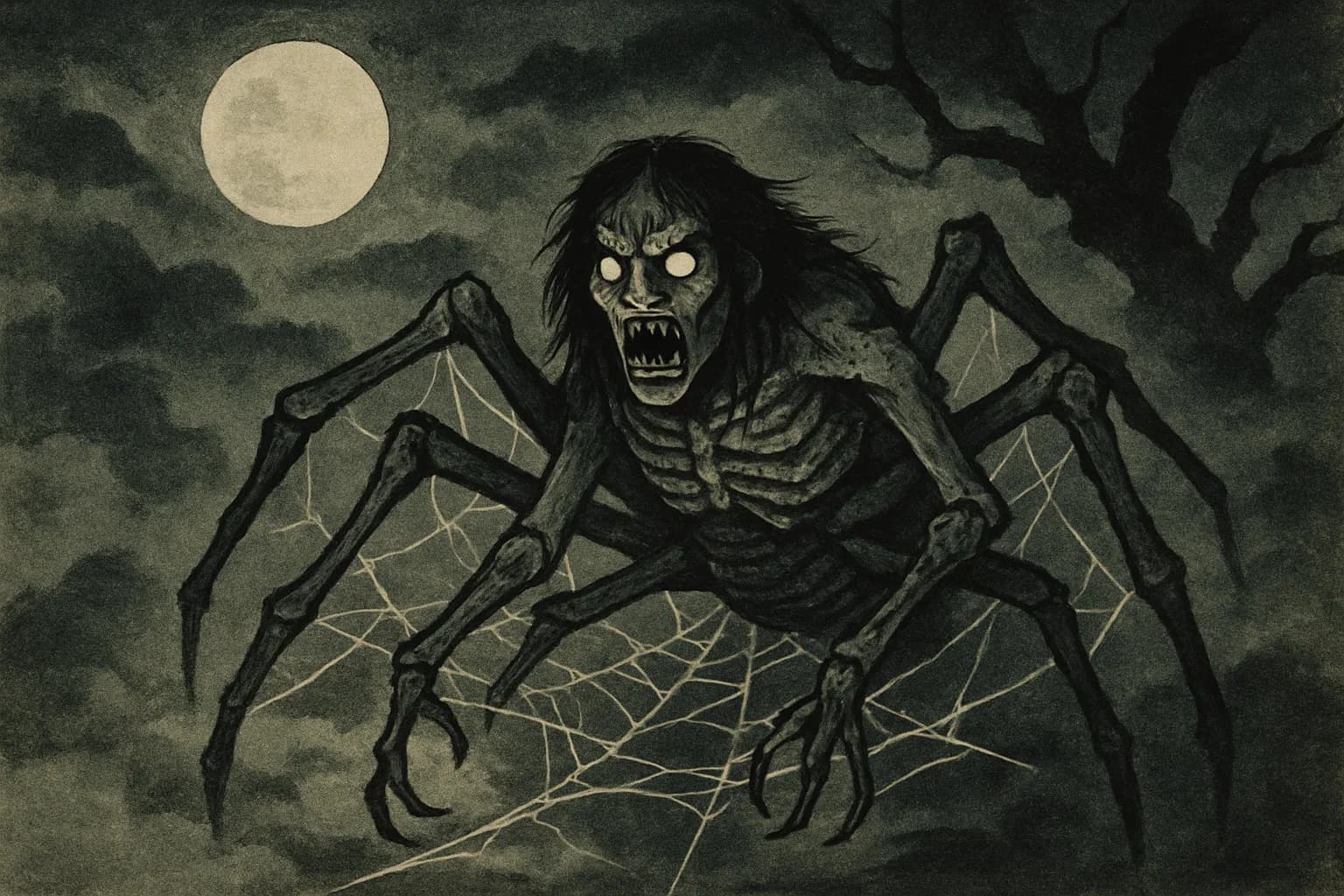
Accounts describe a spider of enormous size, sometimes given a demonic, almost humanoid face grafted onto the body of an arachnid, with a spinneret capable of firing ropes of sticky thread strong enough to bind an armed warrior. In the 14th-century picture scroll Tsuchigumo Zoshi, the creature is drawn as a huge spider crouched inside a skull-littered cave, its web strung across the entrance like a curtain. Later Edo-period prints, especially those by Utagawa Kuniyoshi, lean into the horror of the household under siege: the spider looms behind Yorimitsu's sickbed while ghostly, deformed shapes spill from its web into the room around him.
The attack on Yorimitsu
The core legend, told in variations across the Heike Monogatari tradition and the later Genpei Josuiki, has the tsuchigumo disguise itself as a wandering priest to get near the bedridden Yorimitsu. When the priest's true nature shows itself and Yorimitsu's blade connects, the wound doesn't kill it outright — the creature retreats, and Yorimitsu's blade earns a new name for the strike: Kumogiri, "Spider Cutter." His retainers, the loyal Shitenno who feature in several Yorimitsu tales, follow the blood trail out of the capital to a burial mound. Digging into it, they find the tsuchigumo's true form, a huge mountain spider, and kill it there. In the separate Tsuchigumo Zoshi version, 1,990 skulls spill from its wound.
The story became the basis of a Noh play, also titled Tsuchigumo, in which the spider throws clouds of paper thread over the warriors. The actor Kongō Yuiitsu invented this trick in the Meiji era.
Where the name comes from
Before it meant "giant spider yokai," tsuchigumo was already an old word with a harder edge. In the Kojiki and Nihon Shoki, Japan's earliest chronicles, "tsuchigumo" is used as a slur for indigenous or non-submissive groups who resisted the expanding Yamato court — people the court's scribes described, none too kindly, as short-bodied, long-limbed, and cave-dwelling. Most folklorists read the later spider monster as a fusion of two things: this old term of contempt for a defeated people, and an independent, much simpler fear of large spiders and the diseases blamed on them. By the time the Tsuchigumo Zoshi scroll was painted, the political slur and the monster had merged into a single image — a creature literally of the earth, dug out of a mound, standing in for whatever the ruling class needed an enemy to be.
Tsuchigumo in Japan today
The Noh play keeps the tsuchigumo on stage, with its famous thread-throwing trick, and it's one of the more frequently performed pieces in the repertoire for exactly that spectacle. The spider has also crossed over into games that draw directly on Heian-era warrior legends — it appears as a boss in Nioh 2's Heian-era DLC, Darkness in the Capital, built visibly on the Yorimitsu story rather than a generic monster-spider design. The Kuniyoshi print of the siege, meanwhile, is one of the most reproduced yokai images from the Edo period.