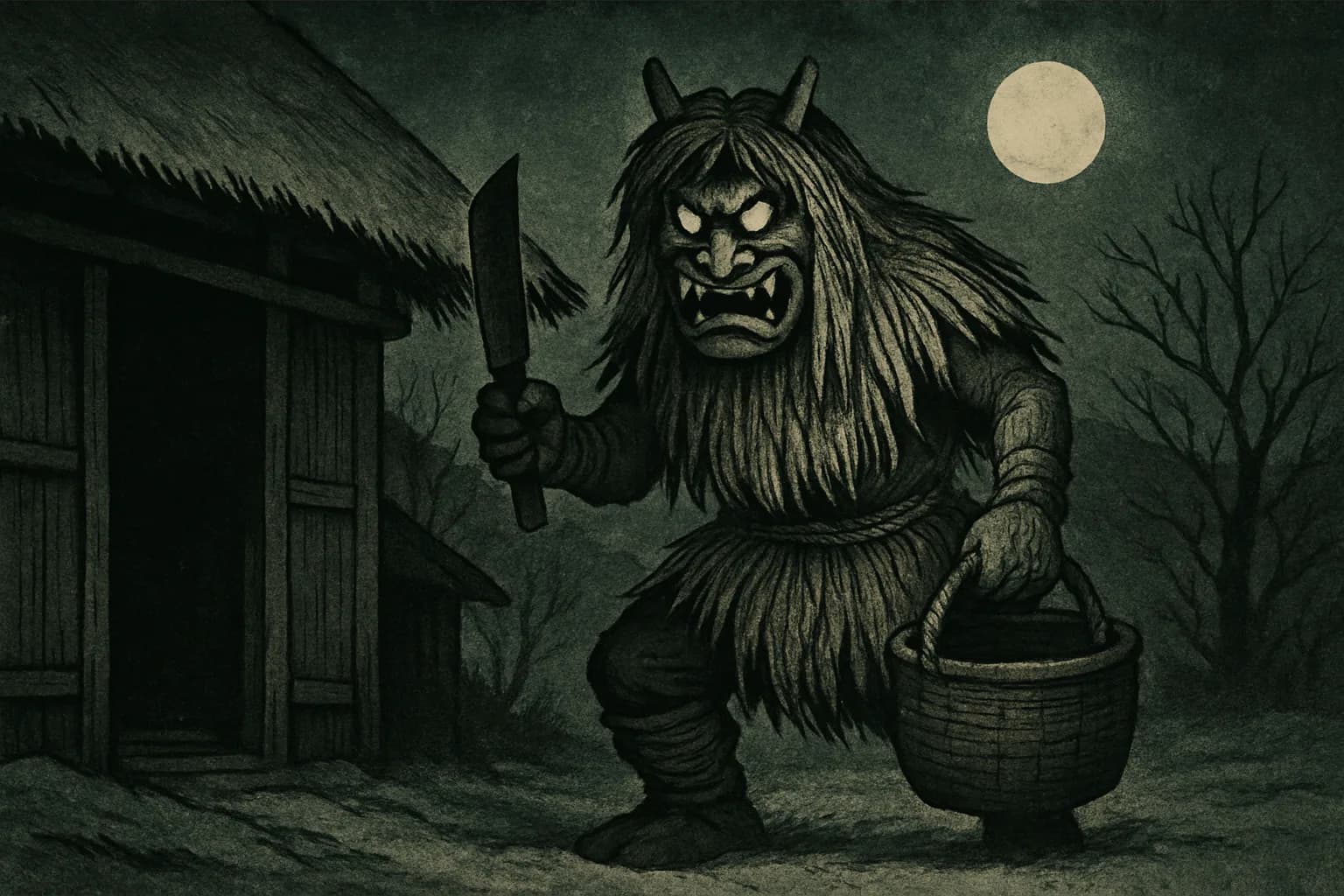
Every December 31st on the Oga Peninsula, a knot of young men pulls on straw capes and fanged wooden masks, picks up a wooden pail and a kitchen knife the size of a machete, and starts walking house to house in the dark. They pound on doors, stomp across the entryway, and roar into the front room: "Naku ko wa inega! Namakemono wa inega!" — "Any crying children here? Any lazy people here?" This is the namahage, and unlike almost every other creature in this almanac, it isn't a story told about the past. It happens again, on schedule, every single year.
The mask, the straw cape, and the knife
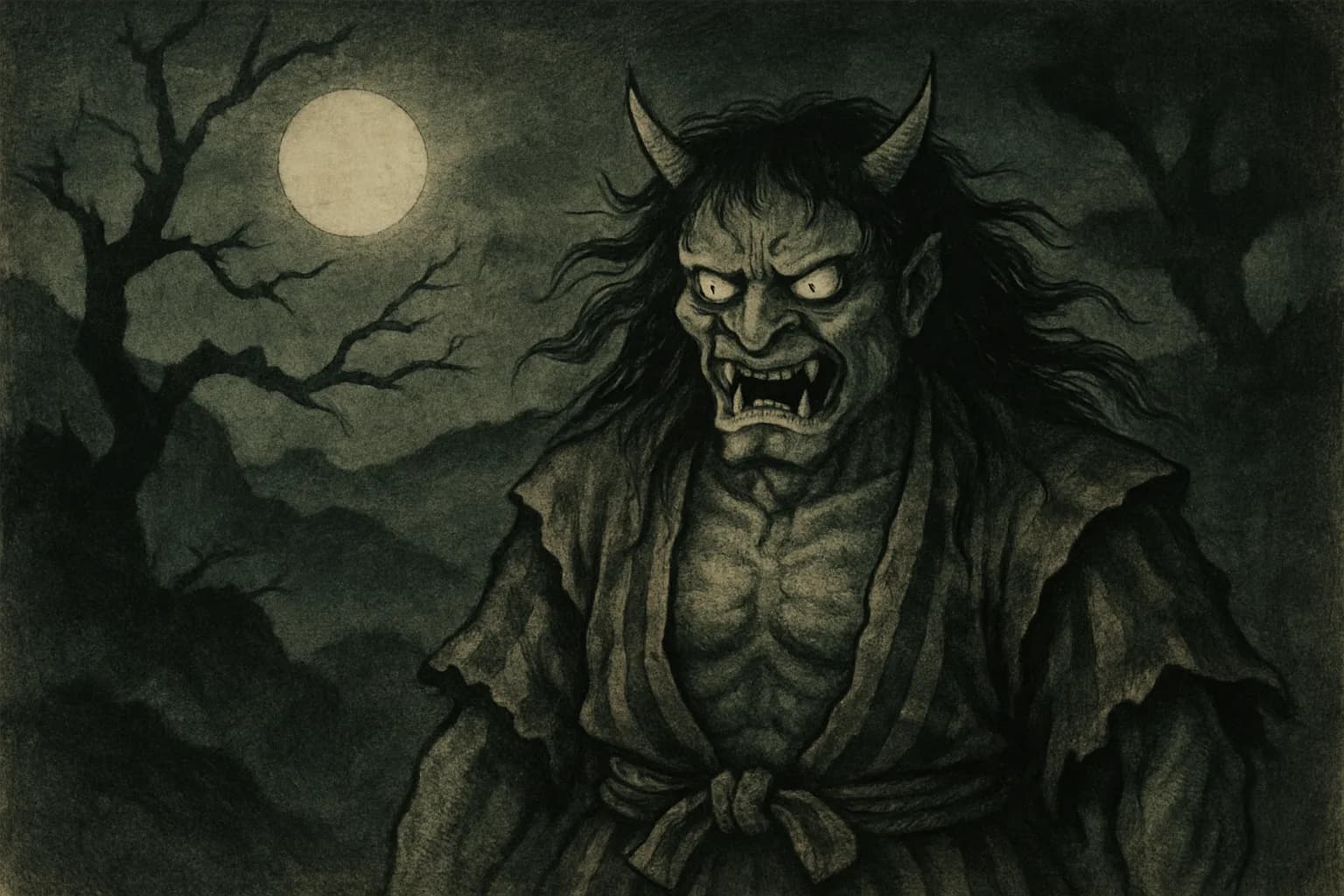
A namahage costume has a fixed set of parts, handed down village by village. The mask is carved from wood or papier-mâché, painted red or blue, with a scowling mouth, bulging eyes, and sometimes a single horn or two. Over the body goes a kera, a heavy cape of loose rice straw that also covers the legs, so the whole figure rustles and sheds strands of straw as it moves — locals scramble to pick up the fallen straw, since it's said to bring good health if tucked into the eaves of a house for the coming year. In one hand the namahage carries a deba-bōchō, an oversized kitchen knife, and in the other a wooden pail or basket, ostensibly for hauling off the flesh of children who won't behave. Nothing about the outfit is meant to be handsome. It's built to be heard coming and to loom in a doorway lit only by a single bulb.
"Any crybabies here?"
The visit follows a fixed script that villages have kept for generations. A group of namahage — usually two or three, sometimes with a lead namahage and helpers — arrives at a house that has agreed in advance to receive them. The head of the household meets them formally, sits them down, and offers rice cakes and sake. The namahage, in a booming, deliberately frightening voice, ask whether the children of the house have been crying, whining, or skipping their chores, and whether any adult has spent the winter sitting too close to the fire instead of working. The parents vouch for their children; the children, often genuinely terrified, promise to behave. Before leaving for the next house, the namahage deliver a blessing — for a good harvest, a good catch of fish, and a healthy year — and the household head sees them out with a bow. For a child in Oga, this is not folklore read in a book. It is a masked stranger crouching down to look you in the eye and ask if you've been good, and the fear is the entire point: it is a yearly inoculation against idleness, administered by the whole community at once.
The thousand steps of Mount Shinzan
One local legend explains how the namahage first came to the peninsula. Five oni were said to have accompanied a visiting Chinese emperor to Oga and, left to themselves, took to raiding the villagers' fields. The villagers struck a wager: if the oni could build a stone stairway of one thousand steps up to the Goshadō halls of Akagami Shrine in a single night, the villagers would hand over a young woman every year; if they failed, the oni had to leave for good. The oni worked fast, and as the steps neared a thousand, a quick-thinking villager imitated the crow of a rooster to make it sound like dawn was breaking. Believing they'd run out of night, the oni abandoned the stairway and left the peninsula. The stone steps up to Akagami Shrine's Goshadō are still counted at nine hundred and ninety-nine.
Where namahage comes from
Folklorists classify the namahage as a raiho-shin, a "visiting deity" — a being that arrives from outside the ordinary world, at the boundary of the old year and the new, to purify a household and correct its faults before departing again. The name itself is thought to come from namomi, the reddish, blotchy burn-mark that skin gets from sitting too long beside an open hearth through a long winter, and hagu, "to peel or strip off." A namahage, in other words, is a spirit whose job is to peel the fire-blister — the visible mark of a season spent doing nothing — off of anyone who's earned one. The ritual predates its own legends; the Mount Shinzan story explains the oni, but the deeper practice belongs to a wider family of New Year visiting-deity customs found up and down Japan's coasts, each with local names and masks, of which Oga's is the largest and most elaborate to survive.
Namahage today
In 2018, UNESCO added "Raiho-shin, ritual visits of deities in masks and costumes" to its Representative List of Intangible Cultural Heritage, grouping the Oga namahage together with nine related rituals from other regions, among them the Toshidon of Kagoshima's Koshikijima Islands. Oga now hosts the Namahage Sedo Festival every February at Shinzan Shrine, where the house-to-house ritual is reenacted publicly around a sacred bonfire for visitors who can't be there on New Year's Eve itself, and the Namahage-kan museum in the city displays more than a hundred masks, each cut in a different hamlet's own pattern. The tradition is not simply preserved behind glass, though — it's also strained. Oga's population has aged and shrunk for decades, and in a growing number of hamlets there are no longer enough unmarried young men left to fill the masks, so neighboring villages now lend namahage to each other to keep every house's door still getting that knock on the last night of the year.