Mount Yuga rises just 274 meters above the Inland Sea, southwest of Okayama. For over a thousand years pilgrims have climbed it to pray. Long before that, local legend says, it belonged to a demon. His name was Akurao, and he ruled the mountain like a private kingdom until the imperial court sent a general to take it back.
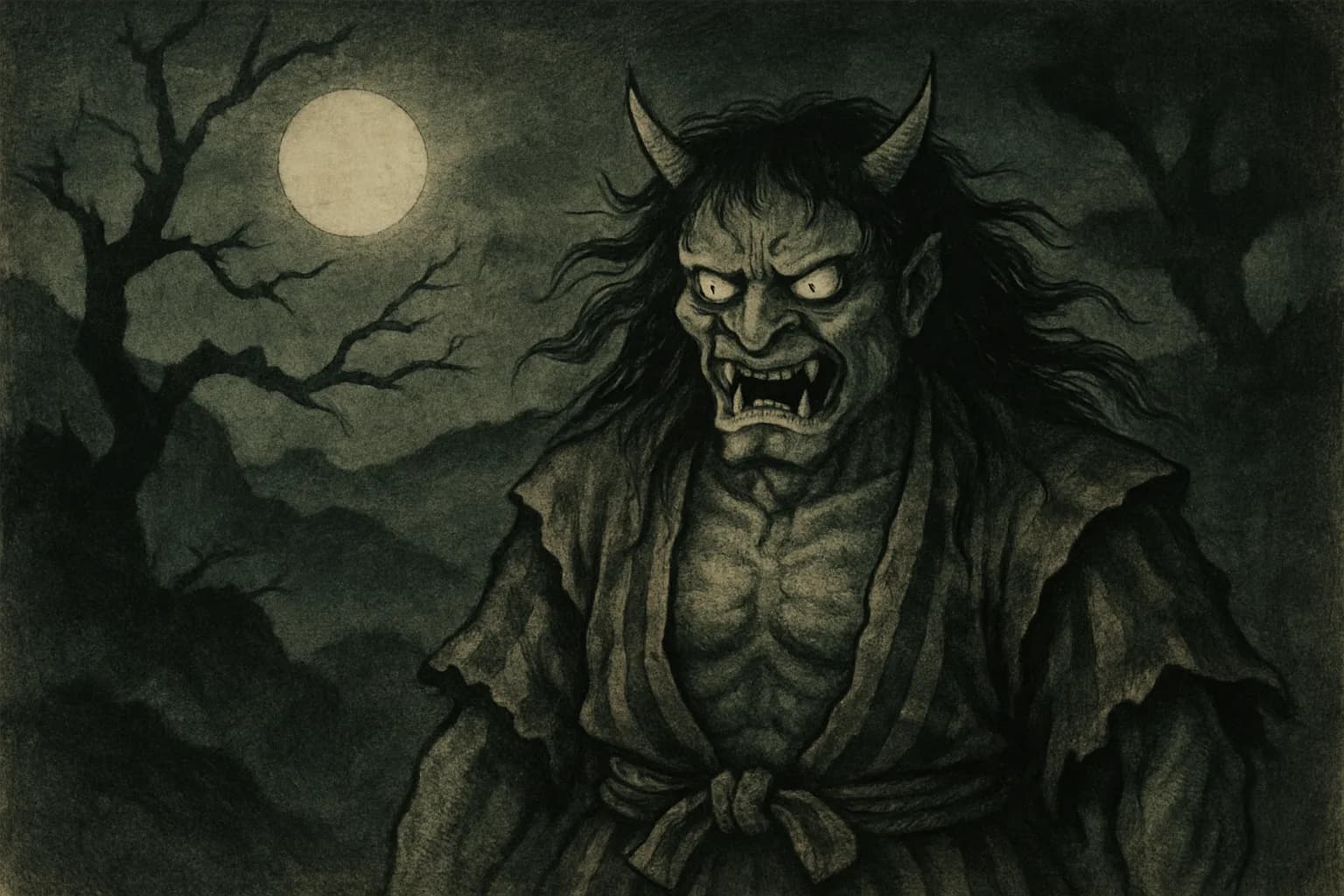
What did Akurao look like?
The old accounts spend less time on Akurao's face than on his tricks. He is described as a demon chief, an oni commander with sorcery to match his strength. He could vanish into fog and haze at will, the stories say, slipping away from anyone who tried to corner him. He kept three retainers at his side: Tōgō Tarō, Kamo Jirō, and Hida Saburō. Some versions call them his sons. Others call them followers who joined him later. One telling even says Hida Saburō started out human, before he fell in with the demon.
A mountain kingdom by the sea
Akurao and his men did not stay on the mountain. They came down into the villages of Kojima to rob and terrorize. Farmers lost their rice and cloth. Travelers went missing. People said the demon and his retainers took whatever they wanted and vanished back up the slope before anyone could follow. Complaints reached the capital, and the court decided the raids had to end.
The seven-day battle
The emperor sent Sakanoue no Tamuramaro, said to be the strongest warrior in the capital. In real history he was a Heian-period general famous for campaigns far to the north. In this legend, his enemy was much closer to home. Tamuramaro prayed for victory before he climbed the mountain. He is said to have called on Yuga Daigongen, the mountain's own guardian deity, all through the fighting that followed. The battle lasted seven days and seven nights. Neither side gave ground easily. In the end, Akurao fell.
Death and a second life
Most defeated oni in Japanese legend simply die, or end up as a warning nailed to a gate. Akurao's story turns instead. Dying, he is said to have repented of his raids and sworn service to Yuga Daigongen. His body broke apart in a burst of golden light. From it came seventy-five white foxes, and those foxes became the deity's messengers. They still carry its blessings to worshippers today, or so the mountain's tradition holds. It is the same trick the fox performs elsewhere in Japanese folklore — the shapeshifting kitsune standing in for a god it serves.
Where it comes from
Okayama tells more than one story like this. Ura, the red-haired giant of Kinojō, was also a raiding demon put down so a local mountain could turn sacred. Shuten-doji, the demon chief of Mount Ōe, follows the same shape further north. A wild power holds a mountain, a hero brings it down in the emperor's name, and the site becomes fit for worship afterward. Akurao's story softens the ending: he is not just killed, he is folded into the religious order he once defied. One old Okayama gazetteer, the Bi'yō Kokushi, even floats a theory that Akurao echoes Prince Sawara, an eighth-century royal blamed for a curse after his own downfall. The text is careful to call this a story, not settled history.
Mount Yuga today
The mountain Akurao once ruled is now one of Okayama's major pilgrimage sites, split since 1873 into the Buddhist temple Yugasan Renkoji and the Shinto Yuga Shrine. From the Edo period onward, pilgrims made a point of visiting Yuga Daigongen alongside Kompira Daigongen, across the water in Sanuki. The custom is called Ryōmairi, the "double pilgrimage," and it is still observed. Visitors still climb the same slope Tamuramaro once fought his way up, praying to the deity a demon gave his life to serve.