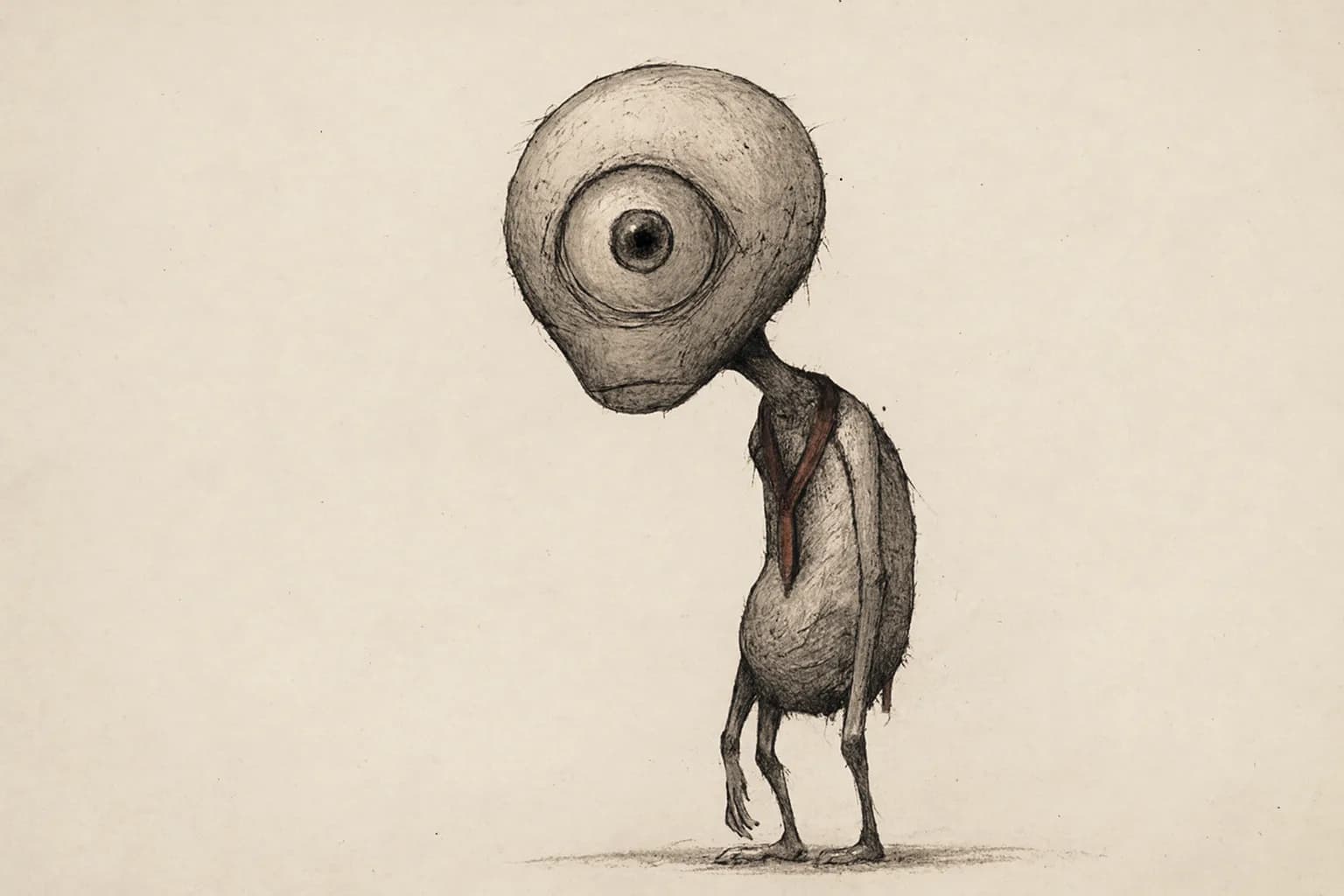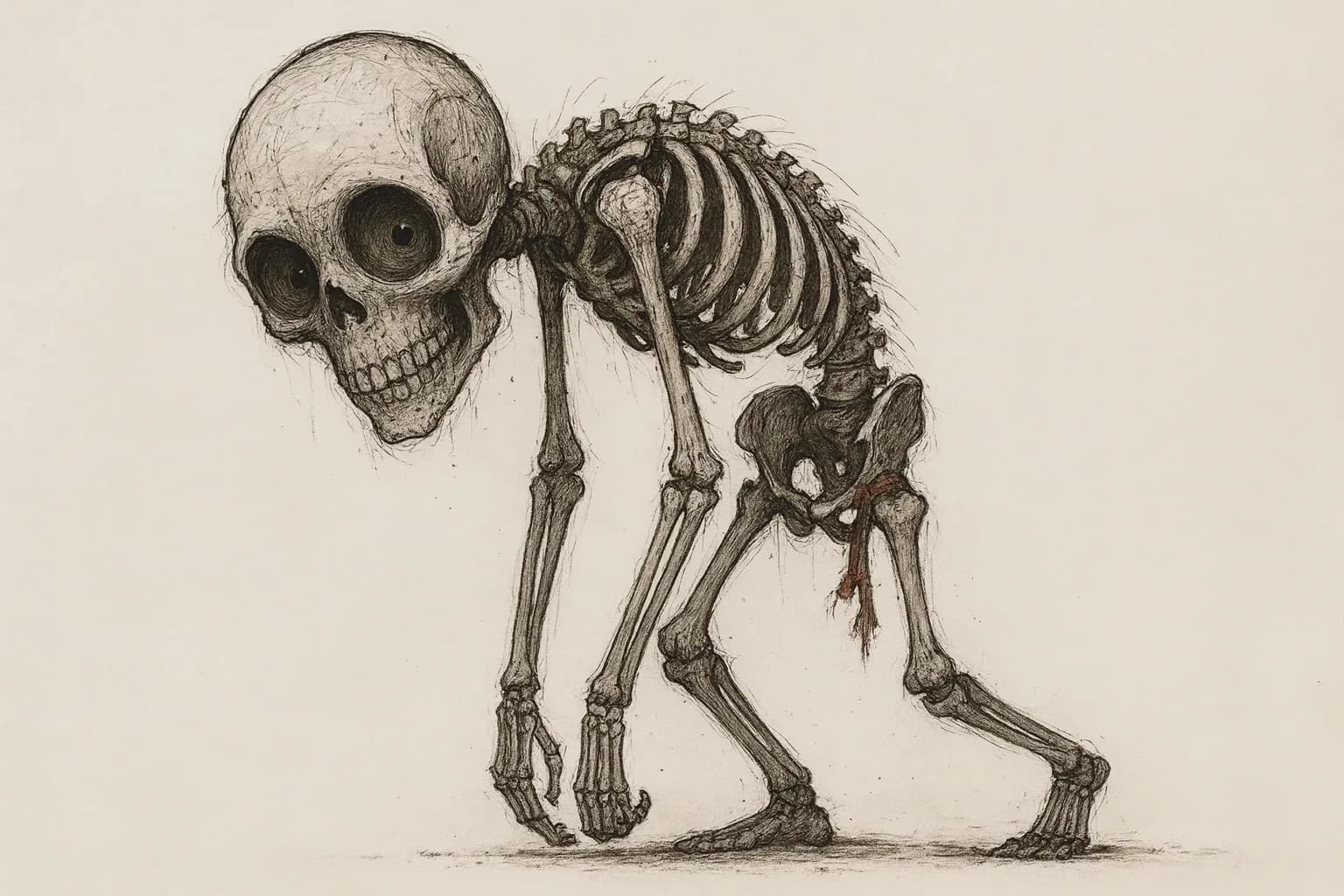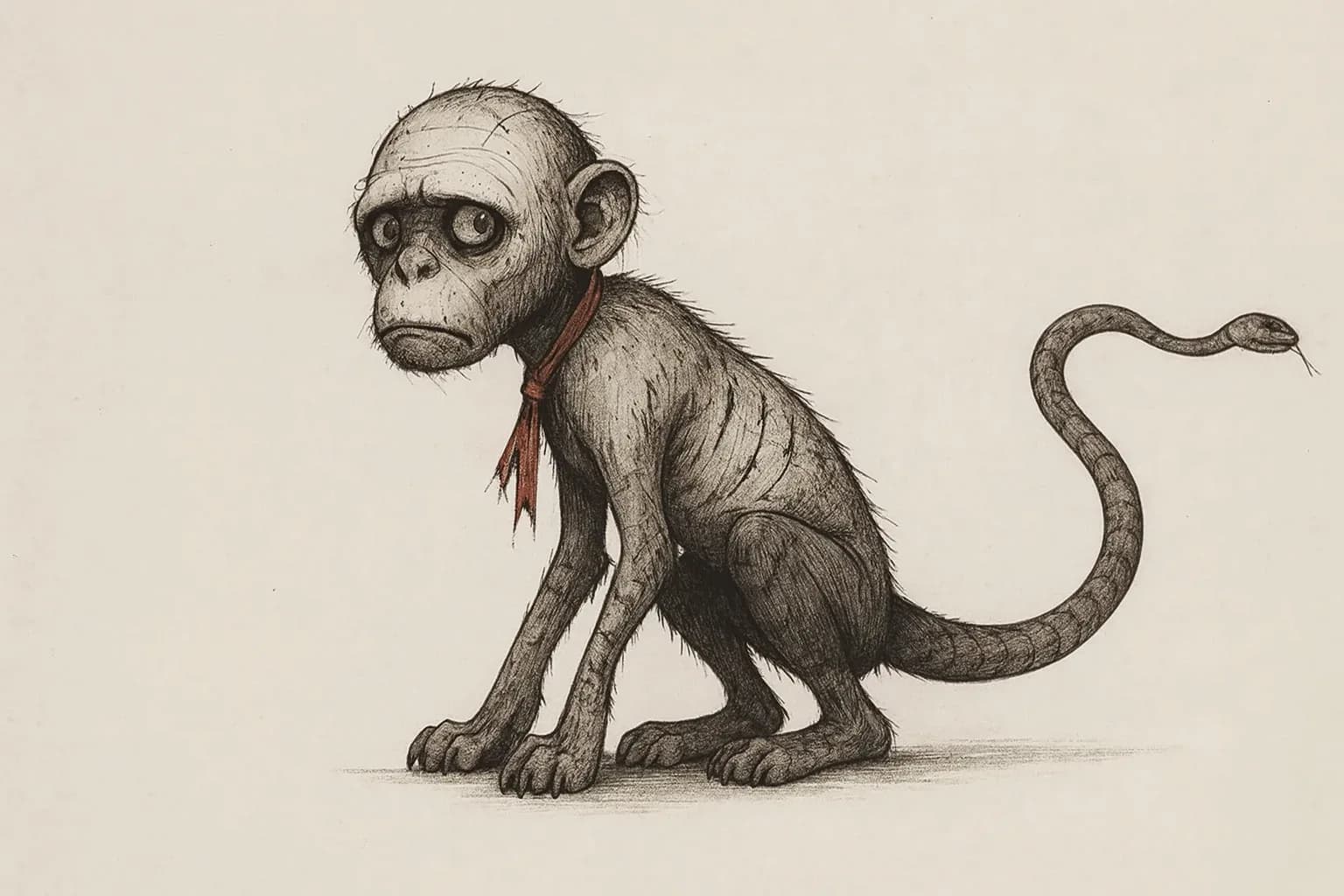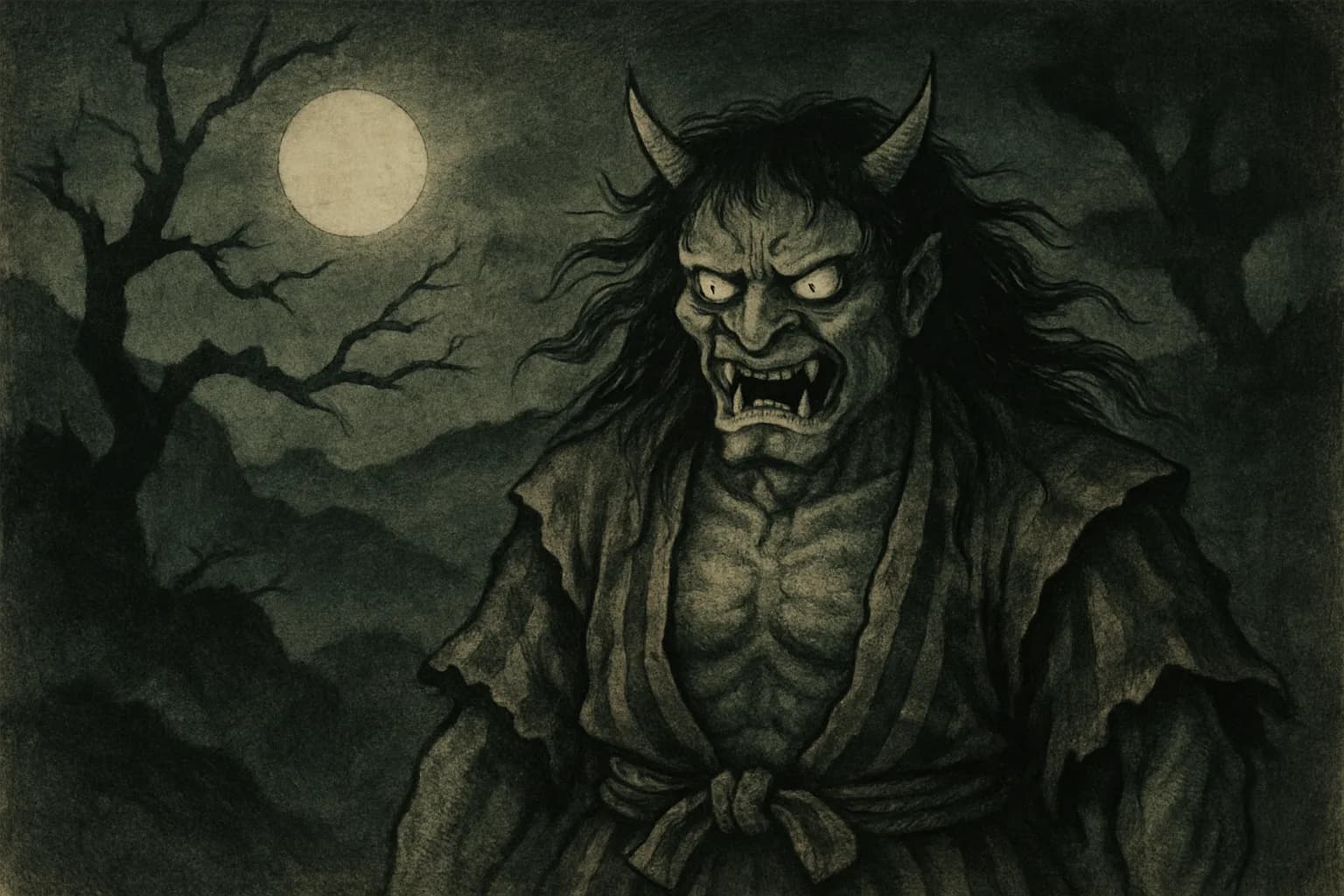
Most yokai come to us secondhand, filtered through centuries of retelling before anyone wrote them down. Gagoze is different. Its story appears in the Nihon Ryoiki, a collection of Buddhist tale compiled by the monk Kyokai in the early 9th century — making it one of the very first oni to be recorded in Japanese writing at all, roughly a thousand years before Toriyama Sekien ever picked up a brush.
What does it look like?
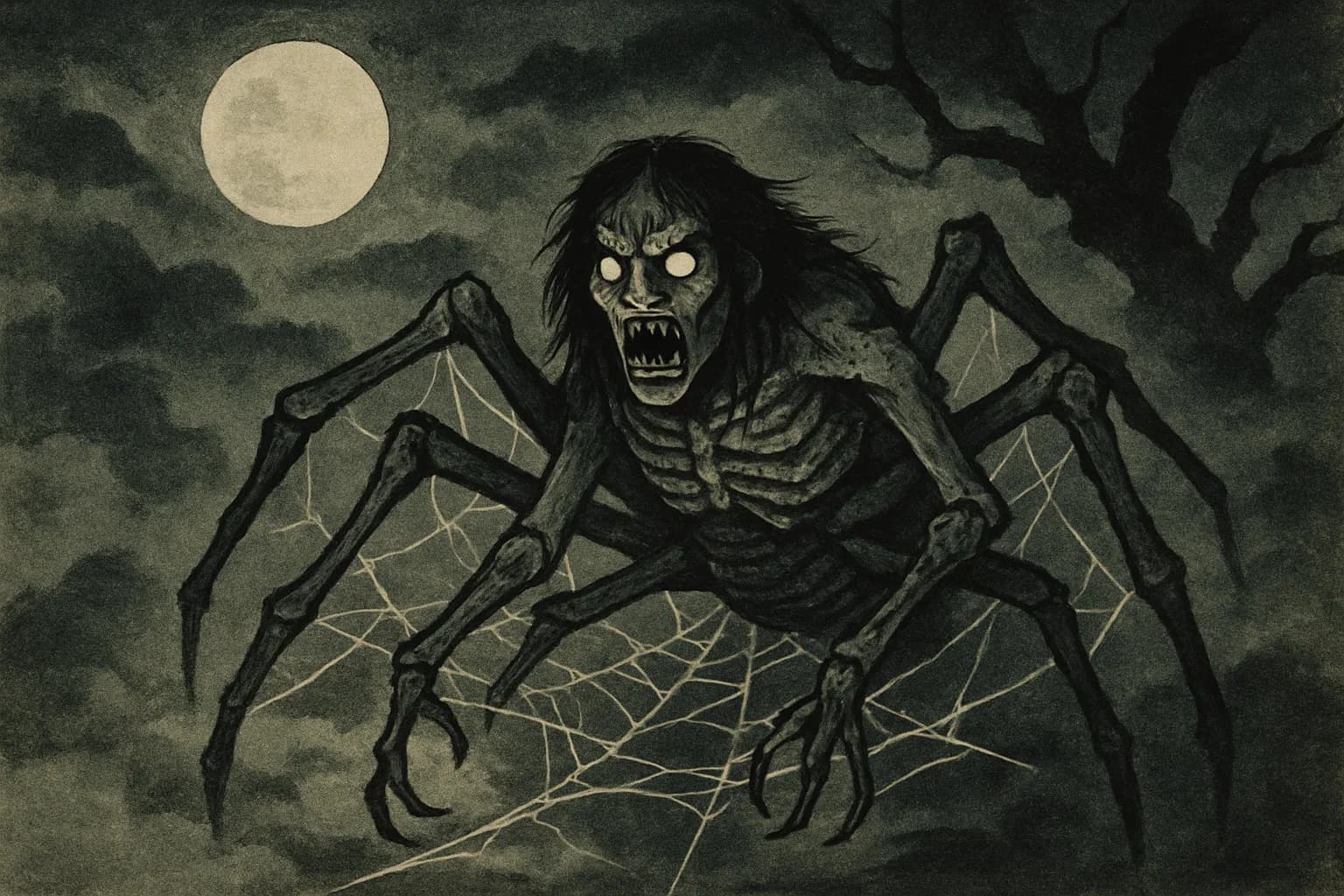
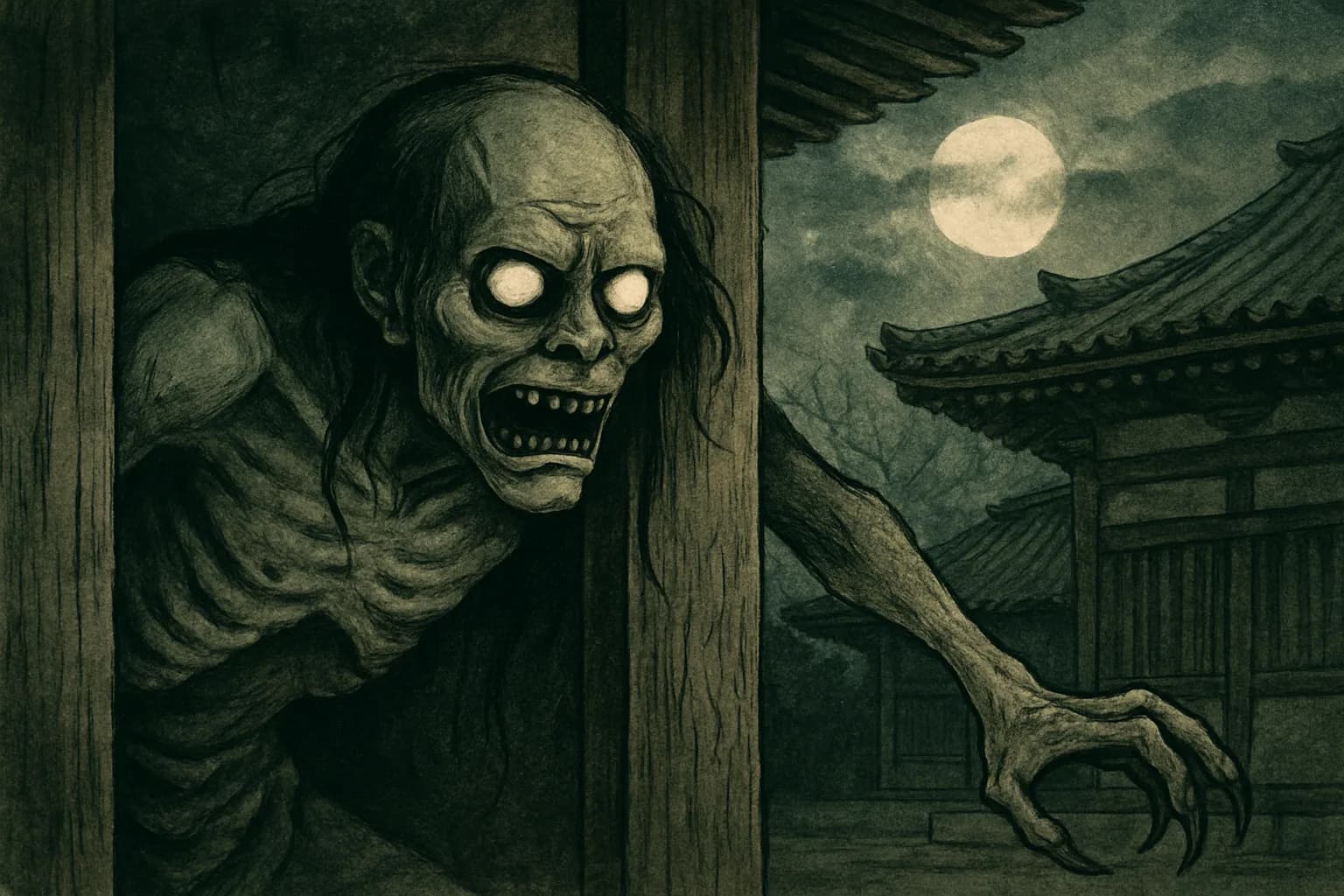
Sekien's own rendering, in his 1776 print series Gazu Hyakki Yagyo, shows Gagoze as an oni wearing a monk's robes, hunched and crawling on all fours rather than standing upright like most of his demons. That crouching, animal posture is the detail that survives — a thing that moves through the dark of a temple compound the way a person shouldn't.
The older Nihon Ryoiki account gives less physical description and more behavior: something that lurked around the temple bell tower at night and killed the boys sent to tend its lamp.
The bell tower killings
Gangoji, in Nara, was one of Japan's earliest Buddhist temples, and by the account in the Ryoiki it had a problem. Boy attendants kept dying, one after another, always near the bell tower, always at night. No one could say what was doing it, only that whoever went up after dark did not come down again.
The thunder child
The story's hero arrives by a strange route. A farmer, caught in a storm, comes across a small child standing where lightning had just struck — a thunder child, spared instead of struck down. In gratitude, the farmer is promised a son of extraordinary strength, born with a snake coiled around his head. That son grows up able to beat the emperor's own strongman at a stone-throwing contest, and eventually becomes an acolyte at Gangoji under the name Dojo.
When the killings at the bell tower would not stop, Dojo volunteered to keep watch.
How the demon lost its scalp
He waited through the night with lit lamps posted around him and men stationed nearby. Near dawn, the demon appeared and reached for him — and Dojo seized it by the hair. It thrashed and pulled so hard trying to break free that its scalp tore loose in his grip, and it fled into the dark, never to trouble the temple again. The torn hair was kept afterward as one of Gangoji's treasures, physical proof that the thing had been real.
Dojo's strength stayed with him. Later tellings credit him with feats like lifting temple roof beams, and he's remembered less as a monster-slayer than as a genuinely superhuman figure who happened to grow up in a temple with a demon problem.
A name used to quiet children
Long after the story settled into legend, "Gagoze" kept working as a threat parents could use on misbehaving kids. In Tokushima Prefecture and on Awaji Island, telling a crying child that Gagoze was coming was a standard way to get them to settle down — the same function a bogeyman serves anywhere, borrowed from a demon that had, by then, been dead in the story for a thousand years.
Where the name comes from
There's no separate name for the creature apart from the temple it haunted. Gagoze is simply Gangoji (元興寺) read in an older, contracted pronunciation — the demon is named for the building, not the other way around. Gangoji itself has a real pedigree: it traces back to Asuka-dera, one of Japan's first Buddhist temples, later relocated to Nara when the capital moved there in 710. A demon story attached to a temple that old carried real weight.
Gagoze today
The temple demon shows up as a named character, Lord Gagoze, in Hiroshi Shiibashi's manga and anime Nura: Rise of the Yokai Clan — proof the story still has legs outside folklore collections, even if that modern character appears to owe little to the bell-tower original beyond the name. Gangoji itself still stands in Nara's old town, its Gokurakubo hall roofed with tiles said to date back to the Asuka period, older than the legend told about it.