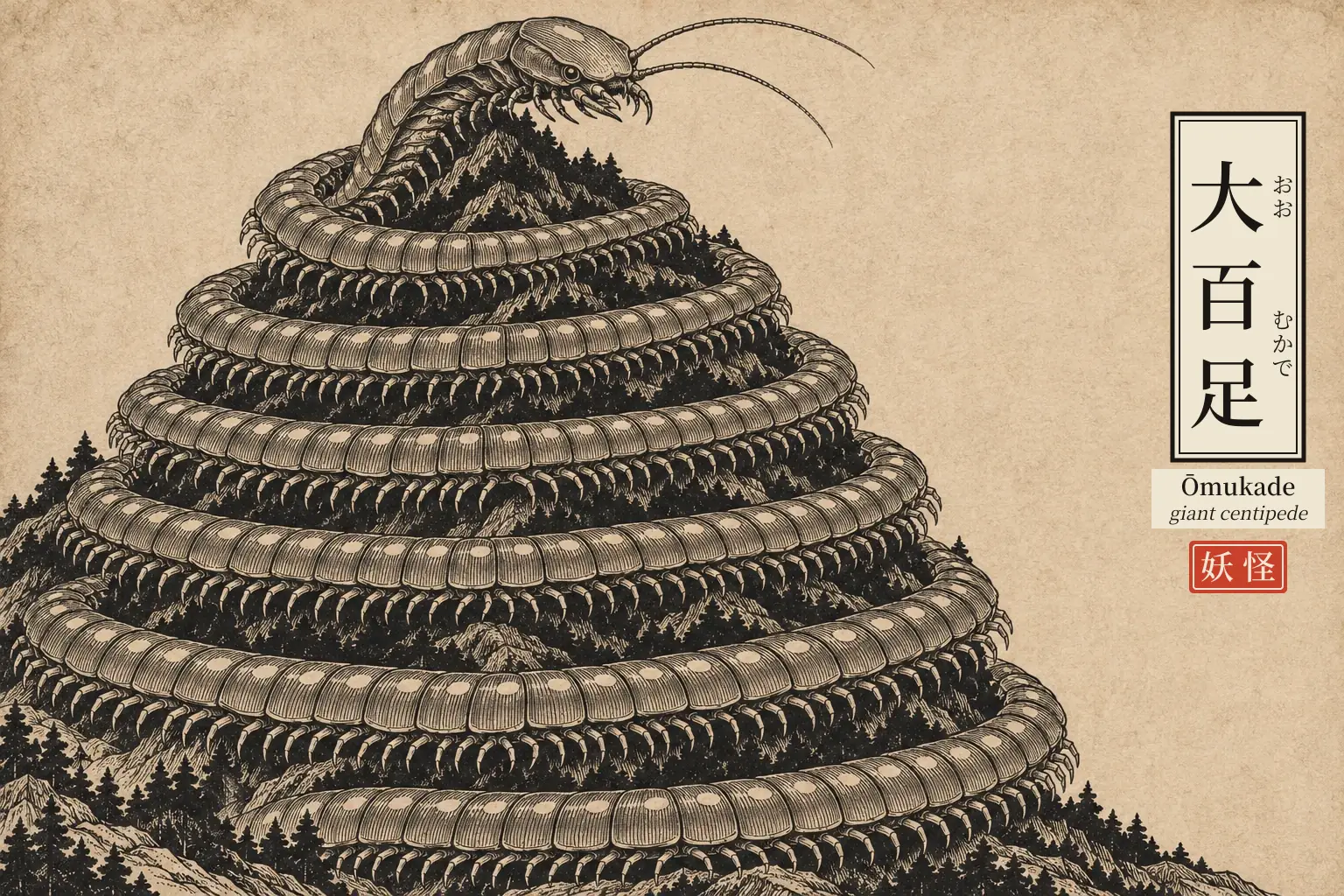
A bronze statue of a bowman stands today beside the Seta no Karahashi bridge. It overlooks Ōtsu, on the shore of Lake Biwa. The bridge is where this story starts. People said a giant centipede, the Ōmukade (大百足), lived on nearby Mount Mikami. Its name is blunt: 大 (ō), "giant," plus 百足 (mukade), "hundred legs" — the ordinary Japanese word for centipede. The details change from version to version.
What does it look like?
No source draws the centipede limb by limb. One gazetteer puts a number on its size. The Ōmi Yochi Shiryaku was written in 1723. It says the centipede was long enough to wind seven and a half times around Mount Mikami. Earlier tellings, in the medieval epic Taiheiki and in otogizōshi versions of the tale, describe it a different way. When it moved to attack, it looked like two or three thousand torches advancing in a line down the mountain. The Taiheiki puts its den on Mount Hira instead of Mount Mikami. The main telling agrees on one vulnerable spot: its forehead.
The bridge, the dragon princess, and the mountain
In the usual telling, a giant snake once lay across the Seta no Karahashi bridge. Travelers were too frightened to cross it. A warrior named Tawara Tōta walked over the snake without flinching. His real name was Fujiwara no Hidesato.
The snake turned into a person. She said she was a dragon princess who lived at the bottom of Lake Biwa. Her whole clan, she told Tōta, was being tormented by the Ōmukade on Mount Mikami. She begged Tōta to kill the centipede.
The arrow that worked where two had failed
Tōta agreed, and waited at the bridge. The centipede came down from the mountain toward him. He fired one arrow, then a second. Both bounced off its body and did nothing.
For his third try, he coated the arrowhead in his own spit before shooting. Spit was believed to carry power against demons. That arrow found the centipede's forehead and killed it.
A later otogizōshi version adds a prayer. Before loosing the arrow, Tōta asks the war god Hachiman for help. After the centipede falls, he cuts the body into pieces.
The dragon princess rewarded him well. She gave him a bale of rice that never ran empty. She also gave him a roll of silk that never ran out. She also brought him to the undersea Dragon Palace. There she gave him a bronze temple bell. Tōta donated the bell to the temple of Mii-dera. That bell has its own afterlife. It is the bell in the later legend of Benkei's Dragging Bell.
Later tellings swell the reward to ten treasures, including a sword. A separate variant adds a suit of armor as a treasure of its own. Different samurai families later claimed the sword and the armor as their own heirlooms.
Where it comes from
The fight first appears in writing in the Taiheiki, a 14th-century war chronicle. It is told in that book's fifteenth scroll. A nearly identical plot shows up a century and a half earlier, in the Kojidan, around 1200. In that older version, a warrior named Awazu no Kanja kills a serpent for the Dragon Palace. The bell he receives in thanks also ends up at Mii-dera. Many readers see this as the older plot that Hidesato's story adapted. It kept the same reward and gave itself a more famous hero.
One folklorist, Wakao, reads the whole fight as a story about mining. In Japanese, the verb for "shoot" an arrow (iru) sounds the same as the verb for "cast" metal. On this reading, the centipede is a vein of iron ore. Killing it is really about smelting that ore.
Go deeper
Books worth owning if this world pulls you in.
- The Book of Yokai →Michael Dylan FosterThe most readable scholarly introduction to yokai — where they come from, what they mean, and the major creatures.
- Japandemonium Illustrated: The Yokai Encyclopedias of Toriyama Sekien →trans. Hiroko Yoda & Matt AltThe complete Edo-period bestiaries that so many of these entries trace back to, in full English translation.
Some links are affiliate links; if you buy through them we may earn a small commission at no extra cost to you.
Ōmukade in Japan today
The legend still marks its ground. A bronze statue at Seta no Karahashi commemorates the fight. Two swords from the story are enshrined today at Ise Grand Shrine. One is the Chikushi, the dragon god's own gift to Tōta. The other is called Mukadegiri, "centipede-cutter," though its link to this fight is not stated outright in the record.
A similar tale is told far to the north, at Iizaka Onsen in Fukushima. There, Tōta kills a different giant centipede. A hot spring bubbles up afterward for him to wash in.
The centipede changes location. The hero does not.