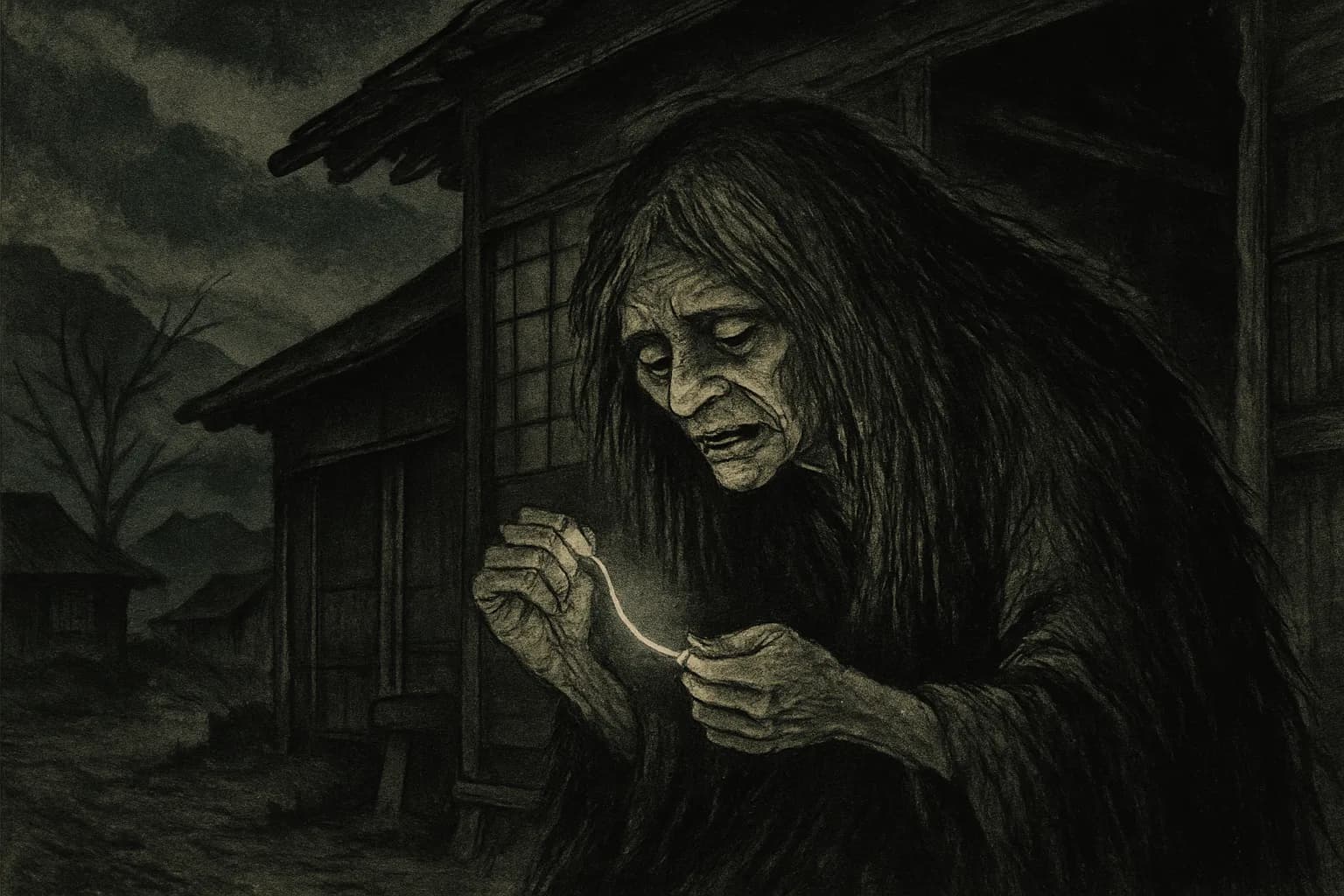
The same trick catches her out in two different provinces. At Joren Falls in Izu, a resting traveler feels a thread loop around his ankle and, sensing something wrong, slips it off and ties it to a nearby stump instead — the stump is wrenched into the pool with a crash that shakes the gorge. Hundreds of kilometers north, at a pool on Sendai's Hirose River, a fisherman does the exact same thing, and a voice rises out of the water afterward, muttering "kashikoi, kashikoi" — clever, clever. That pool is still called Kashikobuchi, the Clever Pool, because of it. Both stories belong to the jorogumo, a spider that lives long enough to become a woman, and patient enough to wait by the water for someone to sit down.
What does it look like?
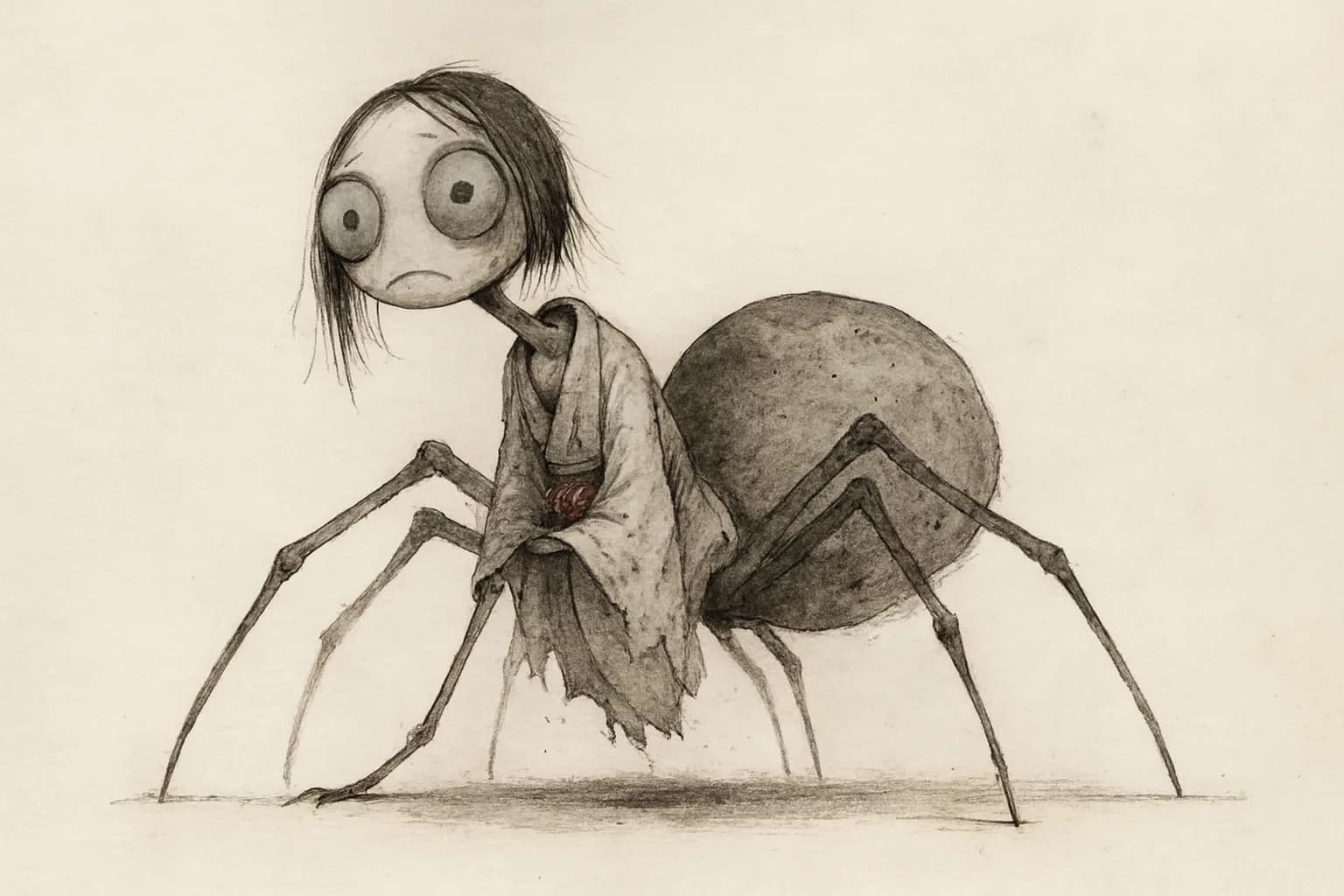
In her true form, the jorogumo is described as an enormous spider, sometimes given extra eyes and a mouth capable of speech. Her more dangerous shape is a beautiful woman — refined, usually encountered alone near a waterfall, streambank, or old ruin, never explaining what she's doing there. Toriyama Sekien's illustration of her, in his Edo-period yokai catalogs, shows her seated and composed while a swarm of small spiders around her breathe fire, a detail that has nothing to do with any spider found in nature and everything to do with how unnatural a creature she's meant to be. Some accounts split the difference and give her a hybrid form for the moment of the attack — a woman's torso above a spider's legs and abdomen, the illusion dropped only once it's too late to matter.
The stump at the falls
The Joren Falls story is the jorogumo's signature scene, and it survives in several tellings. In the most common version, a man rests by the basin at the foot of the falls; something coils around his leg; he transfers the thread to a stump instead of pulling away, and the stump is dragged bodily into the water. In another telling from the same falls, a woodcutter drops his axe into the pool, and a strange woman surfaces to return it — with one condition, that he tell no one what he saw. He holds the secret for as long as he can and finally breaks, drunk, at a gathering, and the story doesn't say kindly what happens to him afterward. A gentler variant has him fall in love with the woman and visit her daily, growing weaker each time, until a priest recognizes the wasting for what it is and intervenes with a sutra.
The song under the water
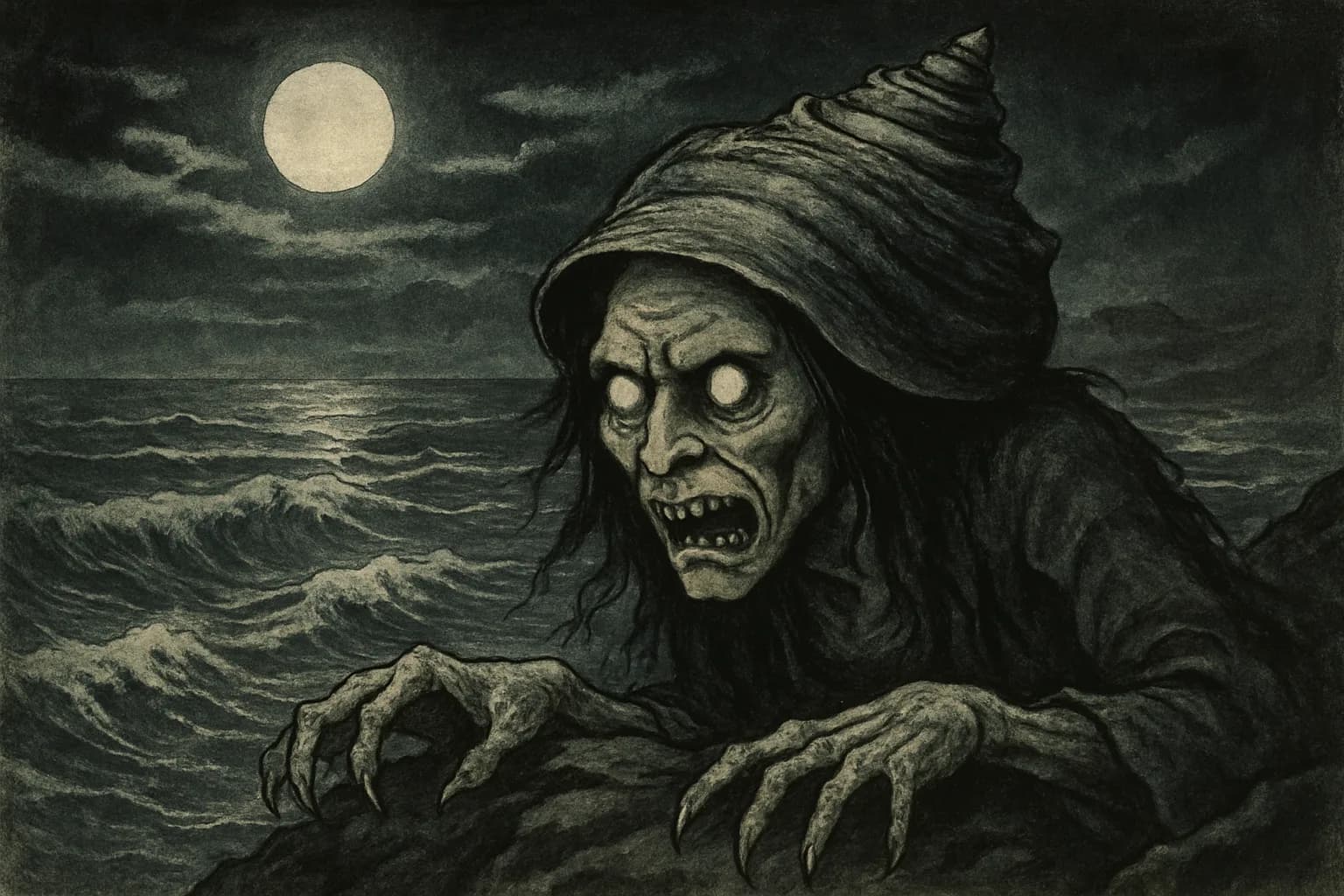
At Kashikobuchi, the lure is sound rather than sight: travelers near the pool report hearing a biwa being played beneath the surface, and men who go looking for the source don't come back. The stump-and-thread test appears here too, independently of the Izu version, which is part of why folklorists treat it as the jorogumo's real signature rather than a detail specific to one place — the same test, the same reveal, the same shape of story, told in two river valleys that had no reason to copy each other.
Where the name comes from
The yokai's name plays on a real word. Jorō (女郎) meant a courtesan or prostitute in Edo-period Japanese, and the ordinary way to write "jorogumo" is 女郎蜘蛛 — "prostitute spider," a name still used today for Japan's common golden orb-weaver, Nephila clavata, on account of its size and gaudy coloring. Toriyama Sekien's version instead used the characters 絡新婦, "entangling bride," softening the insult into something closer to a ghost story while keeping the same idea: a woman who is dangerous specifically because she is desirable. Folklore holds that an ordinary spider crosses over into a jorogumo once it survives four hundred years, a threshold that shows up again and again in Japanese yokai belief — foxes, cats, and other long-lived creatures all earn supernatural power the same way, simply by getting old enough that the world stops recognizing them as what they were.
Jorogumo today
Nephila clavata still goes by the name jorogumo in ordinary Japanese and turns up every autumn in gardens and forest edges across most of the country, a coincidence of naming that keeps the yokai in casual conversation whether anyone means it to or not. The folkloric jorogumo has been a recurring demon in the Shin Megami Tensei game series since its earliest entries, cataloged there alongside other yokai rather than redesigned into something else. At Kashikobuchi, the ending isn't ominous at all: the pool now has a small torii and a stone marker, and the jorogumo said to live there is honored as a guardian who keeps swimmers from drowning, worshipped rather than feared by the people who live along the river she's supposed to haunt.