Toriyama Sekien gave this one a face and a name and then, unusually for him, nothing else. Most entries in his yokai catalogs come with a line or two of explanation — a habit, a haunt, a joke. The ouni got only a picture: a hair-covered woman with a mouth split wide toward each ear, and the two characters 苧うに written beside her. No story. Scholars have spent the two and a half centuries since trying to work out what she was supposed to be.
What does it look like?
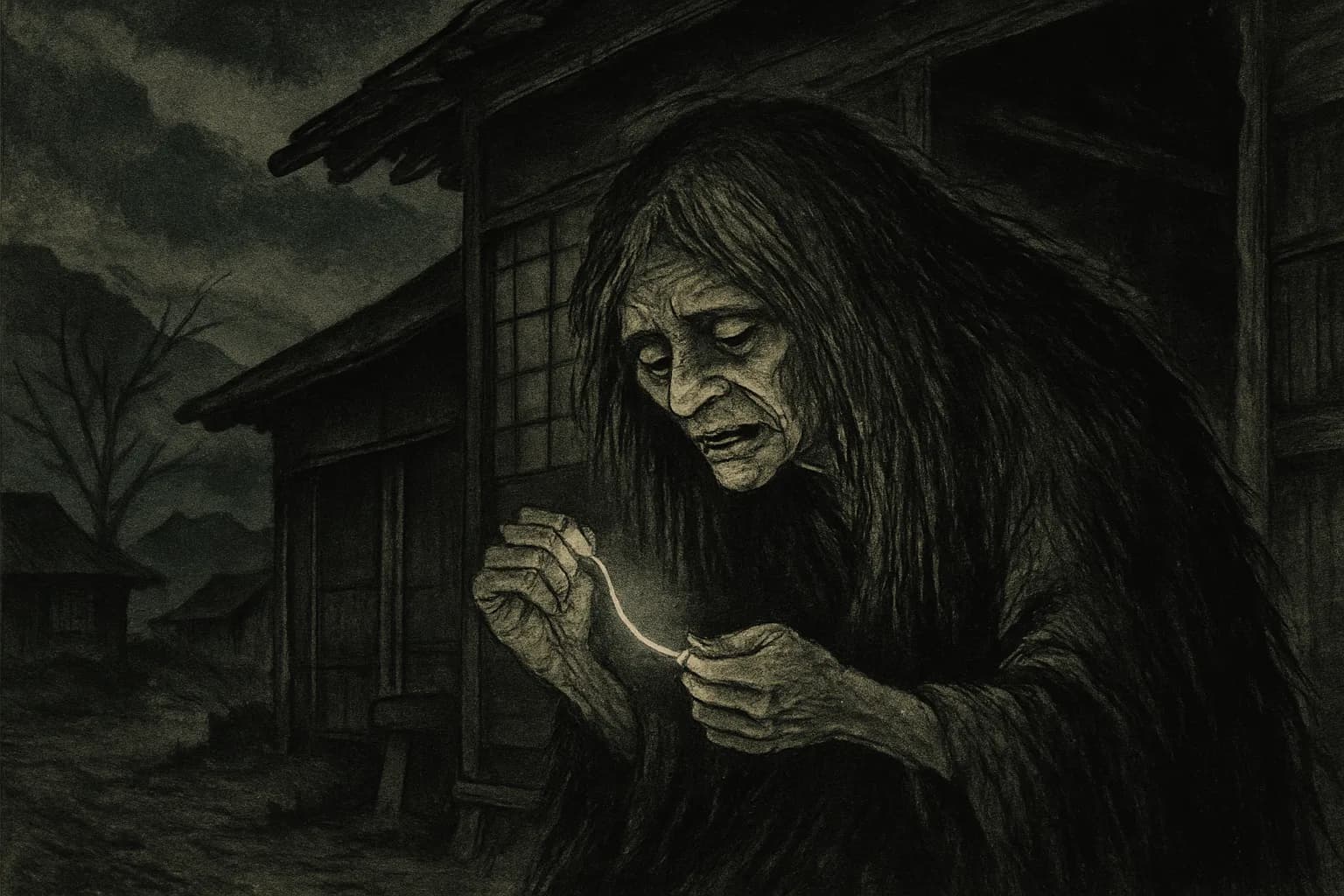
Sekien's ouni is an old woman's face wearing the expression of a kijo — a demon-woman, mouth torn open past the corners — set on a body entirely covered in long, dark hair. There is no shell, no fang, no obvious animal ancestor, just a human shape gone shaggy and wrong. Later folklorists describe her more plainly as an ugly, hairy old woman with an angry face, encountered outside a house or hut, alone, after dark.
The hair is also the pun. 苧 (o) means ramie or hemp fibre — the raw plant thread spun into cloth in premodern Japan — and read together with an old dialect word for oni, the name becomes something like "fibre-demon." Sekien is almost certainly describing a creature whose matted coat looks like a heap of unspun hemp bundled onto a body.
A yokai with no story — until one got attached
Because Sekien left the ouni undocumented, later writers went looking for a folk tradition to match the picture, and one earlier source offered a lead: the 1737 scroll Hyakkai Zukan shows a similar hairy figure under the name wauwau, a nonsense word imitating a cry, with the same blank-slate problem — an image everyone had inherited and no one could explain.
The identification that stuck came later, and it moved the ouni into a different, better-documented category of yokai altogether: the helpful, mountain-dwelling yamauba who turns up at a household's door needing shelter for the night.
The night's thread
In the version of the story recorded in Echigo — old Niigata, on the snow coast — a wild-haired woman appears at a farmhouse after dark and asks only for a meal and a place to sleep. Turn her away and nothing happens; you've simply lost nothing. But a family that takes her in gets something back. Through the night she sits with the household's raw hemp or ramie fibre and spins it into thread, all of it, far more than any one person could finish by hand before dawn — and by morning she is gone, leaving the finished skeins and no trace of who did the work. It's a chore-yokai in the same family as the tales of a mysterious visitor who mills grain or weaves cloth overnight in exchange for hospitality, except here the guest's fibre-thick hair is the same substance she's spinning, as if she is made out of her own trade.
Where it comes from
Two separate things got folded into one yokai here, which is why the ouni feels harder to pin down than most of Sekien's subjects. The picture is 1776; the hemp-spinning story about a wandering yamauba figure is a much older piece of oral folklore about hospitality repaid, recorded independently in villages that process ramie for a living. Modern folklorists — the identification is generally dated to the Heisei era — noticed that Sekien's fibre-covered hag and the region's spinning yamauba shared the same material, and merged them. Whether Sekien himself had that story in mind when he drew her is unknowable; he left no note saying so.
It's a useful reminder that not every yokai in the Edo-period catalogs arrived with folklore already attached. Some of them are just striking pictures that later generations worked to give a home.
Ouni today
The ouni has stayed a minor figure — she shows up in yokai encyclopedias and art books that reproduce Sekien's Gazu Hyakki Yagyo in full, usually with a caption noting how little is actually known about her, rather than in games or anime the way her cousin yamauba does. That obscurity is arguably the most honest thing about her: a face drawn once, a name that's half a pun, and a story borrowed from a different tradition entirely just so she wouldn't have to stand there meaning nothing.