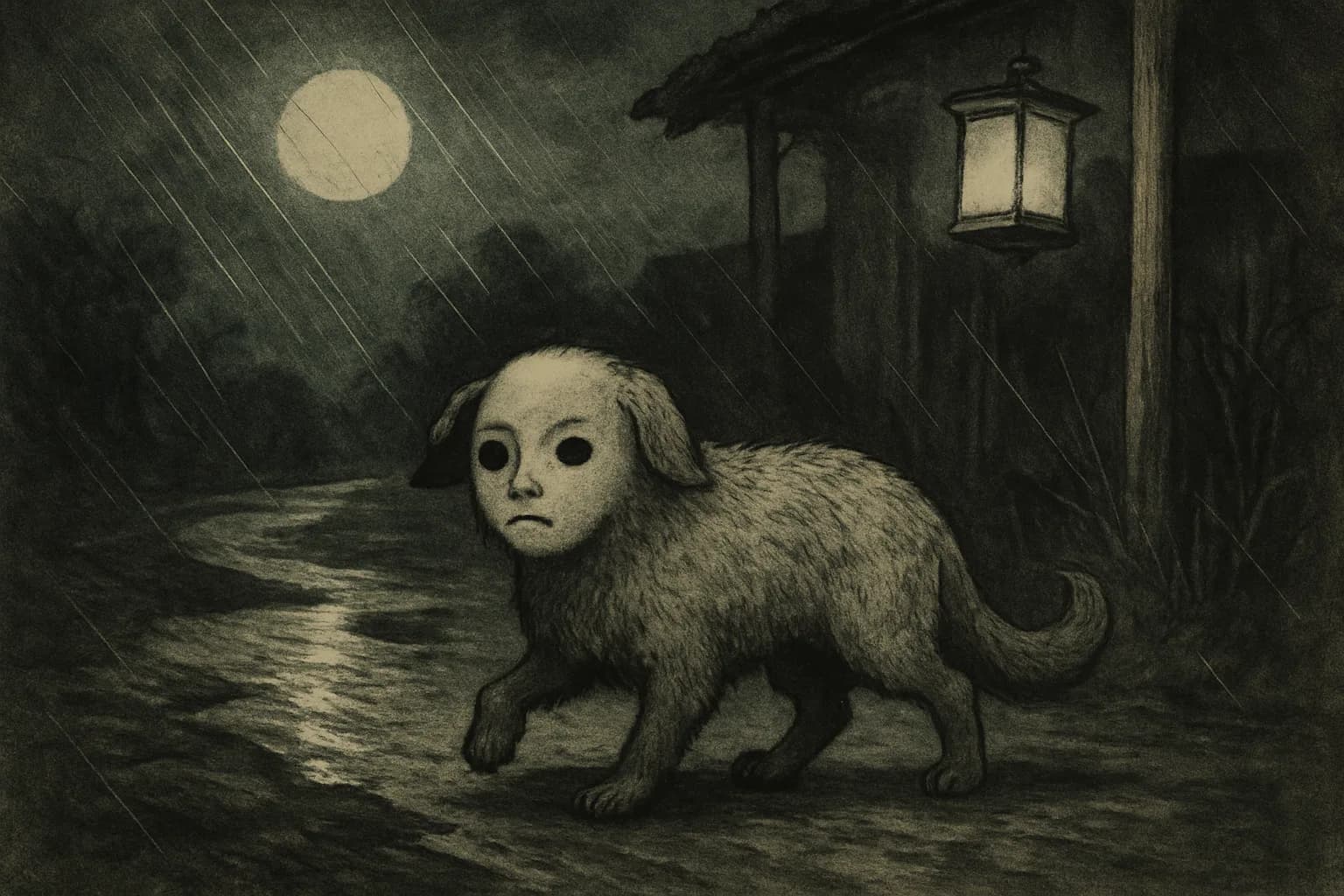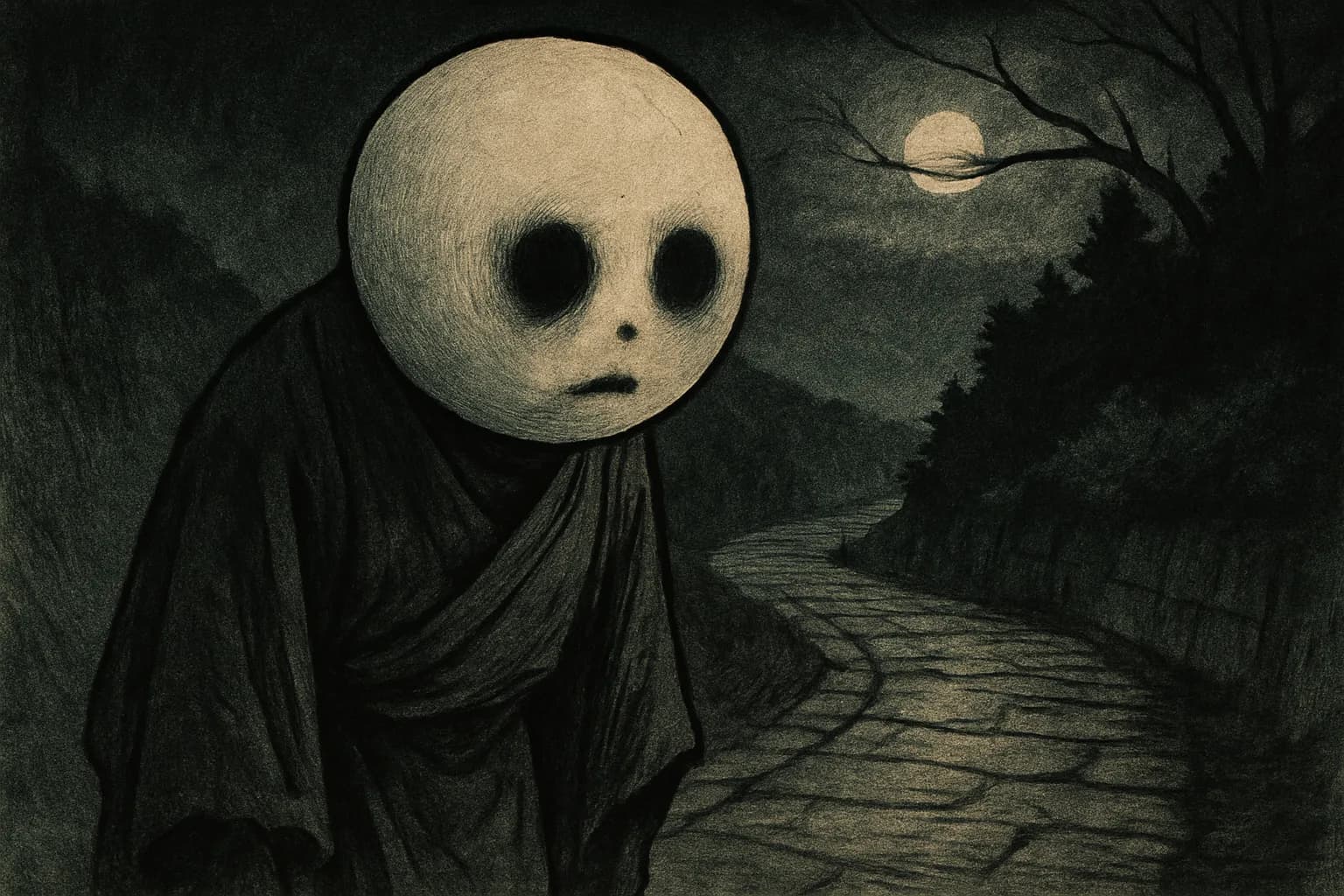
Walk a country road alone after dark in the old Yamato region and you might pick up a second set of footsteps — kata-koto, kata-koto — matching your pace exactly, a few steps back, on a road with nobody else on it. Turn around and there is nothing. Stop and the sound stops with you. Start walking again and it starts again. This is Betobeto-san, and it may be the gentlest thing in the entire yokai catalogue: a presence that does nothing but walk behind you, unless you're rude enough not to let it pass.
What does it sound like?
There is no agreed appearance for Betobeto-san, because almost nobody claims to have seen one. The entire haunting is auditory: the dry clop of wooden sandals on a dirt or gravel road, trailing a solitary walker at a fixed, unhurried distance. Accounts describe the footsteps as neither speeding up to catch you nor falling behind, which is what makes the experience so unnerving rather than merely eerie — something is keeping pace with you on purpose, and it is not the wind, an animal, or an echo, because it stops the instant you do.
Ask it to go first
Nara folklore hands down an unusually specific and low-stakes remedy. A walker who hears the footsteps is supposed to step to the side of the road, turn slightly, and say aloud: "Betobeto-san, o-saki ni o-koshi kudasai" — "Betobeto-san, please go ahead of me." Say it, and the footsteps do exactly that: they move past and off into the distance, and the road behind you goes quiet. There is no fight to win, no object to sacrifice, no dish of water to spill. The entire encounter is resolved with a request for the right of way, as if the thing following you were simply being polite and waiting for permission to overtake.
That detail sets Betobeto-san apart from almost every other roadside or waterside yokai. There is no recorded case of it harming a traveler, dragging anyone off, or even touching them. Folklorists who collected the story treat it less as a threat than as an explanation — an answer to the specific, common experience of feeling followed on an empty road at night, one that resolves the fear with a line of dialogue rather than a warning to stay indoors.
A name with no kanji
Betobeto-san isn't written with characters the way most yokai are. Beto-beto is onomatopoeia for the flat, repetitive slap of sandals on hard ground, and -san is the ordinary honorific Japanese attaches to a person's name — the same suffix you'd use for a neighbor. Put together, the name treats the yokai less like a monster and more like an unseen fellow traveler who happens to share your road for a stretch. Folklorist Yanagita Kunio, who catalogued regional yokai beliefs in the early twentieth century, recorded the Yoshino-area version of the story more or less as a piece of practical etiquette passed between villagers: what to say if you ever find yourself in this situation, because sooner or later, someone would.
Where it comes from
Toriyama Sekien included Betobeto-san in his 1776 catalogue Gazu Hyakki Yagyō (画図百鬼夜行), one of the same Edo-period bestiaries that gave the kappa and hyakki yagyō tradition their lasting visual form. An entry like this one poses an odd problem for an illustrator working in a picture-scroll format built around drawn monsters: there is, by the story's own logic, nothing to draw. Sekien's catalogues generally lean on the human witness and the setting — a night road, a startled traveler — rather than invent a body for a yokai that folklore insists has none.
Unpaved roads through rice paddies and forest edges were genuinely disorienting after dark before electric light reached rural Japan, and a lone walker's own footsteps can echo strangely off an embankment or a stand of trees. A story that gives that phenomenon a name, a fixed behavior, and a scripted way to end it turns an ambiguous, mildly frightening sensation into something manageable — you're not lost or in danger, you've just met Betobeto-san, and there's a set of words for that.
Betobeto-san today
Reference works on Japanese yokai, including Shigeru Mizuki's illustrated yokai dictionaries, list Betobeto-san alongside other Nara-region folklore as a standard entry in the broader family of "sound-only" yokai — creatures defined entirely by an audible phenomenon rather than a sighting, a category that also includes the bean-washing Azukiarai. It hasn't picked up a mascot or a merchandising life the way the kappa has; there isn't much to put on a keychain when the whole point of the story is that there's nothing there. What survives instead is the phrase itself, still cited in yokai guides as one of the few genuinely useful pieces of folk advice in the entire tradition: if you ever hear footsteps behind you on an empty road, step aside and ask them to go first.