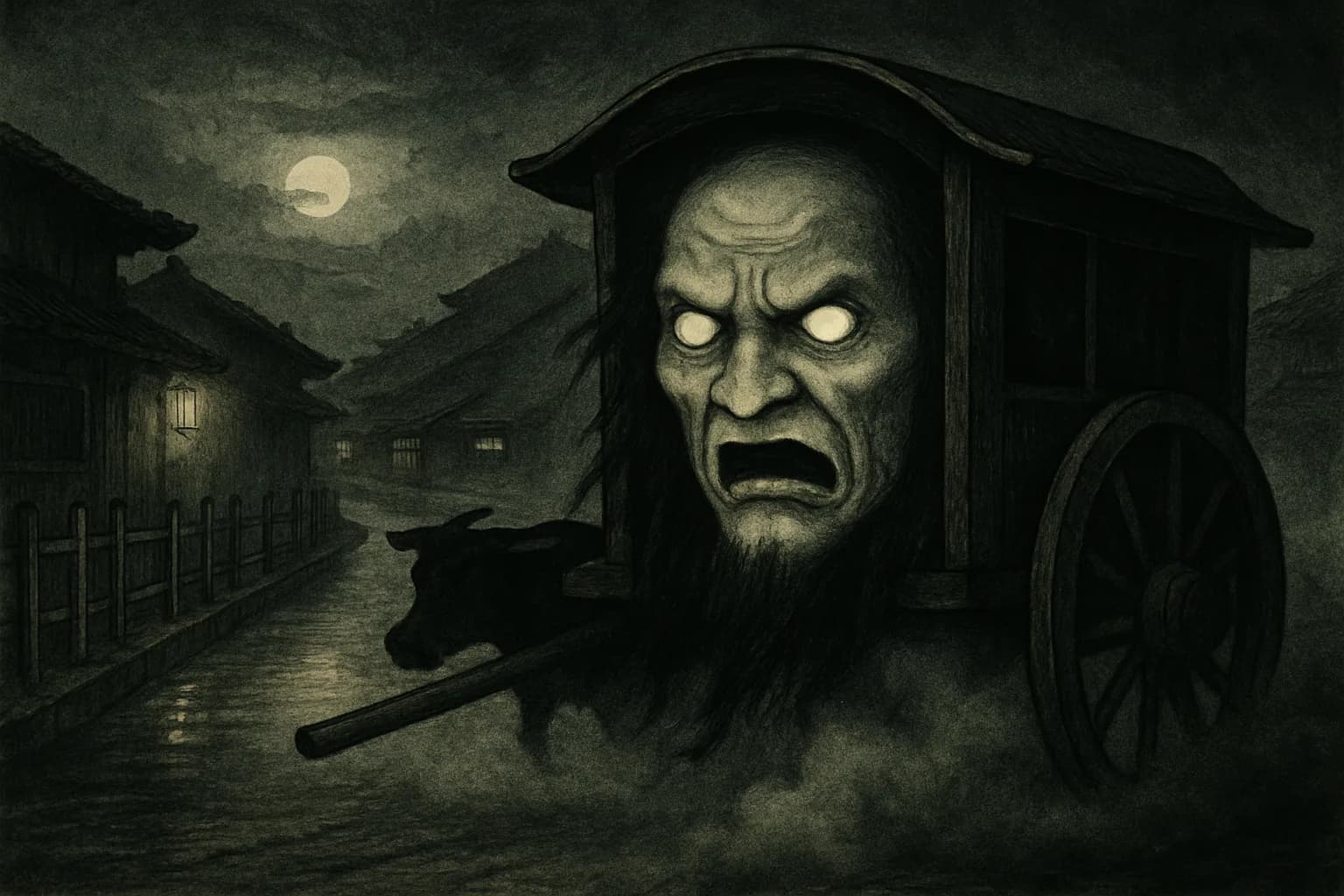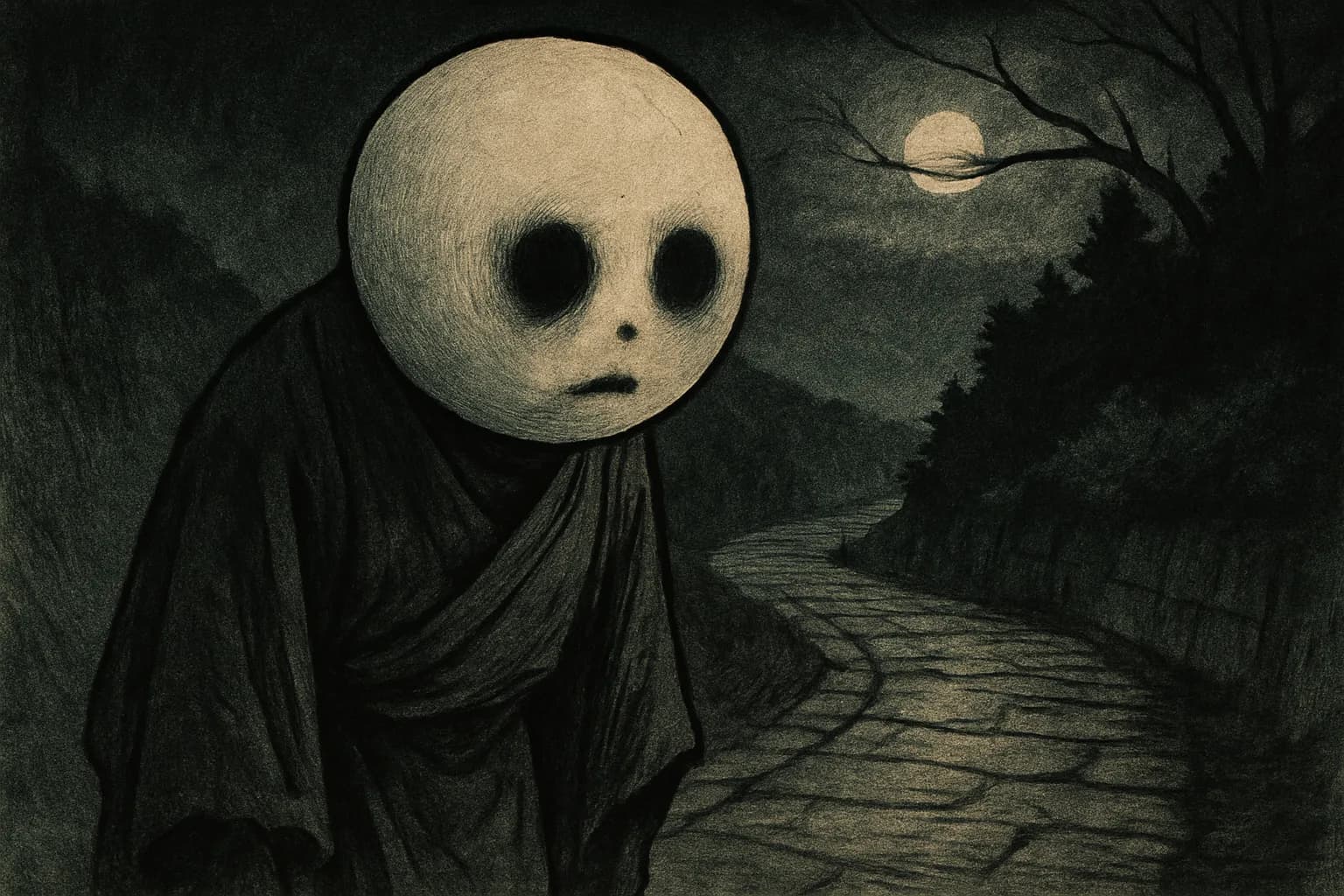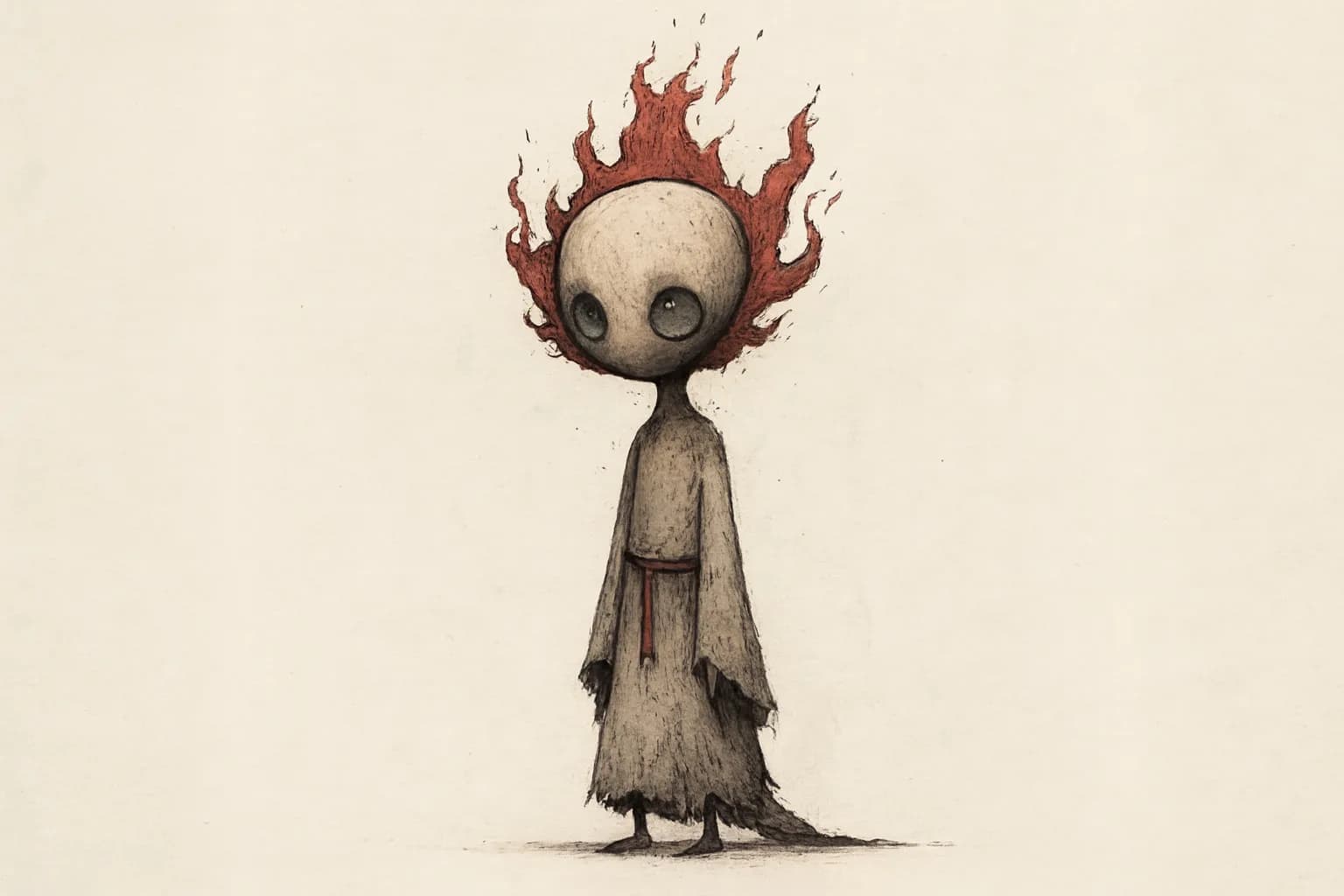
Most yōkai settle into one story that gets retold with small local changes. Akabōzu never did. It has three separate legends, from three provinces, and they barely resemble each other. In Niigata it steals a temple bell. In Kyoto it flares up behind a folding screen and disappears as a good omen. In Ehime it stands on a beach holding its own lantern and walks calmly into the sea. All that ties the three together is a name and a shape: a bōzu — a Buddhist priest, or literally "shaved head" — colored red. 赤 (aka) is simply "red."
What does it look like?
Description is thin in all three tellings, which is itself unusual for a yōkai. Strip away the plot and what is left is a shaved head, a robe, and a red color that is sometimes worn and sometimes glowing. The Ehime witness gave a height: over 180 centimeters, taller than any ordinary man, carrying a bright lantern. The Kyoto account describes the figure as red and "standing amid blazing flames," as if the fire were part of it rather than something it was holding. The Niigata version is the most physical of the three — strong enough to carry off a heavy bronze bell and fight off an armed man. None of the three mentions a face.
The stolen bell of Rinsen-ji
The Niigata story is set at Rinsen-ji, a temple in what was then Echigo province. Akabōzu stole the temple's bronze bell and caused a run of other trouble around it. The warlord Uesugi Kenshin, who had been sent to Rinsen-ji as a boy to train as a monk, ordered his most feared retainer to deal with the creature. That retainer was Kojima Yatarō, nicknamed "Oni Kojima" — Kojima the demon — for his record in battle. Yatarō went to the temple alone, fought Akabōzu, and won, bringing the bell back with him. The story stayed popular long enough that the ukiyo-e artist Katsushika Hokusai painted it two and a half centuries later, in a large color print titled Oni Kojima Yatarō, Saihōin Akabōzu, made around 1833–34.
An omen behind the screen
The Kyoto version reads nothing like a monster story. It comes from Kansō Jigo, an essay collection written around 1793–97 by the court noble Yanagihara Norimitsu. A courtier named Hino Ichii Shigeta was drinking with friends late one night when the space behind a folding screen suddenly lit up. They looked, and found a bright red priest standing in flames. It said nothing and vanished. No one was hurt, and nothing was stolen. The household took the visit as a good sign, not a warning — the reverse of what most yōkai promise. The folklorist Tada Katsumi has compared this account to zashiki-warashi, the child-shaped household spirit from the Tōhoku region that is likewise said to bring luck to the house it visits.
The lantern on the shore
The Ehime story comes from Ainan, on the coast of the old Nanyo district, and was not written down until 1991, taken from an elderly couple's oral account. A fisherman, finishing his work for the night, noticed a light on the beach. He walked over to look and found Akabōzu standing there, holding the light itself. It did not speak or come toward him. It simply turned and walked into the sea. The fisherman hauled his boat further up the sand and went home. The fear outlasted the sighting: locals are still said to avoid that stretch of shore after dark.
Where it comes from
Three provinces used the same name for the same shape, and never agreed on what it did. That mismatch is the real story here, more than any single legend. "Bōzu" yōkai — shaved heads in robes — are common across Japan, a kind of folk shorthand for "something happened here that nobody could explain." Color did the sorting: aobōzu (blue) and shirobōzu (white) fill the same slot in other regions, each tied to its own local tale. Nothing connects the Niigata bell theft to the Kyoto omen to the Ehime beach walker except that each town, independently, reached for the same two words to name what its people saw.
Akabōzu today
Akabōzu never became a mascot or a franchise regular the way kappa or tengu did. What is left is smaller and more local. Rinsen-ji still stands in Niigata, still tied to Uesugi Kenshin's childhood there, bell story or not. And on one particular beach in Ehime, more than three decades after a fisherman's account was written down, people are still said to keep away once the sun goes down.