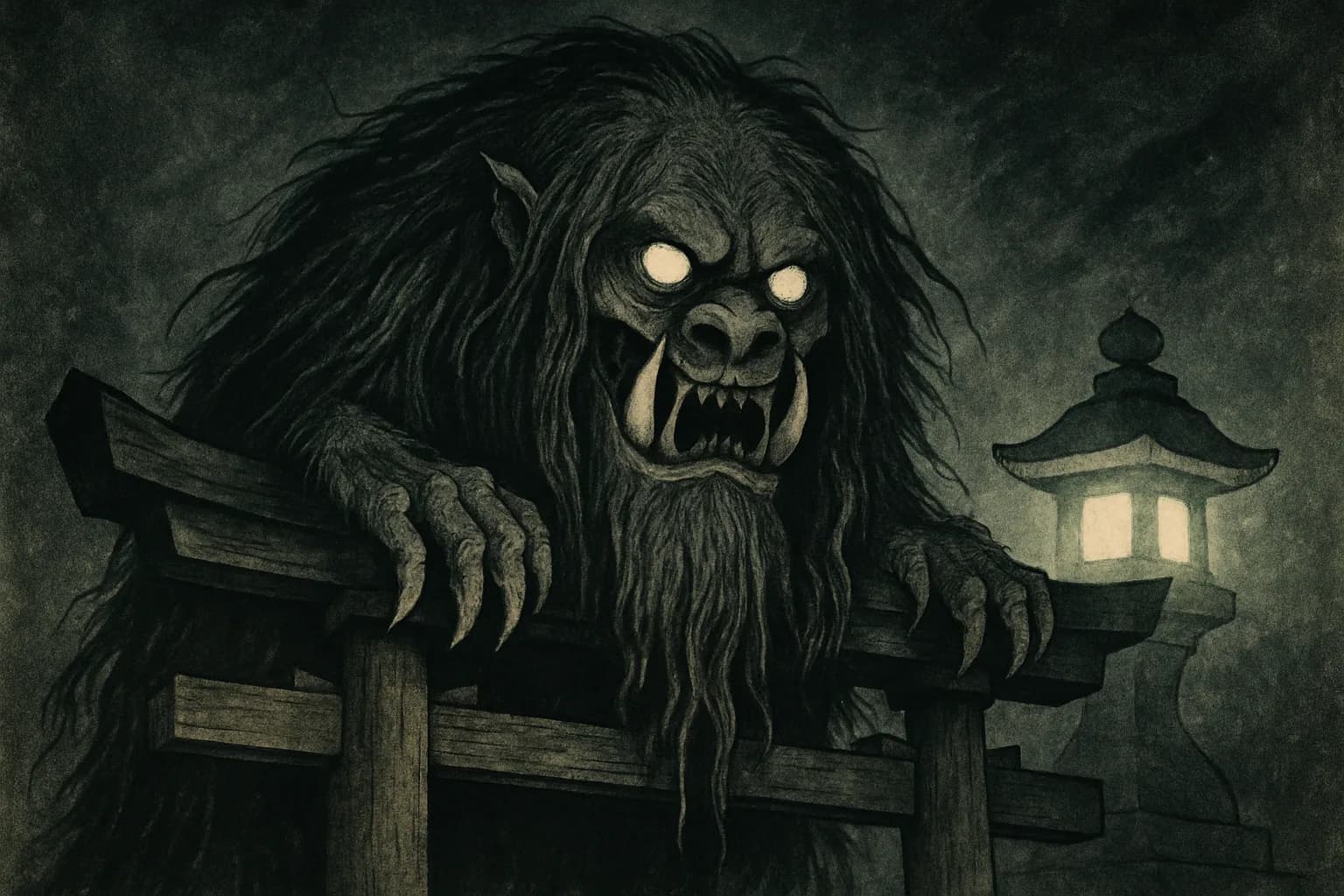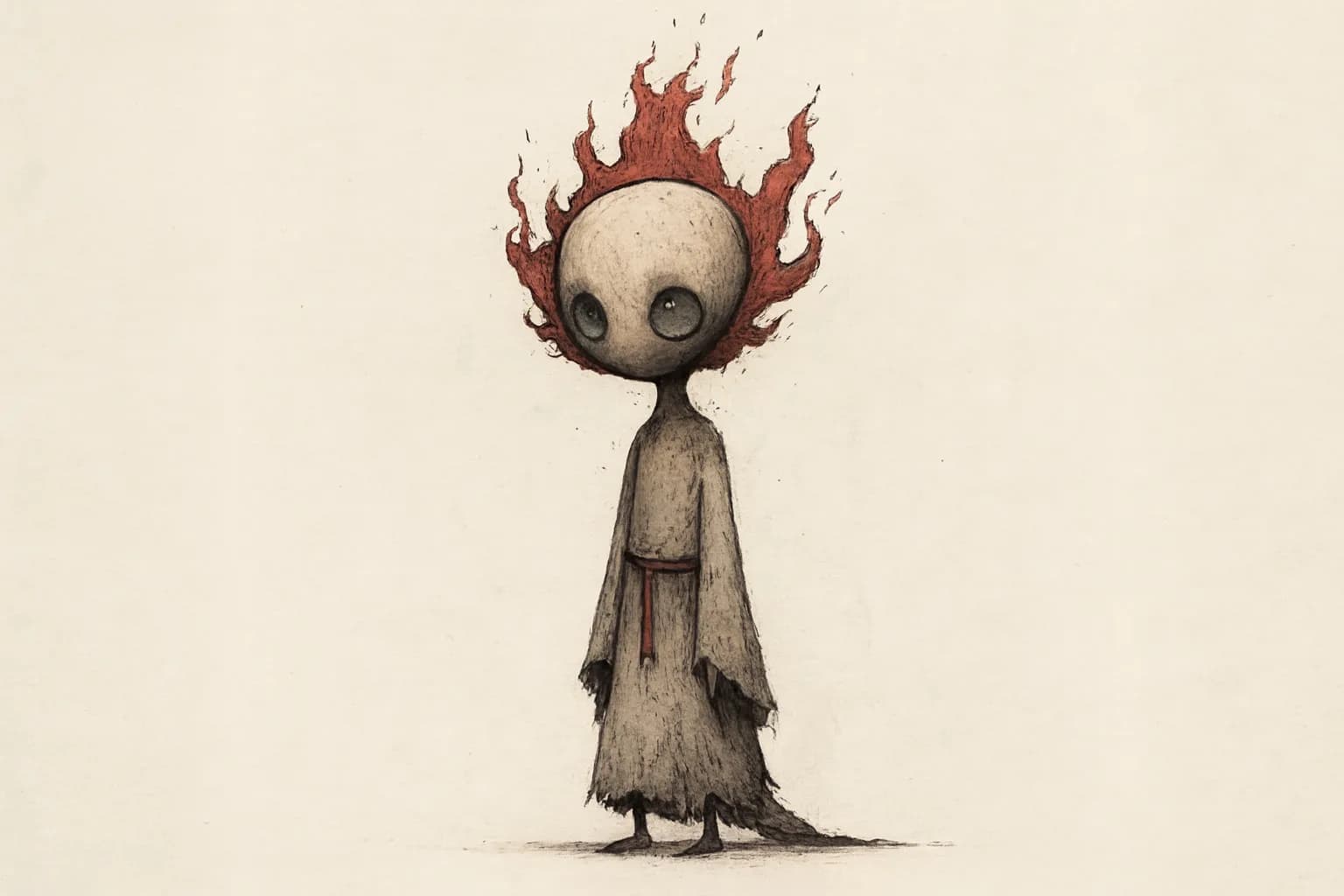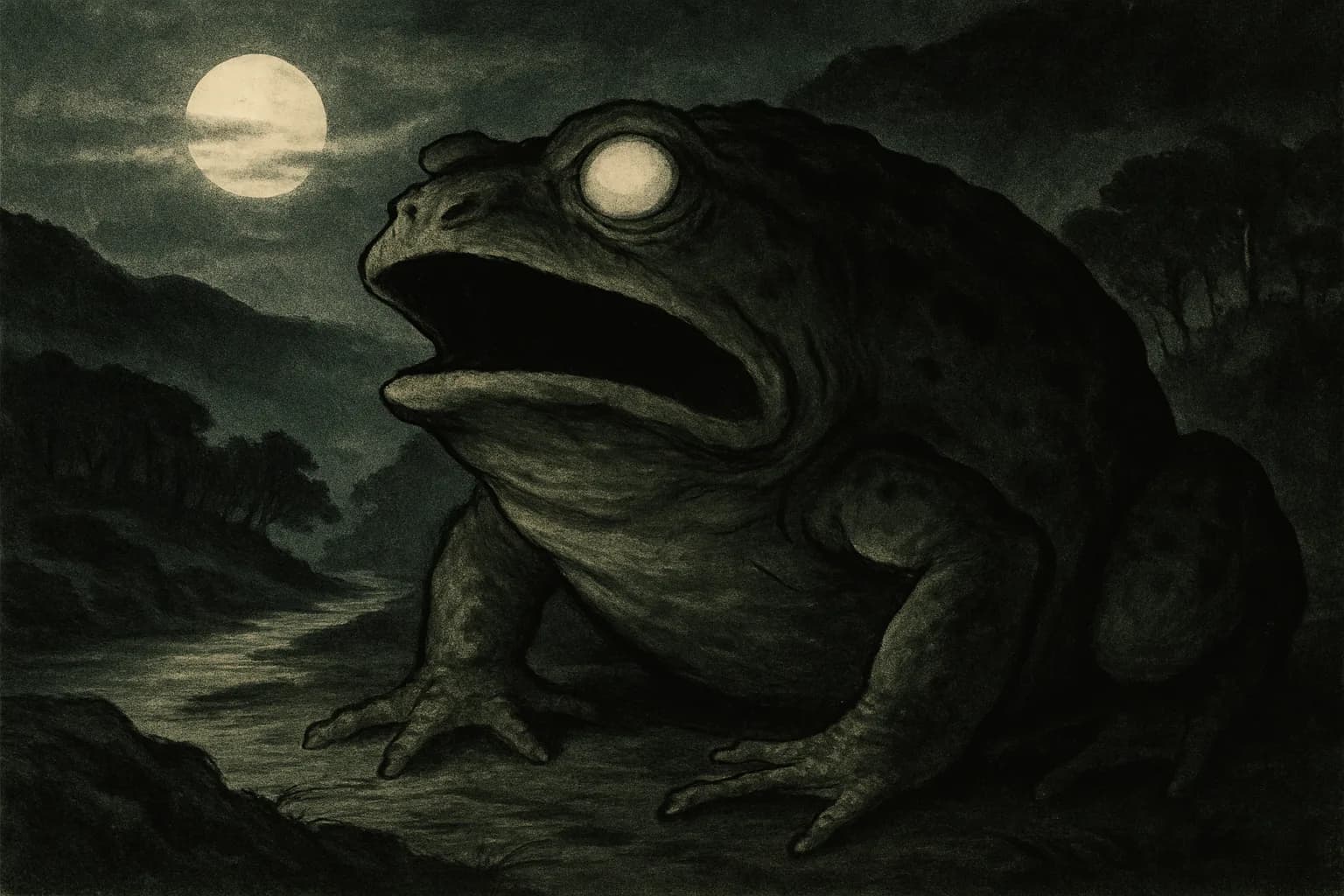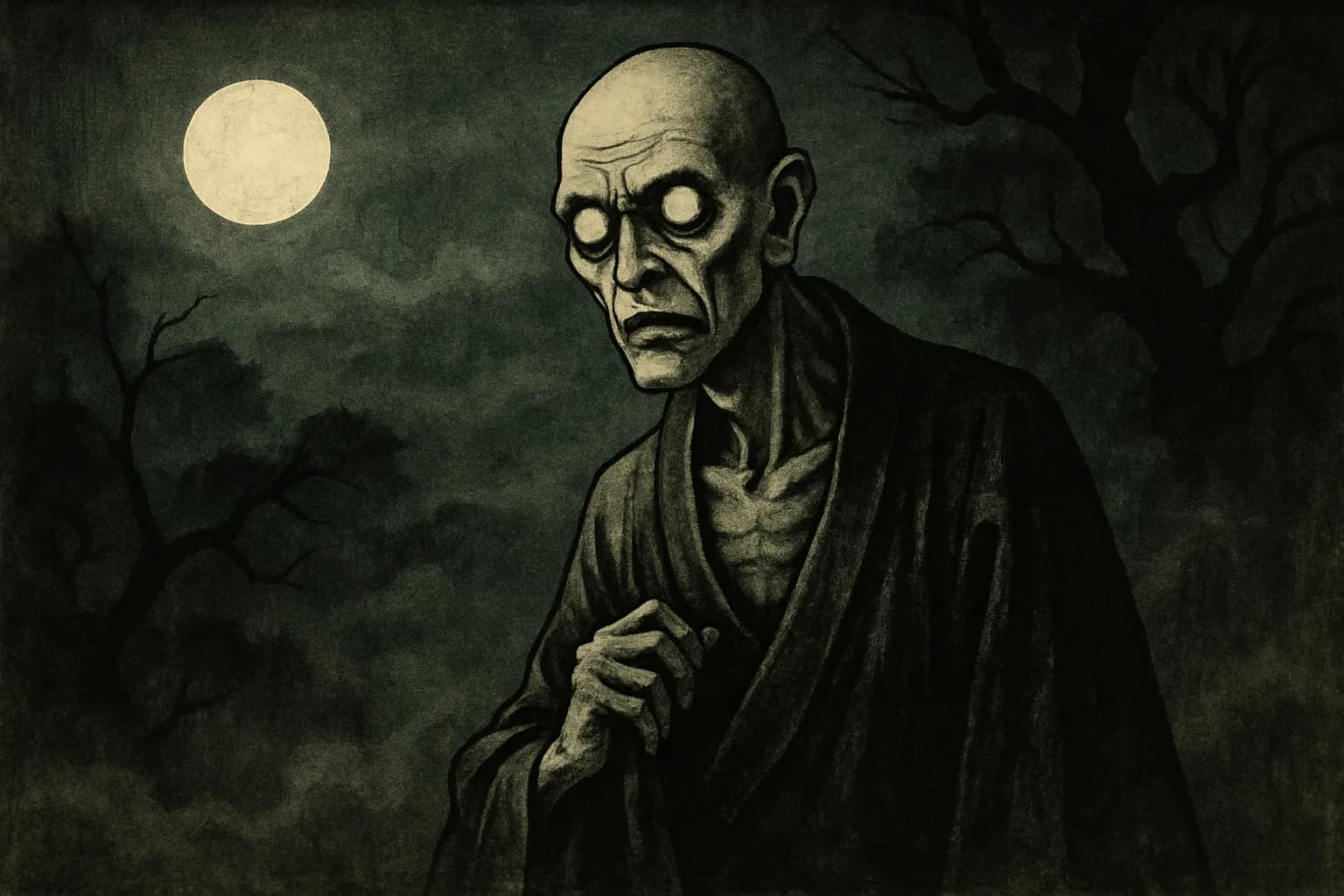
A traveler climbing a hill road after dark sees a figure ahead — a bald, robed man, unremarkable, standing where a stone marker or a stand of trees breaks the path. It's only natural to look up to see his face. That's the mistake. The moment your eyes lift, he grows. Look higher to keep his face in view, and he grows again, faster, until your neck is craned all the way back and the thing towering over you is no longer anything like a man.
This is mikoshi-nyudo, and the name is a warning built into the grammar: 見越 (mikoshi) means "to see over" or "to anticipate," and 入道 (nyudo) is the term for a lay Buddhist who has shaved his head and taken religious vows — a stock shape for many bald, monk-like yokai across the country. Put together, the name describes exactly what the creature does: it sees how far you'll look, and keeps getting ahead of your gaze.
What does it look like?
At first glance, nothing alarming — a shaven-headed man in a monk's robe, standing still on a road, bridge, or hillside at night. The transformation only starts once someone looks at him and, almost by reflex, tips their head back to take in more. Toriyama Sekien's 1776 print collection Gazu Hyakki Yagyo ("The Illustrated Night Parade of a Hundred Demons") includes an entry titled simply "Mikoshi," showing the figure half-swallowed by the shadow of a large tree. It's a matter of scale, not anatomy: the whole body is growing, not just the neck.
The trap of looking up
The danger isn't claws or teeth. It's vertigo. A person who keeps craning to follow the rising face eventually loses their balance and falls backward — and in the harsher village tellings, that fall is fatal, or the creature closes the distance while you're down and finishes the job. Some accounts describe a strangling grip; others simply have the victim found dead or half-mad from fright at the base of the hill the next morning. The mechanism is always psychological before it's physical: mikoshi-nyudo wins by making you keep looking.
How not to die
Japanese folklore, true to form, hands down a specific counter-move. If you catch yourself facing the thing, you're supposed to look at it the wrong way — from its head down to its feet, instead of feet up to head — which is said to sap its power to keep growing. Better still, say the word that gives the creature its name back to it: "mikoshita" (見越した), "I've already seen through you," sometimes chanted as "miage nyudo, mikoshita." Caught anticipating the anticipator, the monk is said to shrink and vanish on the spot. Some regions add calmer fixes. In Kanagawa, people said to calmly smoke a pipe; in Shizuoka, to measure its height. Either way, refuse to react — a creature built entirely on startling people has nothing left to do with someone who won't be startled.
Not one monster, but a type
Nearly every region of Japan has its own version of this stunt. On Sado Island in Niigata, villagers told of the miage-nyudo ("look-up monk"), who works the same trick on a night slope and knocks travelers over backward. Elsewhere the same behavior turns up under the names taka-nyudo, taka-bozu, nobiagari, and shidaidaka — different names, same lesson about a night road that keeps rising in front of you. Several regional accounts go further and claim the "monk" isn't a monk at all, but a tanuki, fox, weasel, or mujina that has taken the shape to hunt lone travelers, or even a mundane object — an abandoned paper lantern or a bucket left by the roadside — animated just enough to loom.
Where it comes from
The nyudo shape recurs across Japanese ghost lore — umi-nyudo out at sea, yama-nyudo in the mountains — a bald, robed figure that borrows the outline of a wandering priest and empties it of anything holy. Part of the unease is exactly that borrowed respectability: a tonsured stranger on a dark road was someone you were supposed to trust, or at least not challenge, and the yokai turns that expectation against the traveler. Folklorists have also connected the "grows the more you look" motif to a simple trick of night vision — a genuinely dark hillside gives almost no reference points, so a nearby, ordinary-sized shape can seem to swell as your eyes strain to resolve it. The story gives that optical confusion a face and a name.
Mikoshi-nyudo today
The size-shifting monk turns up as a recurring figure in Mizuki Shigeru's long-running GeGeGe no Kitaro franchise, where — true to the folklore — his signature trait is changing his own scale at will. On Iki Island, a rustling wara wara in the bamboo warns that it is near. You must say "Mikoshi-nyudo, minuita" ("I saw through you"), or falling bamboo will kill you.