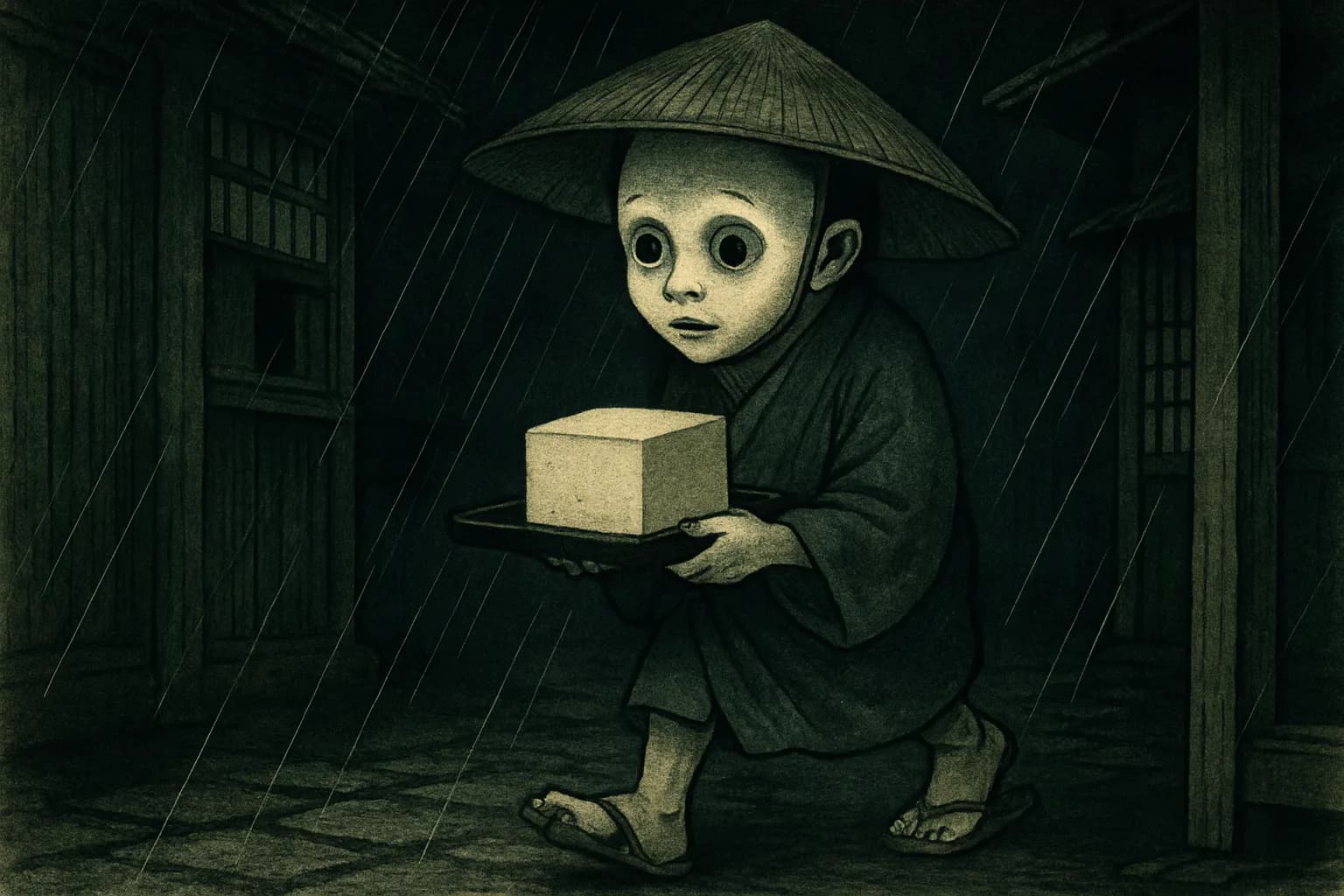
Walk an empty road at dusk in the old Kanto countryside and you might feel watched — not by two eyes, but by one. That single, unblinking eye belongs to hitotsume-kozo, a boy no taller than a ten-year-old, shaved-headed like a temple page, who steps out from behind a hedge or a stone marker just long enough to make a traveler's heart stop. He rarely does anything worse than that.
What does it look like?
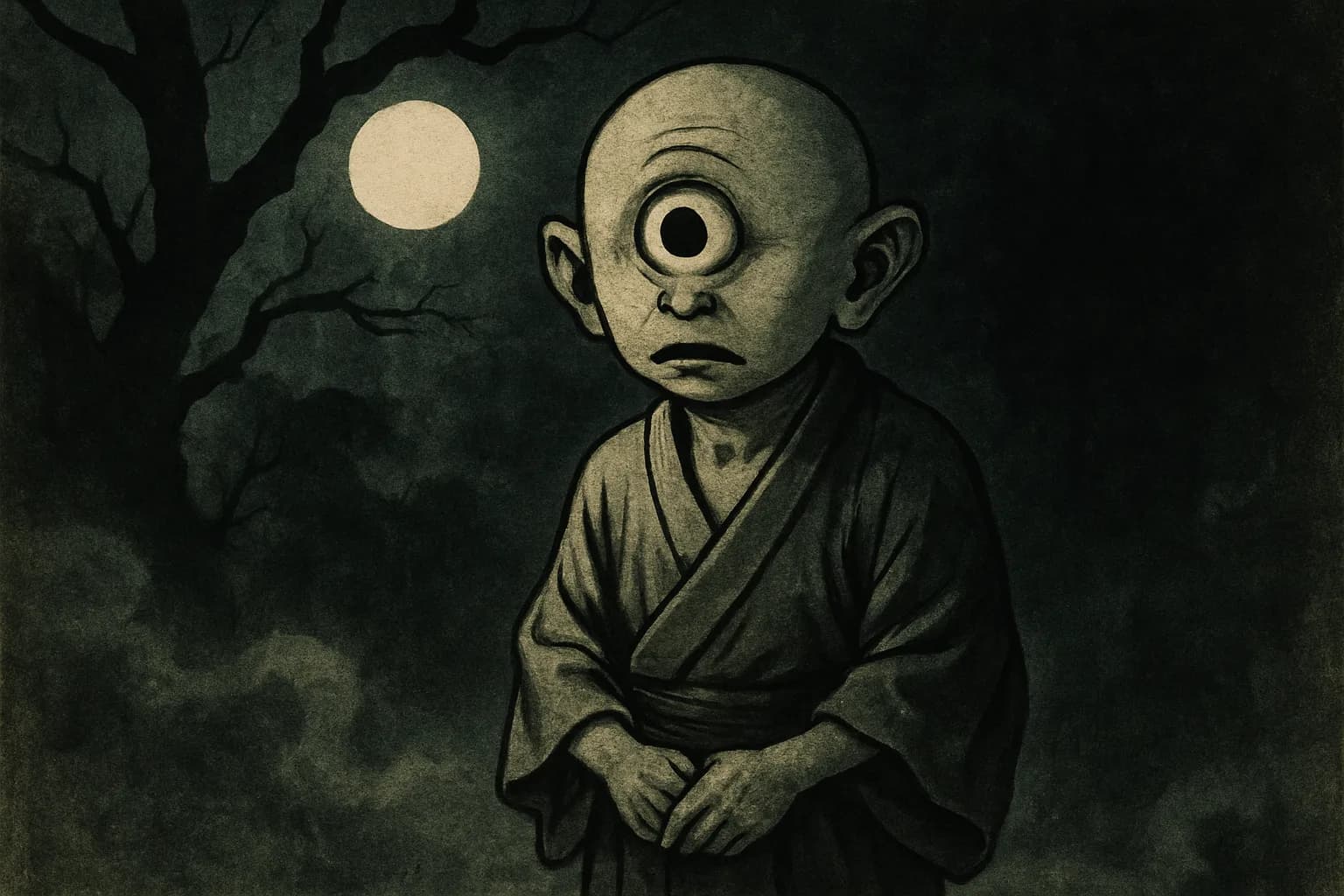
The name describes the creature exactly: 一つ目 (hitotsu-me, "one eye") + 小僧 (kozo, a young temple acolyte or errand boy). Accounts agree on the basics — child-sized, pale, dressed like a novice monk in a plain robe, with a single round eye set in the middle of a smooth face where a nose and second eye would otherwise sit. He shows up alone, usually at twilight or after dark, on roads, in front of temple gates, or loitering near a well.
Unlike many yokai, he rarely chases, grabs, or curses anyone. His whole method is the moment of eye contact — the jolt of realizing something is wrong with the face looking back at you.
A prankster, not a predator
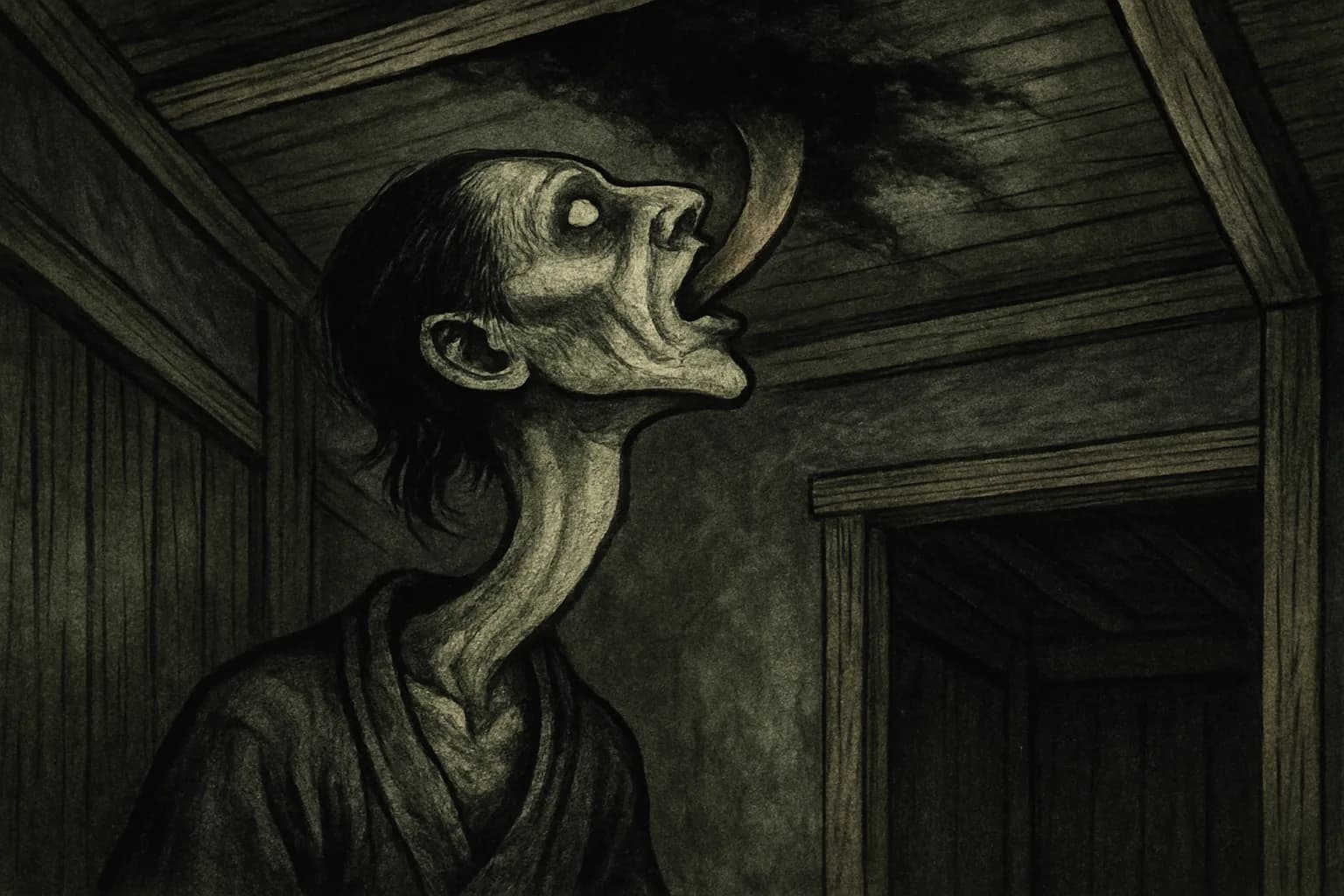
Folk accounts from Tokyo, Saitama, and the surrounding Kanto plain treat hitotsume-kozo as closer to a nuisance spirit than a genuine threat. He startles pedestrians, peers into windows, and vanishes before anyone can get a second look. Some tellings put him in the service of, or as a young attendant to, mikoshi-nyudo, the tall bald monk who grows taller the more you look up — as if the one-eyed boy were sent ahead to soften up a traveler before the bigger fright arrives.
The eye-basket at the gate
The creature's most distinctive folklore attaches to a real calendar custom still observed in parts of Kanto: Kotoyoka (事八日), marked twice a year on the 8th day of the second month and the 8th day of the twelfth month by the old calendar. On these nights, a one-eyed visitor — sometimes named directly as hitotsume-kozo, sometimes described as a wandering deity in similar form — was said to travel from house to house taking stock of each household's conduct.
To keep it from lingering, families hung a mekago (目籠) — an open-weave bamboo basket full of small holes — on a tall pole outside the gate. The reasoning given in village accounts varies: some say the one-eyed visitor, faced with a basket bristling with dozens of hole-"eyes," feels outmatched and moves on; others say it simply cannot resist stopping to count every hole, and gives up the house as too much trouble before it finishes. Either way, the many-eyed basket beats the single eye.
The ledger he carries
Some Kanto villages gave the one-eyed visitor a job, not just a face. On the 8th day of the twelfth month, he walks from house to house with a notebook. He writes down every fault he finds: a door left unlocked, a family behaving badly. Then he leaves the notebook with the dōsojin, the stone guardian god at the edge of the village. On the 8th day of the second month, he comes back to collect it. Some versions say he hands it to the god of plague.
So villages burned the notebook first. In Seya, in today's Yokohama, people built a temporary shrine for the dōsojin and burned it in the New Year bonfire. In parts of Izu, the dōsojin figure itself went into the fire at the January festival. When the one-eyed boy came for his notebook in the second month, it was gone, and the household's faults went unreported.
A boy who rolled up the scroll
The best-known Edo story comes from Kaidan Oi no Tsue, an 18th-century collection by Hezutsu Tōsaku. A man named Kojima Yakiemon, of Yotsuya in Edo, was waiting in a room of a samurai house in Azabu. A boy of about ten came in and began rolling the hanging scroll up and down.
Yakiemon told him to stop. The boy turned and said, "Keep quiet." His face had one eye. Yakiemon screamed and fainted. He spent about twenty days in bed. The household later told him calmly that this happened four or five times a year, and that the boy never did any real harm.
That is the whole character in one scene. He is rude, he is startling, and he is not dangerous.
Where it comes from
Before he had his modern name, he had a picture. Sawaki Sūshi's scroll Hyakkai Zukan (1737) draws a one-eyed figure and calls it Me-hitotsu-bō, "one-eyed priest." Later Edo monster scrolls repeat the figure under the same name. In the old northeast, people called him hitotsu-managu.
Why a temple boy? One theory points to Mount Hiei. Its legends tell of a one-eyed, one-legged monk, said to be a form of the great abbot Ryōgen. The boy's robe may be a small echo of that figure.
The folklorist Yanagita Kunio asked the deeper question: why one eye at all? In his essay "Hitotsume-kozō" and later in Yōkai Dangi (1956), he treated yokai as gods who had fallen from worship. In some regions, the mountain god was said to squint. People often described a squint as having "one eye." Yanagita also suggested that people chosen to serve a god were once marked by damaging one eye and one leg. A separate theory looks to iron-making: smiths who lost an eye from staring into the furnace, and the one-eyed smith god Ame-no-Mahitotsu. English pages often give that one to Yanagita, but his own argument was about the mountain god.
These are readings, not records. What is recorded is the pattern itself: one-eyed, one-legged spirits turn up across Japan, often near mountains, and usually at the edge of the year.
Hitotsume-kozo today
The eye-basket custom has not entirely disappeared. In pockets of the Kanto region, some households still put out a mekago or similar woven basket around Kotoyoka, a small, deliberate echo of a warning that once kept a one-eyed visitor from stopping at your door.