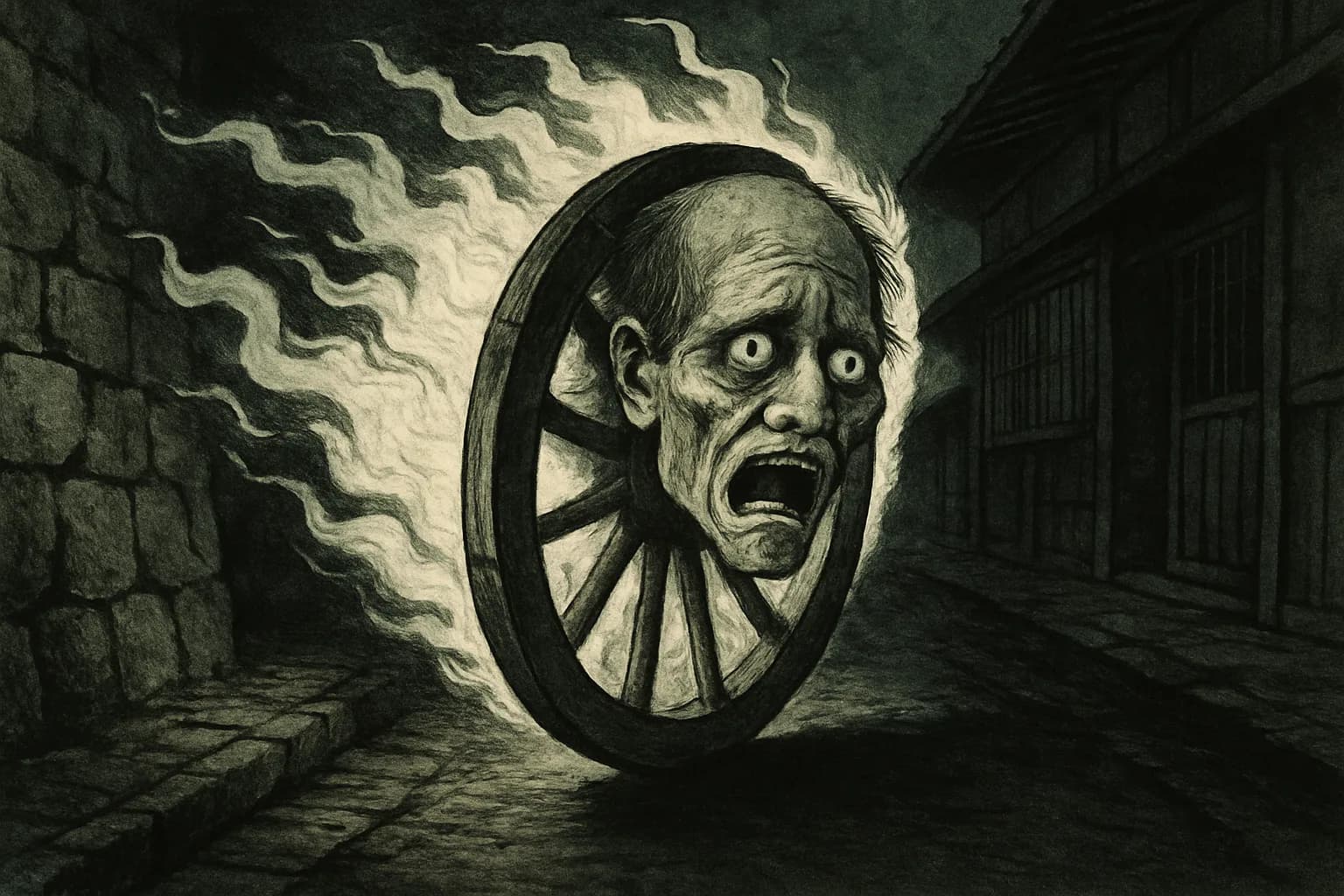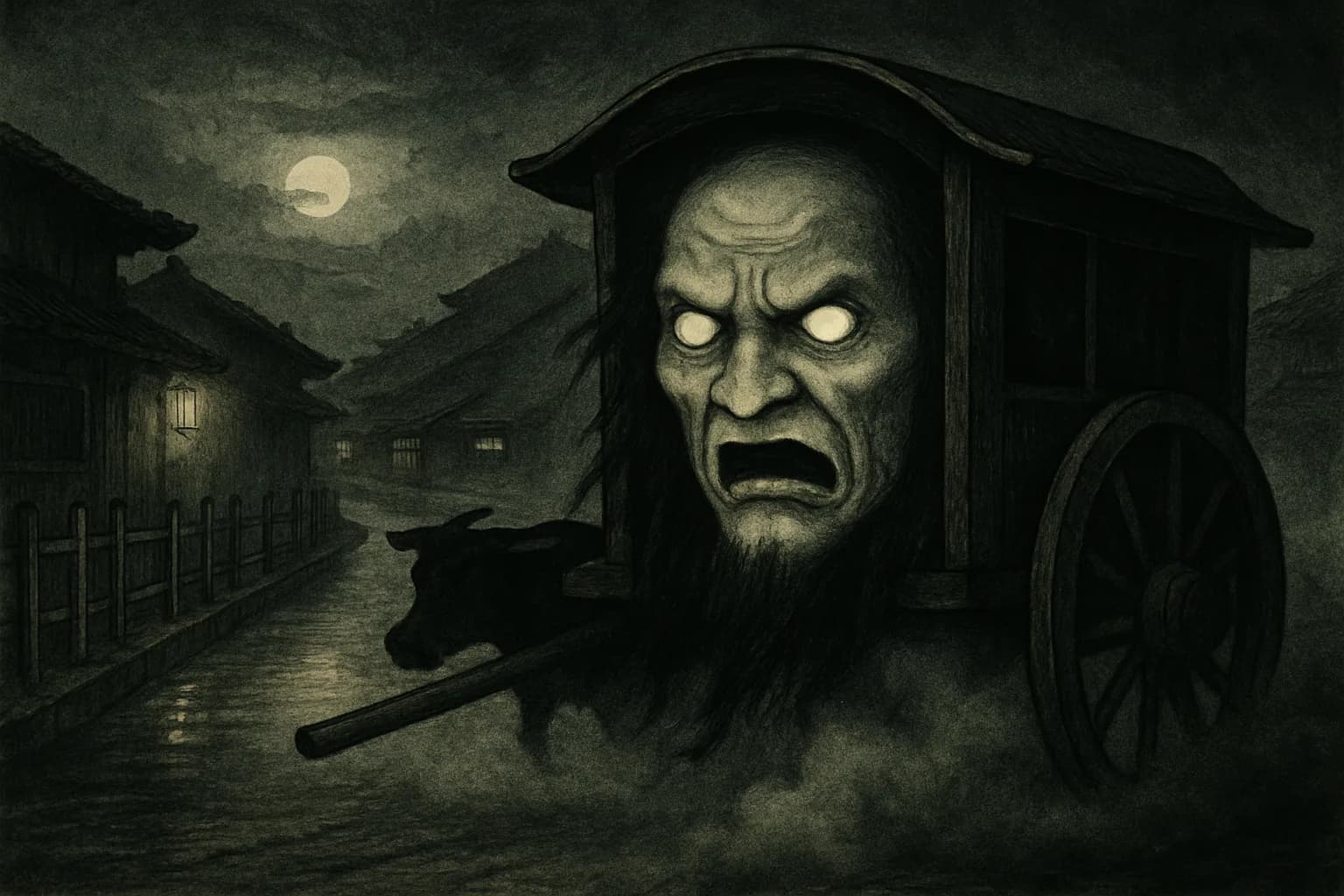
No ox pulls it. No driver sits at its side. And yet on certain nights in old Kyoto, when the moon burns through a low mist rather than shining clean, a gissha — the roofed, two-wheeled ox-carriage of the Heian aristocracy — rolls silently down an empty street. Its bamboo blinds are drawn back, and where a passenger's face should be, there is instead one enormous face, filling the whole frame of the window, watching the street go by.
What does it look like?
Toriyama Sekien drew Oboroguruma in his 1779 print collection Konjaku Gazu Zoku Hyakki ("The Illustrated Bestiary of Times Past, Continued"), rendering it as a half-transparent aristocratic carriage — the same style of vehicle nobles used for temple visits and festival processions — with a single grotesque, glaring face stretched across the space behind the blinds. The cart itself is otherwise unremarkable: no flames, no extra limbs, nothing overtly monstrous about the woodwork. The wrongness is entirely in the face and the emptiness around it — no ox in harness, no attendant walking beside the wheels, just the carriage advancing under its own power through the haze. Its name describes the setting more than the creature: oboro means hazy or indistinct, the word used for a moon seen through thin cloud, and guruma is simply "cart."
A grudge over parking spots
Heian-period ox-carts were rolling status symbols, and where one parked mattered enormously. At major events — none more so than the Kamo Festival, the spring procession honoring Kyoto's Kamo shrines — nobles competed openly for the best roadside viewing spots, and their attendants were not above shoving a rival's carriage aside to make room for their own. A carriage forced out of position, damaged, or exposed to public view was a genuine social humiliation for whoever sat inside it, and folklorists who study Oboroguruma read the yokai as that specific humiliation given a body: not fear of ghosts in general, but the very particular, very human sting of losing a public argument over where to stand.
The dispute Sekien pointed to
Sekien's caption for the print points at the most famous version of that scene in Japanese literature: the "carriage quarrel" from Murasaki Shikibu's Tale of Genji (early eleventh century). In the Aoi chapter, Lady Rokujō travels to the Kamo procession in a modest, unmarked carriage, hoping for a private glimpse of Genji among the marchers. The retinue of Genji's principal wife, Aoi no Ue, arrives afterward, and in the crush for space her attendants — not recognizing or not caring whose carriage they were dealing with — shove Rokujō's vehicle out of the way and damage it, exposing her to the crowd. The novel treats this public disgrace as one of the sparks that sends Rokujō's jealousy spinning out of her own control, until her resentment detaches from her and stalks Aoi as a living ghost. Oboroguruma's link to that scene appears to be Sekien's own addition, made centuries after Murasaki wrote it — less an illustration of the novel than a folk image borrowing its most recognizable grudge to explain a haunted cart.
Where it comes from
Carriage-shaped apparitions were already circulating in picture scrolls before Sekien worked them into his bestiaries, and some yokai researchers place Oboroguruma among the tsukumogami — objects that, given enough time or enough concentrated feeling directed at them, wake up. Here the "hundred years" of the classic tsukumogami story is compressed into a single unbearable night: the carriage doesn't need to age into a spirit, it only needs to absorb enough of its owner's fury. Read that way, Oboroguruma sits closer to a possession than a monster — a vehicle driven, forever, by an emotion its original rider could no longer contain.
Oboroguruma today
The design has had a modest afterlife in yokai-themed games that draw directly on Sekien's prints, including as an enemy encounter in Team Ninja's Nioh (2017), which rebuilds much of its Kyoto-era bestiary straight from the Edo-period source material rather than inventing new designs. It has never picked up the wider fame of its wheel-yokai relatives Katawaguruma and Wanyudo, and no plush version exists — it remains a niche entry, mostly known to readers who go looking specifically for Sekien's carriage pages, still rolling down a street named for a festival that ended over a thousand years ago.