In the Kōka district of Ōmi Province, a woman heard a wheel grinding past her house on the same road, night after night. She was warned not to look. She looked anyway — and found her own child gone, replaced by a voice from the wheel telling her to mind her own household before she went minding the road outside it.
What does it look like?
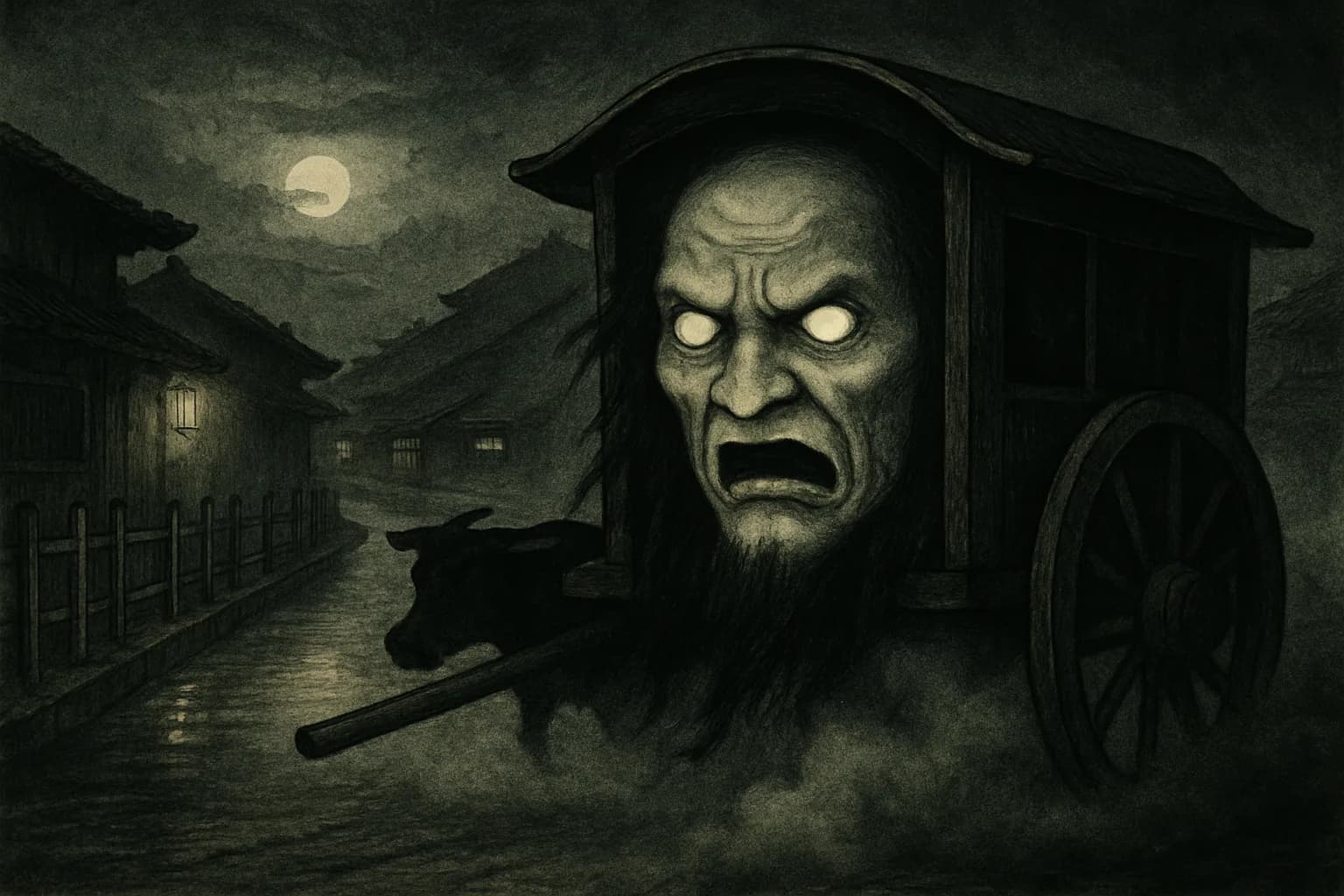
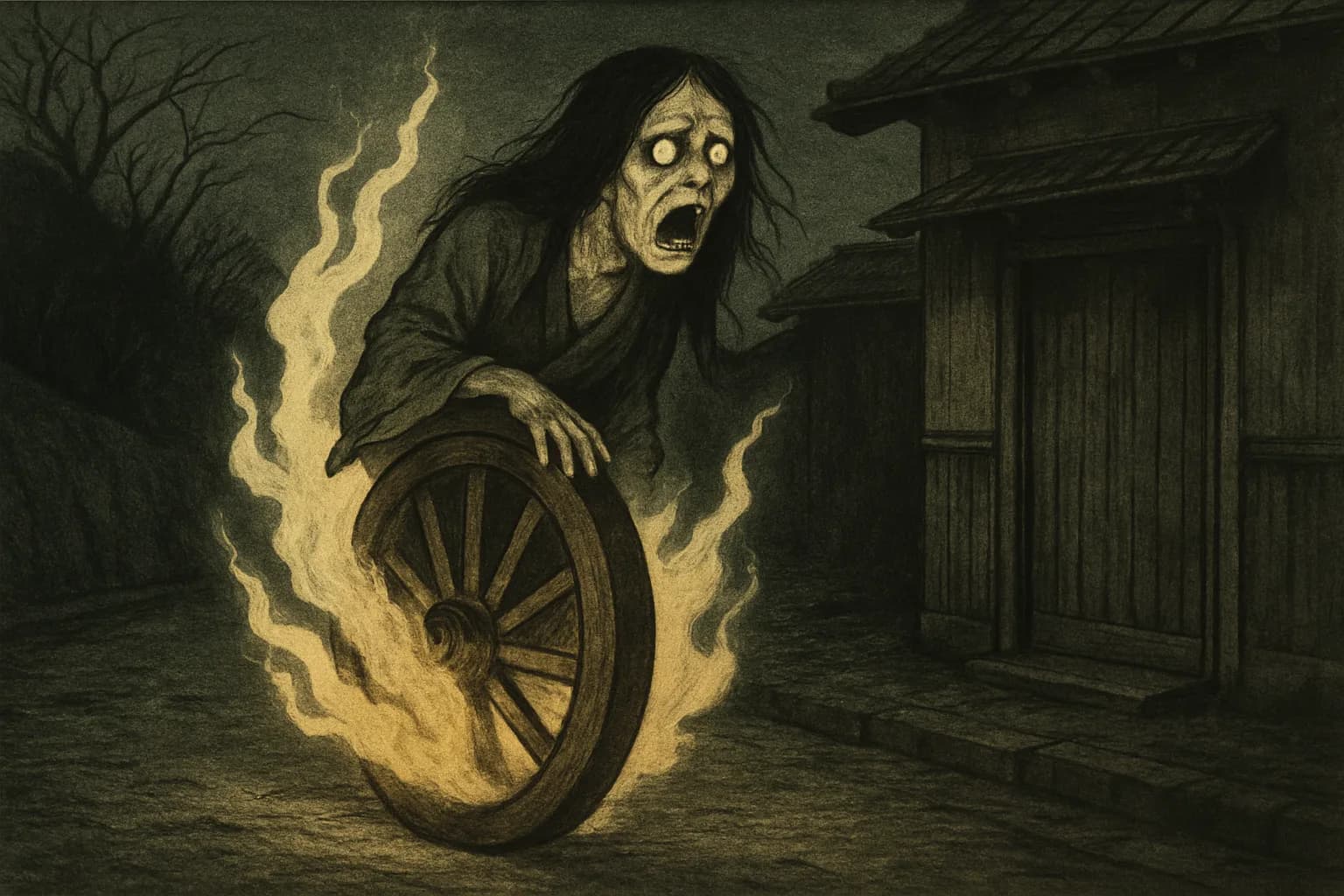
Katawaguruma is a single ox-cart wheel, wrapped in fire, rolling down a road with no axle, no cart body, and nothing pulling it. Where a rider would sit, a woman's upper body is fixed into the burning hub, her face somewhere between suffering and fury. The name is literal: katawa (片輪) means a lone wheel, one half of a pair with its match missing, and guruma (車) is simply cart. Early written accounts from the 1670s don't specify the figure's sex at all — it's the 1743 collection Shokoku Satobito-dan that fixes it as female, and Toriyama Sekien follows that version in his 1779 print collection Konjaku Gazu Zoku Hyakki, where the now-standard image comes from: a wheel on fire, a woman's face and shoulders at its center, moving alone through the dark.
The mother who looked
The best-known Katawaguruma story is a village tale from Kōka. A wheel could be heard passing along the road at night, and residents had agreed among themselves not to look at it, only to listen and let it go by. One mother broke the agreement, cracking her door open to see what was making the noise. What she saw was the flaming wheel with its woman's face — and it saw her back. Her child vanished from the house that same night. When the wheel returned, it spoke to her directly: she should have been watching her own child instead of satisfying her curiosity about a stranger on the road. Ashamed, the mother composed a poem of apology and posted it where the wheel would pass. On its next circuit, the yokai read the poem, relented, and gave the child back unharmed. It was never seen on that road again.
It's an unusually merciful ending for a yokai story — the creature punishes, then forgives a genuine change of heart, which is not a courtesy most Edo-period monsters extend.
An older, harsher sighting
A separate and earlier account places a version of the same figure on Higashi-no-Tōin, a street in Kyoto, during the Enpō era of the 1670s. This telling has no repentant ending. The wheel is described as objecting specifically to the city's habit of night-time gossip and idle wandering after dark, rolling through the streets as a warning against loose talk rather than as a test of any one household. Read together, the Kyoto and Ōmi tellings suggest a figure whose core threat — don't watch, don't gossip, don't go looking at what passes you in the dark — got reused across different towns with different morals attached, the way a ghost story migrates from neighborhood to neighborhood picking up local detail as it goes.
Where it comes from
Katawaguruma belongs to a small family of Kyoto-region yokai built from the wreck of the gissha, the roofed ox-carriage that marked aristocratic rank in the Heian court. Wanyūdō and Oboroguruma are its closest relatives — a flaming wheel with a monk's face, and a hazy carriage with a giant staring one — and all three read as versions of the same idea: an object of status and privilege, stripped of its owner, its ox, and its dignity, condemned to keep moving forever. Where Wanyūdō's torment is generic and directed at anyone who meets its eyes, Katawaguruma's stories consistently attach themselves to watching — specifically, to women who look when they've been told not to, and who are then made to answer for a lapse in duty at home. Folklorists who study these tales generally read them as cautionary fiction aimed at exactly that audience, using the wheel's menace to enforce a mother's proper attention rather than to punish curiosity in the abstract.
Katawaguruma today
Katawaguruma has never developed anything close to Wanyūdō's visibility. There's no widely circulated modern illustration style built around it the way there is for the burning-wheel monk, no recurring video-game boss, no toy. What survives is almost entirely the written record: Sekien's print, the handful of Edo-period story collections that carry the Kōka legend, and the yokai encyclopedias that keep both alive for readers who go looking. It remains, more than most of its contemporaries, a story you have to read rather than one you're likely to bump into casually — appropriately enough, for a yokai whose whole plot turns on someone looking at something they were told to leave alone.