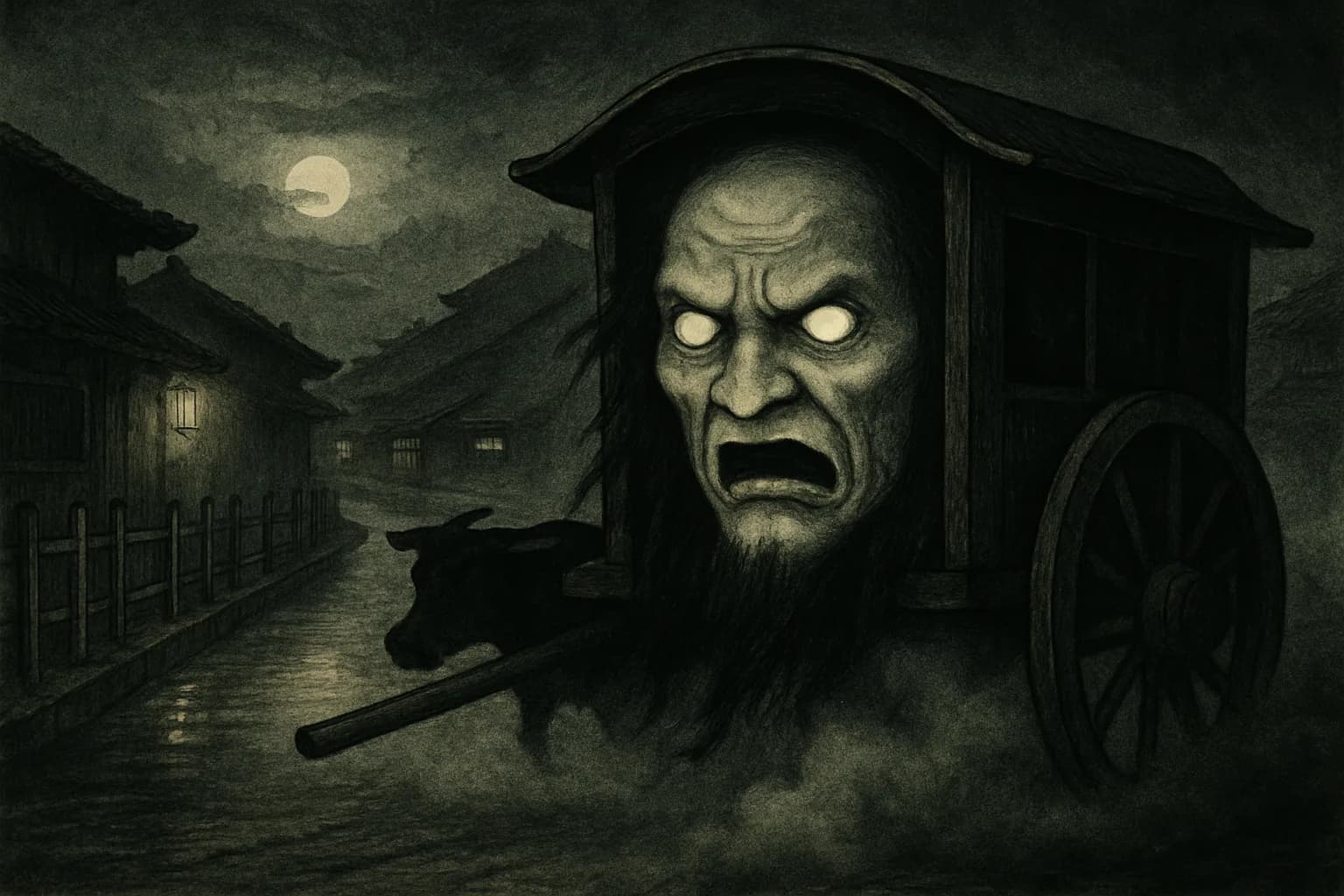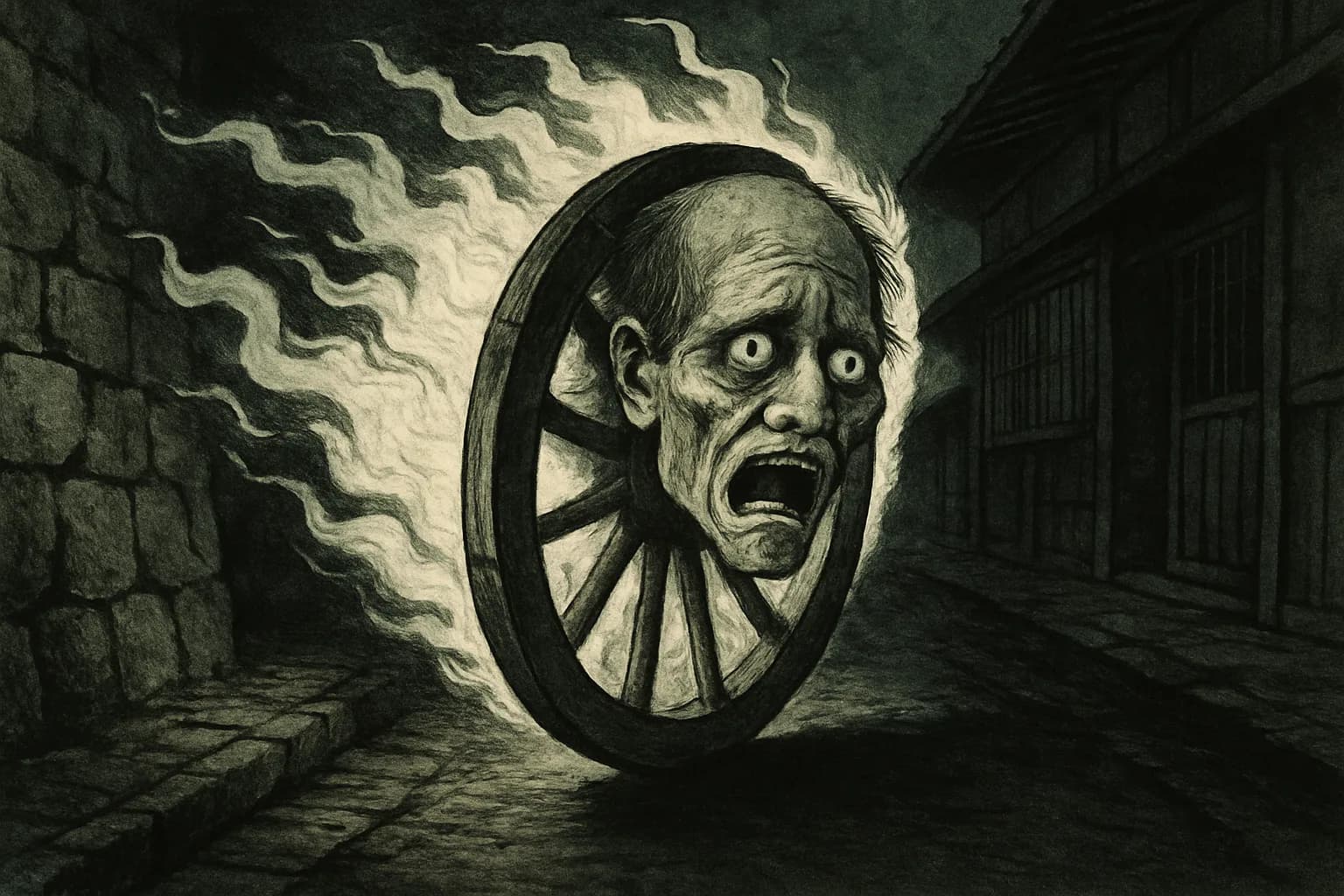
A traveler on a Kyoto road at night hears it before seeing it: a low, grinding rumble, growing louder, with no cart and no ox anywhere in sight. Then it turns the corner — a single wooden wheel, wreathed in fire, rolling on its own. At its hub, where the axle should be, is a man's face, twisted into a permanent scowl of rage and suffering. This is Wanyudo, and if it looks at you, tradition says you or someone you love will die soon after.
What does it look like?
Toriyama Sekien drew Wanyudo in his 1779 print collection Konjaku Gazu Zoku Hyakki ("The Illustrated Bestiary of Times Past, Continued") as a large cart wheel engulfed in flame, a bald, glowering monk's head fused into its center where the hub would sit. It has no body, no cart, no ox to pull it — just the wheel itself, propelling forward through the dark on burning spokes. The face is male, shaven-headed like a Buddhist priest, and locked in an expression of torment rather than malice for its own sake, as though the suffering came first and the menace afterward.
A wheel that steals what it sees
The core legend is simple and cruel: Wanyudo rolls down roads at night, and anyone who meets its gaze either dies shortly after or has their soul torn from their body on the spot. Some versions have it demanding that a house shutter its gate against it, on pain of dragging a family member off in its place. Villages along routes said to be haunted by Wanyudo kept their doors barred after dark and their children inside, less because of a specific ritual defense than out of the plain rule that the wheel is not to be looked at.
Wanyudo belongs to a family of yokai built around ox-carts, or gissha, the ceremonial vehicles used by Heian-period nobility. Its close relative Katawaguruma — "the one-wheeled cart" — appears in a nearly identical role, sometimes described as a wheel bearing the upper body of a naked woman rather than a monk's face, and folklorists have long treated the two as regional variants of the same idea rather than separate creatures. Kasha, the flaming cart-beast that snatches corpses from funerals, shares the same burning-wheel imagery and sometimes the same illustrated page.
Where it comes from
Wanyudo is generally read as a punished-monk story. One account tied to the town of Nabari in Iga Province holds that a feudal lord who abused his power was reborn as this wheel of flame — a man who governed cruelly in life set spinning forever after death, his face fixed in the anguish of it. That reading fits a wider pattern in Buddhist-inflected folklore, where the burning wheel recalls images of karmic suffering and endless, cyclical punishment, repurposed here into a roadside monster rather than an abstract teaching. The ox-cart itself was a mark of aristocratic status in the Heian court, and a wheel that has outlived its cart, its ox, and its rider reads easily as a symbol of that world's arrogance rolling on after everything else has burned away.
Wanyudo today
Wanyudo has had a long afterlife as one of the more recognizable "burning wheel" images in Japanese horror and fantasy art, and the flaming-wheel-with-a-face design shows up periodically in yokai-themed video games and illustrated bestiaries that draw directly on Sekien's print. It has never developed the mascot-friendly softening that happened to creatures like the kappa or tanuki — there is no cute Wanyudo plush — and it remains, largely, exactly what Sekien drew: a wheel on fire, a face that should not be looked at, and a road with nothing else on it.