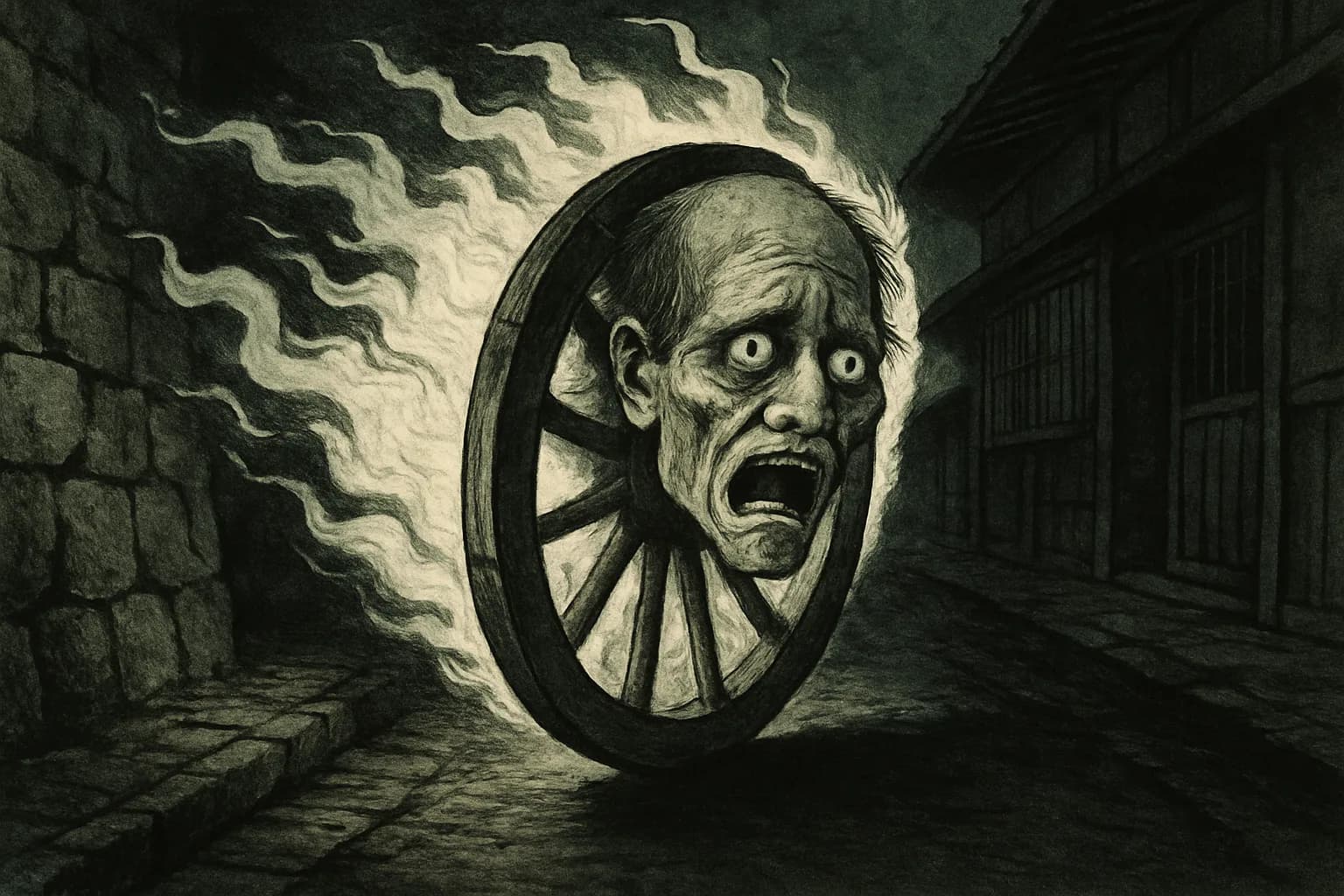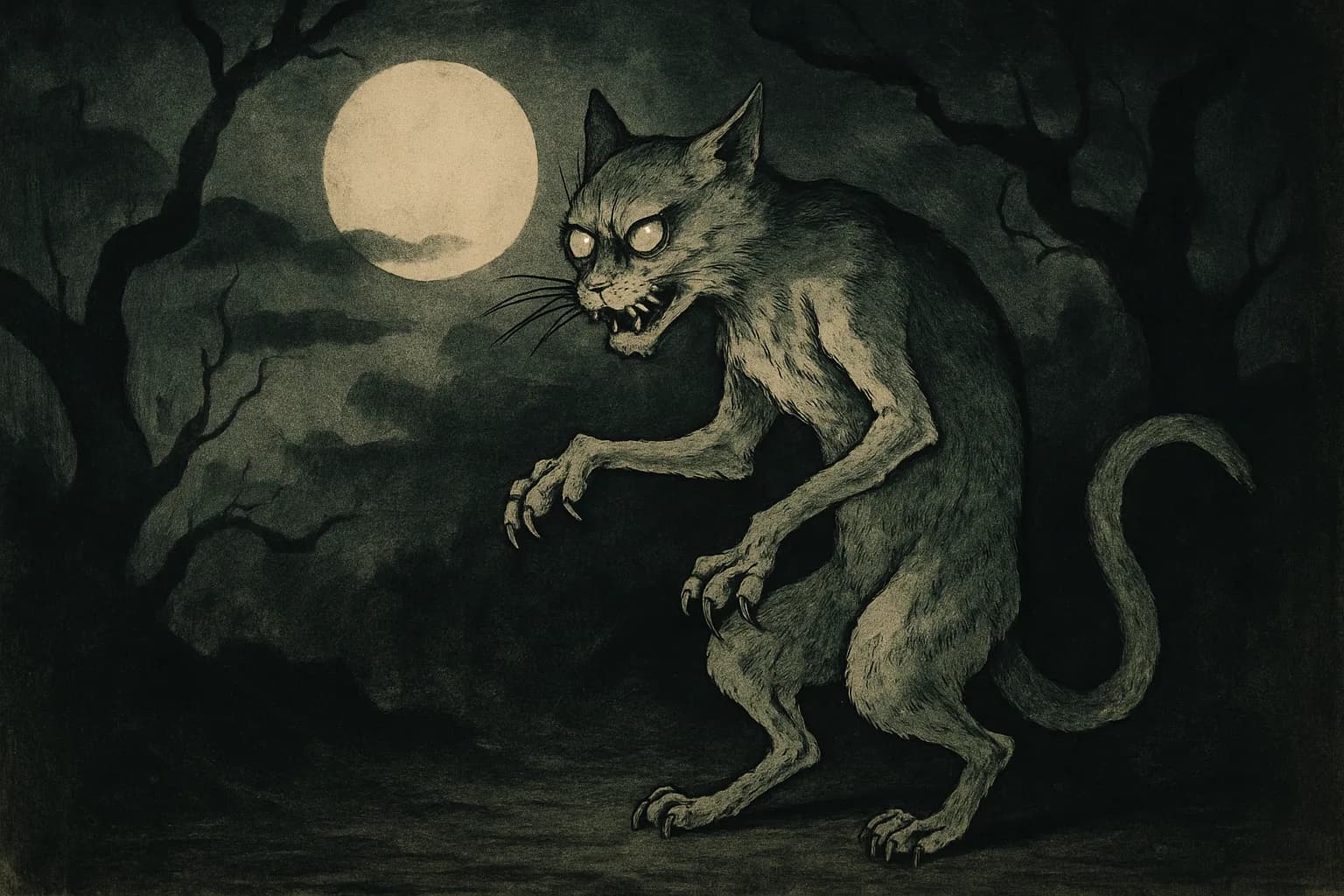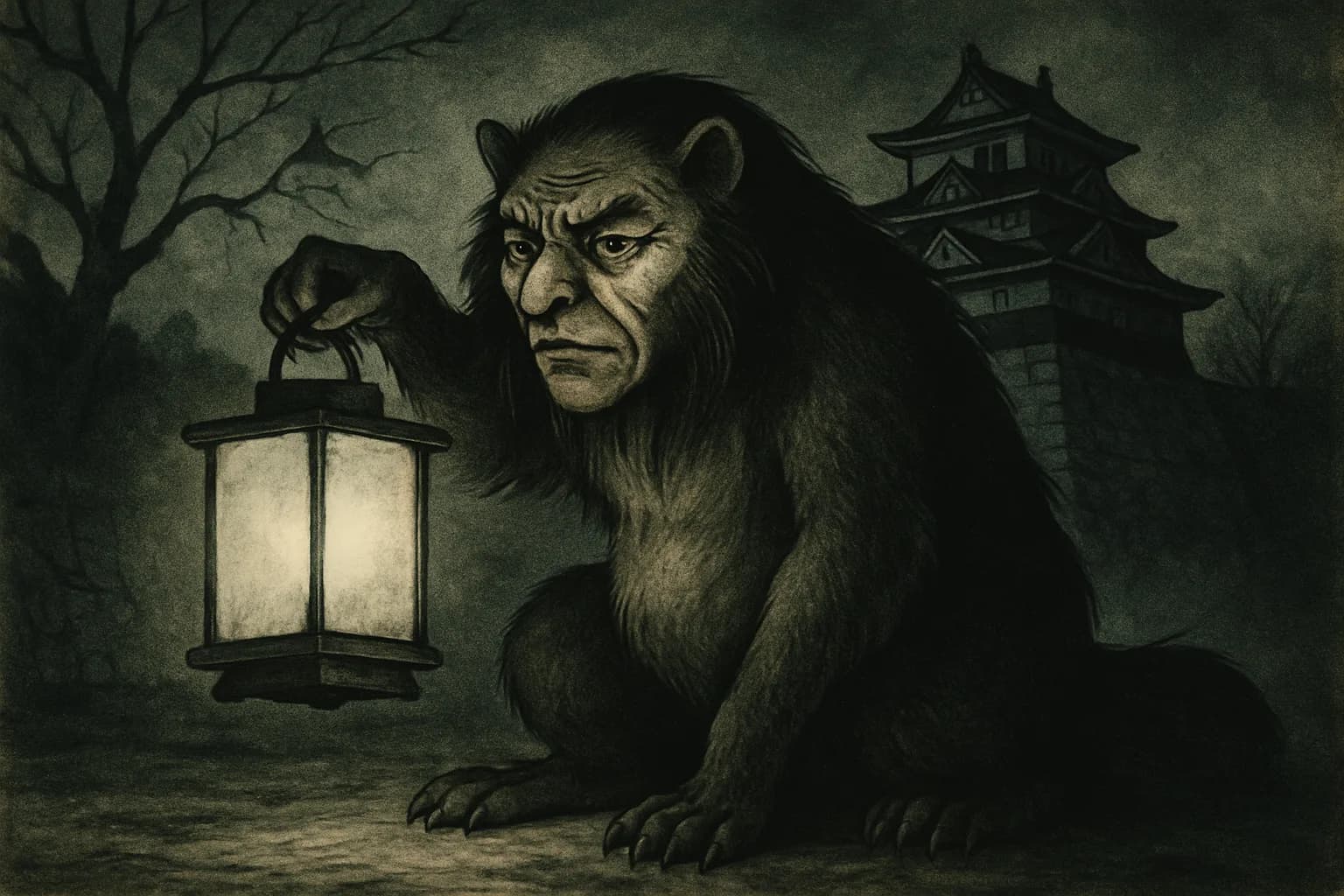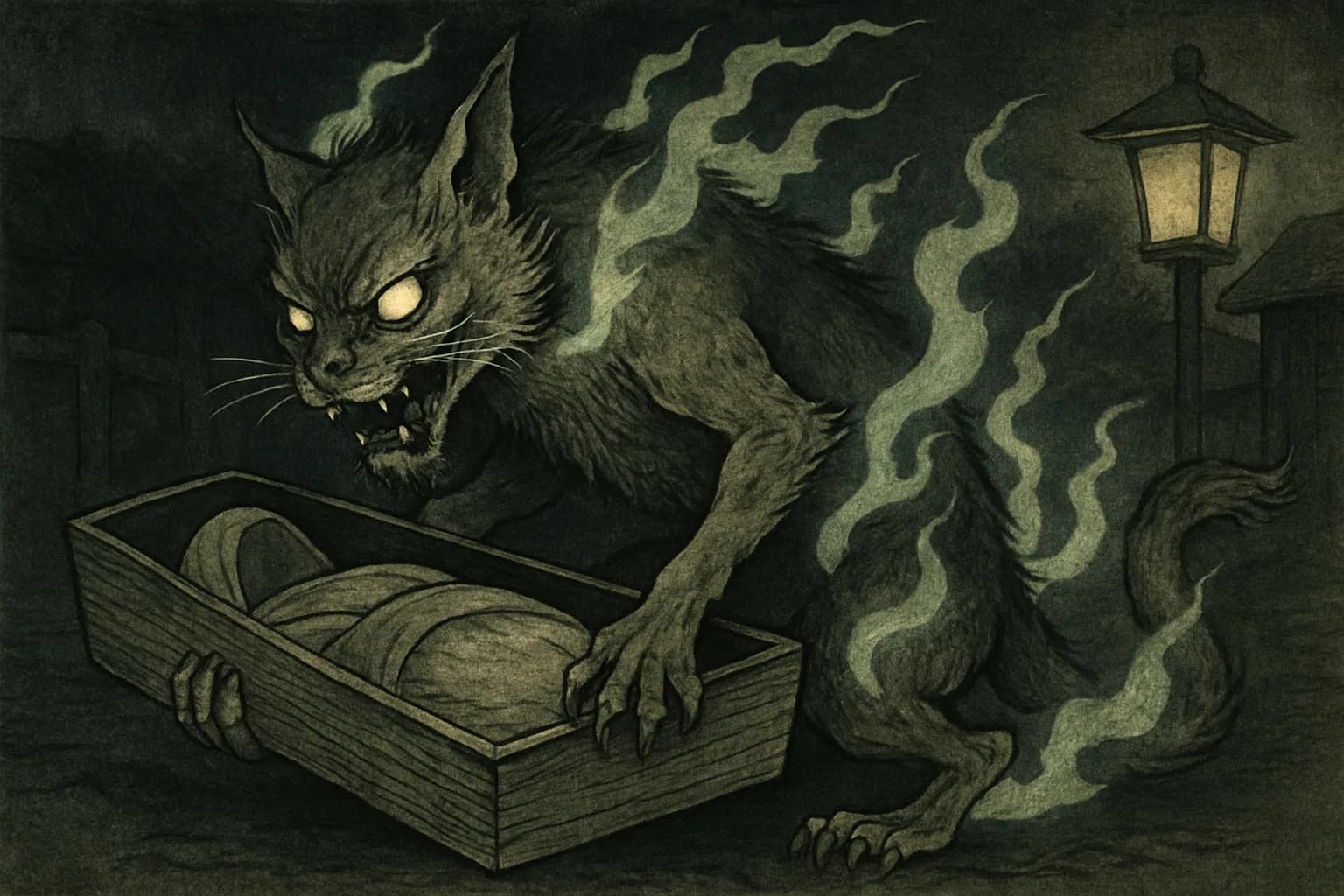
A funeral procession in old Japan was never entirely safe. Between the moment a person died and the moment their body was sealed in the ground, mourners kept watch, because a corpse left unguarded could draw the attention of the kasha — the "fire cart" — a burning, cat-faced thing said to plunge from a black cloud, rip open the coffin, and haul the body off before the priests could finish their sutras.
What does it look like?
Accounts describe the kasha as a monstrous cat or cat-demon wreathed in flame, sometimes riding or dragging a burning wheeled cart, sometimes appearing as the cart itself, spokes alight, rattling down from the sky. Toriyama Sekien drew it this way in his Konjaku Hyakki Shui (1781), a rear view of a flaming, wheel-legged creature reaching into an open coffin with a corpse's leg still visible inside — one of the starkest images in his whole catalogue of yokai. The name itself, written 火車, is borrowed from a Buddhist term for the burning cart that ferries sinners to hell, and folklore fused that idea directly onto a cat.
A funeral thief with a moral
The kasha did not come for everyone. It came, tradition held, for the wicked — those who had lived cruelly, cheated their neighbors, or died unrepentant. Storm winds and sudden darkness over a graveyard were read as warning signs that a kasha was near, and mourners would hear a clatter like cartwheels and a low, cat-like yowl moments before it struck. In some tellings it simply snatched the corpse and vanished; in others it left the body torn apart, a punishment made visible for everyone at the funeral to see.
This is why Edo-period funerals kept a strict vigil: someone stood watch over the coffin at all times, incense burned continuously, and mourners avoided leaving a body alone even for a short walk to fetch water. A kasha attack was less a random horror than a kind of folk justice — proof, to a village, that the dead man's debts had finally come due.
The old cat behind the fire
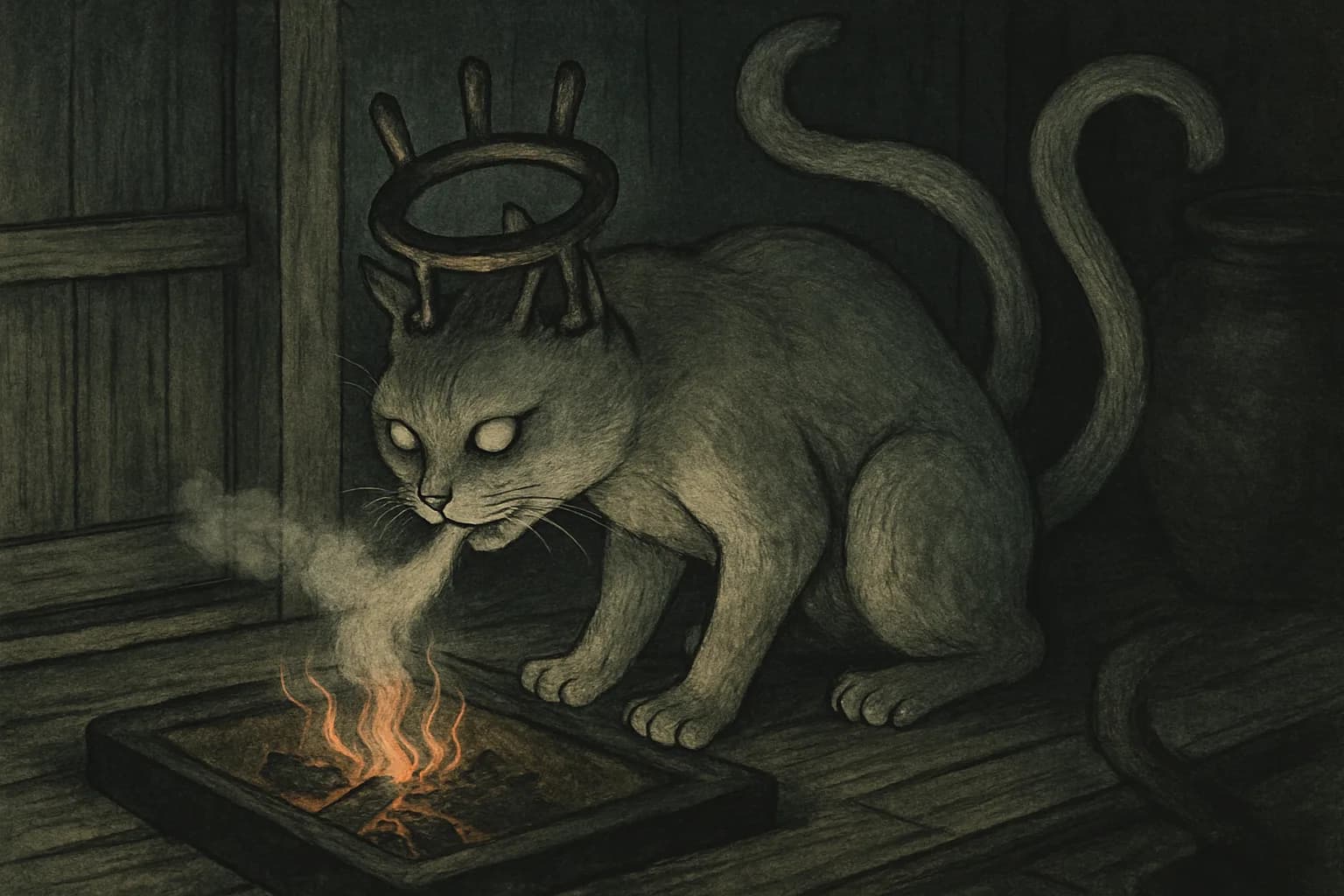
Most folklorists trace the kasha back to the nekomata, the forked-tailed cat that grows monstrous with age, and to a wider belief that a cat allowed to live too long, or one that leaps over a corpse, can reanimate the dead or steal it away. Village households killed or gave away cats that had lived unusually long lives specifically to avoid this fate. Over time the corpse-stealing cat and the Buddhist hell-cart merged into one figure: a monster that was both an animal grown sinister with age and an agent of otherworldly punishment.
How mourners fought back
Folklore gave funeral parties real countermeasures, not just fear:
- A sword laid across the coffin. A blade placed on top of the casket, edge up, was believed to bar a kasha from reaching in.
- Unbroken vigil. Mourners took shifts so the body was never left alone between death and burial — the single most consistent defense across regional accounts.
- Loud recitation of sutras. Continuous chanting was thought to keep the kasha at bay long enough for the burial to finish.
None of these were treated as guaranteed. A kasha that wanted a particular corpse badly enough, the stories imply, would eventually get it — the rituals bought time, not certainty.
Where it comes from
The kasha sits at the intersection of two much older ideas: the aging housecat as a source of supernatural danger, and the Buddhist image of hell's burning chariot arriving to collect the guilty. Japan's folk imagination rarely separated animal and punishment cleanly, and the kasha is one of the clearest results — a monster that is simultaneously a predator, a portent, and a verdict on how someone lived.
Kasha today
The kasha appears far less often in modern media than its cousin the bakeneko, but it survives in regional funeral customs and in scholarly retellings of Edo kaidan (ghost story) collections, and Sekien's original woodblock print is still reproduced in books on yokai art as one of the more unsettling entries in his bestiaries. Some rural areas retained the custom of placing a blade on a coffin lid well into the twentieth century, a habit whose original purpose — keeping a burning cat-demon from the dead — long outlived general belief in the creature itself.