A monkey that has lived too many years for any monkey. A hen that has lived too many years for any bird. In the old villages of Iwate and Aomori, enough age was its own kind of transformation. The animal did not die of old age. It became a futtachi — something stronger and stranger, no longer bound by what it used to be.
What does a futtachi look like?
A futtachi starts life as an ordinary animal. The old accounts name monkeys and hens most often. What marks it as a futtachi is not a fixed shape. It is age: the animal has lived for years far past any normal lifespan for its kind.
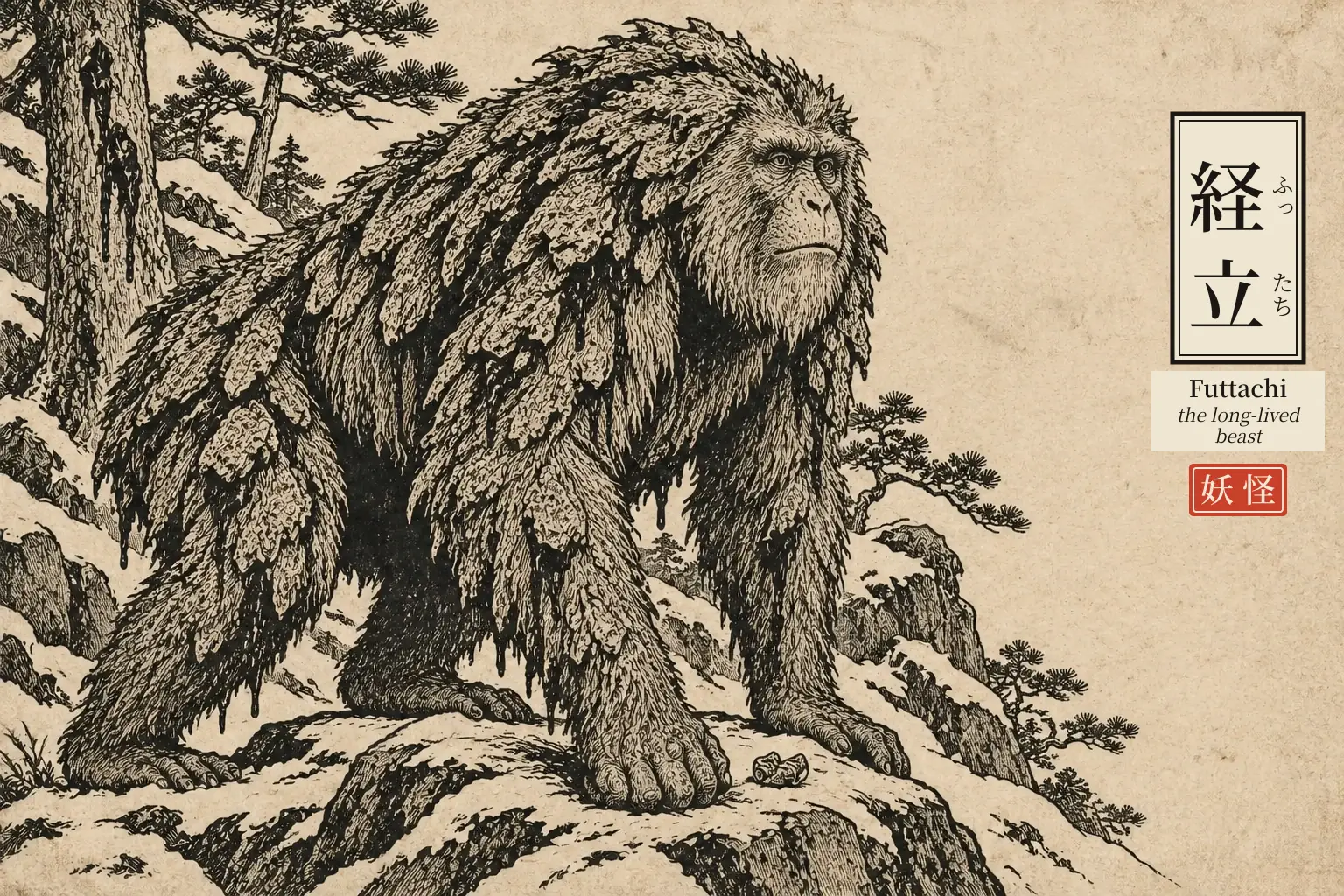
The monkey-type futtachi gets the clearest description. Its fur is said to harden with pine resin and sand, packed on like armor. A bullet could not get through it.
A futtachi does not always keep its original shape, either. One story turns a giant cod into a handsome man who walks into a village at night — a case where the age itself unlocks a change the animal's body never shows.
経立 is read as a whole: futtachi. The two characters hint at a meaning rather than spelling one out exactly. 経 can mean "to pass" or "to elapse," and 立 can mean "to stand" or "to become." Put together, they suggest time passing until something new stands up — a reading no single source confirms directly, but one the name invites.
The monkey that steals women
The earliest written record we found is Yanagita Kunio's Tōno Monogatari (1910). It places part of the legend around Kurihashi, once a village in Kamihei District and now part of Kamaishi City, Iwate. Yanagita recorded futtachi said to come from both dogs — or wolves — and monkeys.
The monkey futtachi has the fullest written record. Its armor of resin and sand made it almost impossible to kill. It was said to like human women, and to carry them off from villages. The phrase "the monkey futtachi is coming" was used to frighten children in places where the story was told.
The hen that killed her own household's children
A second account comes from Akka, once a village in Shimohei District and now part of Iwaizumi, also in Iwate. It was collected by a folktale research group from Kokugakuin University. A hen kept by one household is said to have lived long enough to become a futtachi. She held a grudge: the family had been eating her eggs. Once she had changed, she began killing the children born into that same household, one after another.
The source gives no reason the family kept her once the deaths began, and no ending to the story. It survives as a single grim fact about what happened in that house.
The cod that posed as a suitor
A third story, also set in Akka, turns the transformation toward courtship rather than revenge. A strikingly handsome man started visiting a young woman's home every night. He was so good-looking that people around her suspected he might be a monster.
They told the woman to test him. Next time he came, she was to wash his feet in water that had been used to boil adzuki beans. She did, and the man suddenly turned ill and left. The next morning, a large cod washed up dead on the shore nearby. People said the dead fish was the same creature. It had been a cod futtachi all along, wearing a human face to court her.
Where it comes from
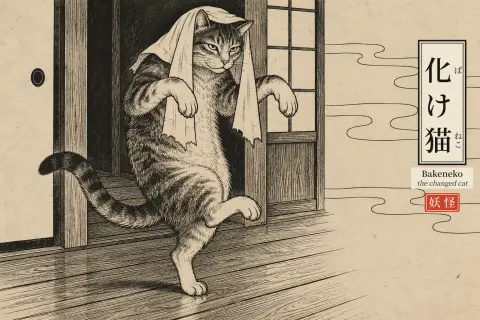
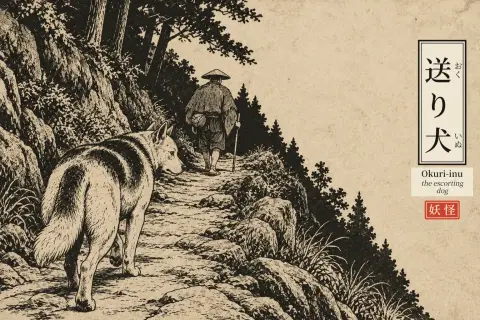
Japanese folklore keeps a whole shelf of animals that cross into something else simply by growing old. The nekomata is a cat whose tail splits in two with age. Its milder cousin, the bakeneko, gains a human voice the same way: by outliving the years a cat is supposed to get. The okuri-inu, a dog or wolf that trails a traveler on a mountain road at night, comes from the same Tōhoku countryside and the same unease about what an old animal in the forest might have become.
What ties the futtachi stories together is not one shape. It is a rule. In these mountains, enough time passing was dangerous on its own. An animal that lived long enough stopped behaving like one. The oldest, wildest corners of Iwate and Aomori were exactly where that extra time was easiest to find.
Go deeper
Books worth owning if this world pulls you in.
- The Book of Yokai →Michael Dylan FosterThe most readable scholarly introduction to yokai — where they come from, what they mean, and the major creatures.
- Japandemonium Illustrated: The Yokai Encyclopedias of Toriyama Sekien →trans. Hiroko Yoda & Matt AltThe complete Edo-period bestiaries that so many of these entries trace back to, in full English translation.
Some links are affiliate links; if you buy through them we may earn a small commission at no extra cost to you.
Futtachi today
The futtachi has stayed a regional, lesser-known figure. Away from Tōno's own folklore circuit, it rarely turns up in games or anime under its own name, unlike better-known transforming animals such as the nekomata or the fox spirit kitsune. Its clearest home is still the one Yanagita gave it in 1910: the hills around Tōno, where an animal that grew too old was never only an animal anymore.