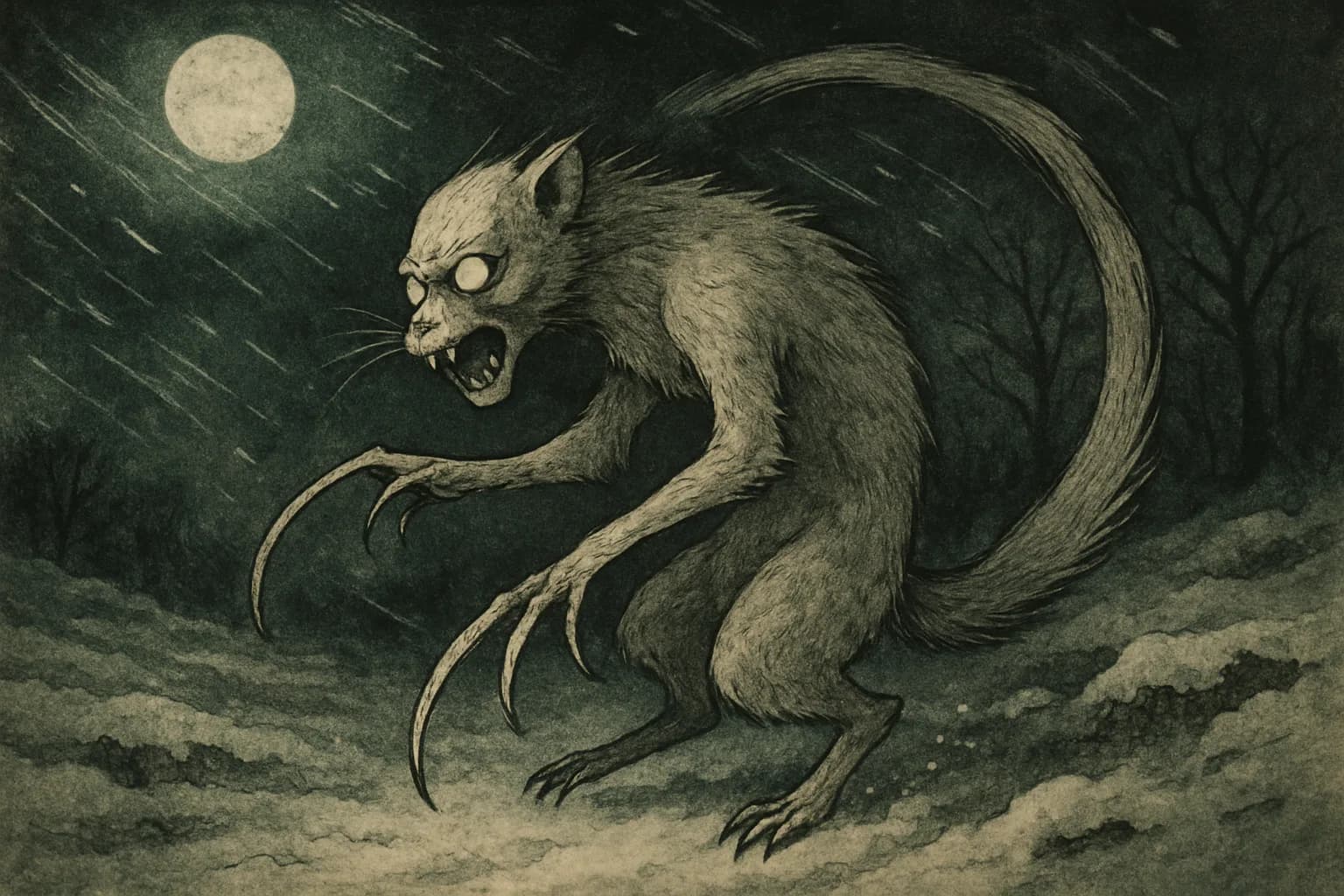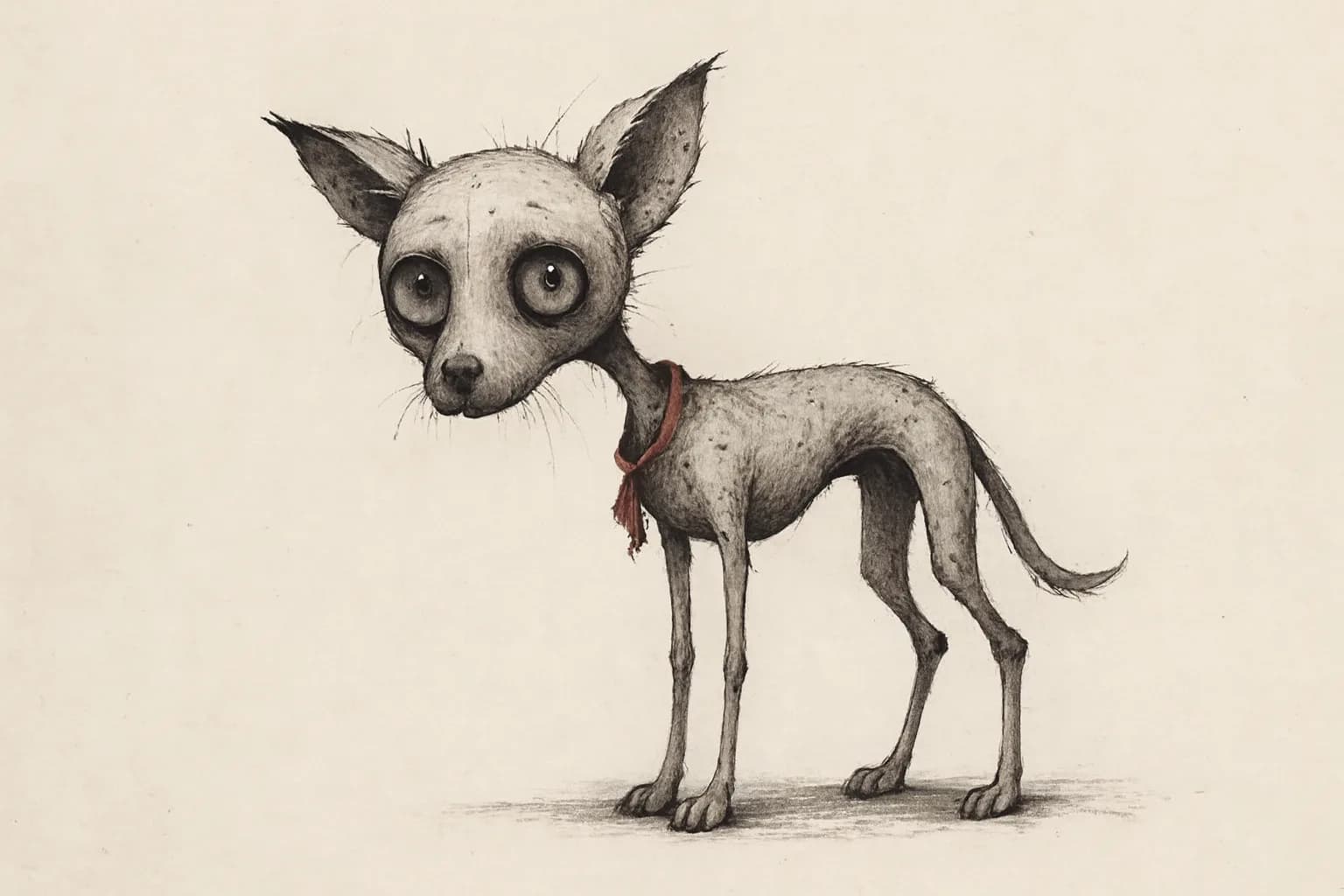
Walk a mountain path alone at night in old Japan, and something might start following you. Villagers gave it a name: okuri-inu, the escort dog. 送り (okuri) means "seeing someone off." 犬 (inu) means dog. The name sounds kind. The rule behind it is not. Stay on your feet, and it walks you home safely. Stumble, and it treats you like prey.
What does it look like?
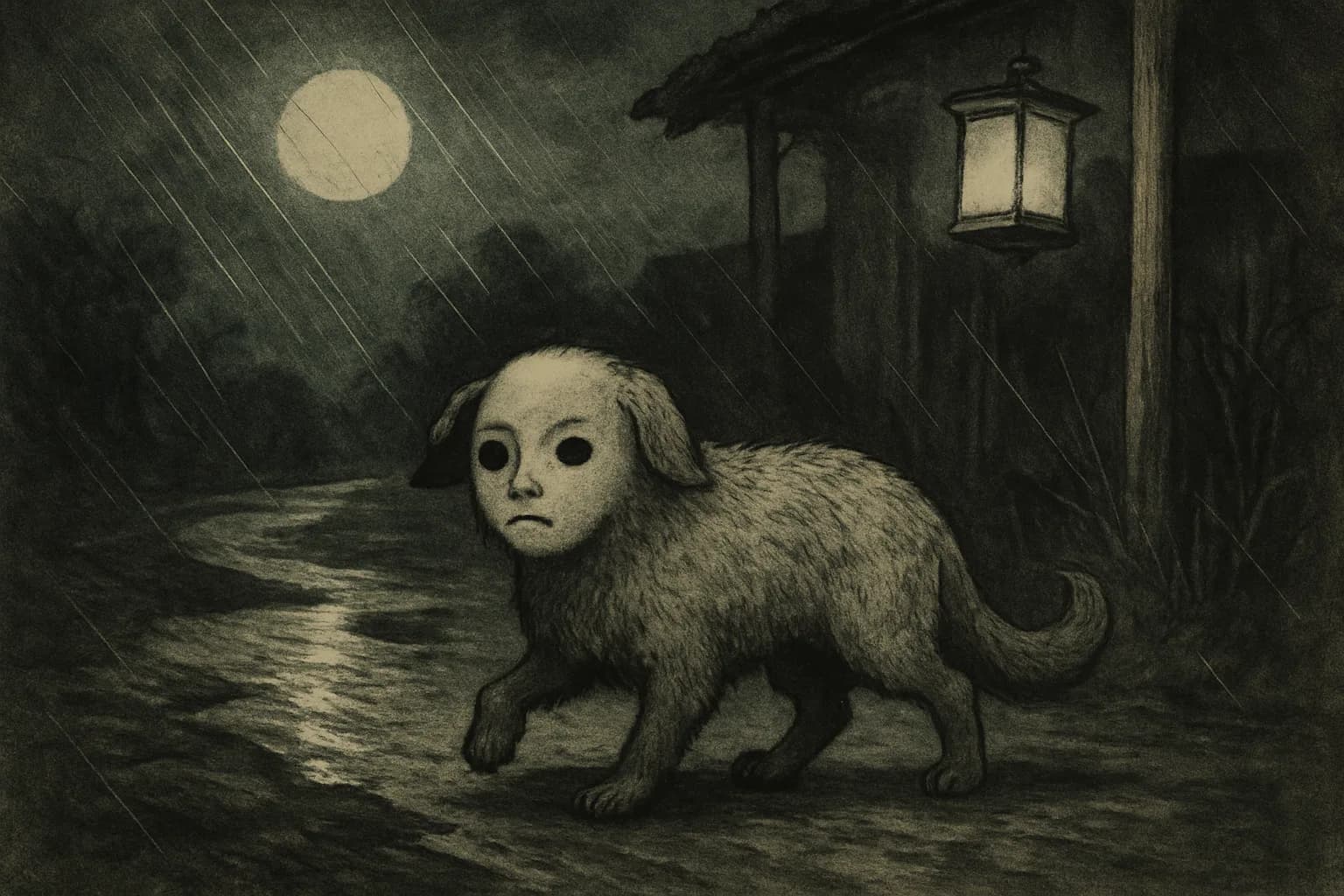
An okuri-inu looks like an ordinary dog. Most tellings give it no fangs, no glowing eyes, no monstrous size. That is part of the fear: a traveler cannot always tell a stray dog from the yokai itself. It keeps a fixed distance behind the walker, matching their pace exactly. Speed up, and it speeds up. Slow down, and it slows too.
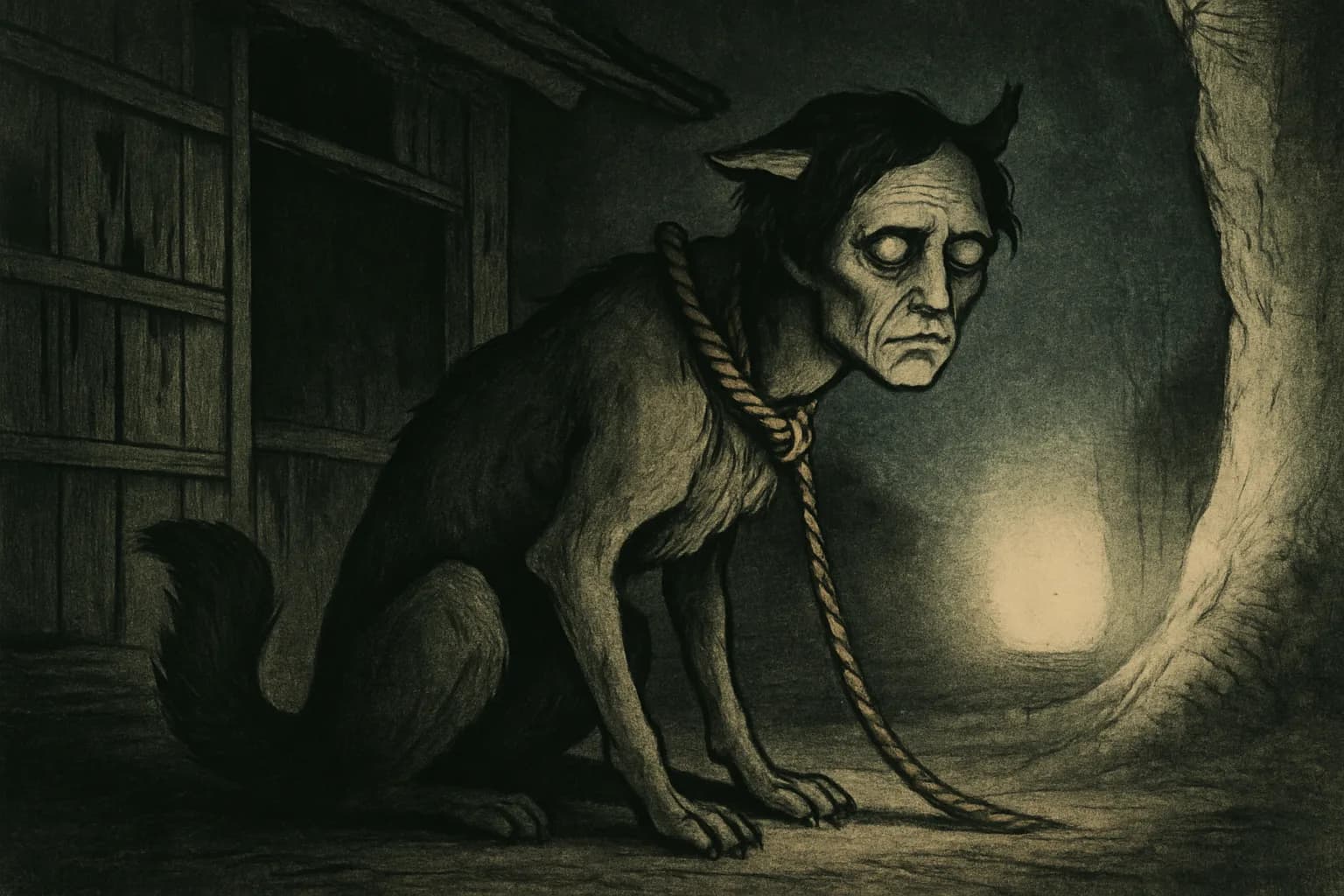
In colder mountain regions, some tellings swap the dog for a wolf and call it okuri-ōkami, "escort wolf." The behavior stays the same. Only the animal changes, depending on what actually roamed the local peaks.
The rule that decides your night
Every account of okuri-inu turns on one rule. Keep walking steadily, and the dog does you no harm. Older tellings say it does more than that: it guards the road, keeping worse things away until you reach your door. Fall, trip, or stop too suddenly, and its manner changes. Some tellings say it lunges the moment a walker goes down, as if a fall were a signal that prey is finally within reach.
Some collectors read the fall-rule as a lesson in composure: panic looks like weakness, and calm looks like nothing has gone wrong. Whether or not that reading is right, every version rewards the same thing — don't let fear show in how you move.
If you fall
Folklore hands down a specific trick for surviving a stumble. Do not scramble back up in a panic. Sit where you landed and act as if you meant to rest. Some tellings have the walker say something calm out loud, like announcing a short break. Then stand up slowly and keep walking at an ordinary pace. Tricked into thinking nothing went wrong, the dog keeps its distance and lets you pass.
Villages also taught a second courtesy. Once home safely, turn at the door and thank the dog before going inside. Skipping that step was considered rude, even though the dog itself was rarely seen clearly enough to thank by name.
Where it comes from
Okuri-inu belongs to a wider Japanese habit: turning a real fear of night roads into a creature with rules. Mountain paths before electric light were genuinely dangerous. Uneven ground, sudden drop-offs, and real predators all waited in the dark. A walker who fell there could be badly hurt with no one nearby to help. Giving that danger a dog's shape, and a single condition — don't fall — turned an abstract risk into a story a child could remember.
The wolf variant, okuri-ōkami, points to an older layer underneath. The Japanese wolf once roamed these same mountains before it went extinct in the early twentieth century. In some regions, wolves were treated as guardians rather than pests. The shrine deity Oguchi no Magami is worshipped at Mitsumine and other mountain shrines as a wolf that protects travelers and farms. Okuri-inu and okuri-ōkami carry a trace of that same idea. It is an animal that can protect you on the road, or kill you for falling down.
Okuri-inu today
Okuri-inu never got a cartoon mascot the way the kappa did. Its afterlife is mostly linguistic. Okuri-ōkami survives in everyday Japanese as slang for a man who offers to walk a woman home, then makes an unwanted move. The same escort turns predator, just with more ordinary intentions than a mountain yokai.
Reference works on Japanese folklore, including Shigeru Mizuki's illustrated yokai dictionaries, still list okuri-inu and okuri-ōkami side by side as regional variants of one belief. Unlike Betobeto-san, whose footsteps are harmless company on an empty road, an okuri-inu is never entirely safe to ignore. Shikoku's own dog-spirit tradition, the inugami curse, is a different animal altogether — bound to a family line, not a mountain path — but the two beliefs show how much weight old Japan put on dogs: loyal and dangerous at once, depending on how you treat them.