Ask anyone which Japanese animal changes its shape, and they will say the fox. Kitsune is one of the most searched yokai words in English. It is the nine-tailed fox in Naruto and the Ninetales in Pokémon.
But on paper, the fox was not first.
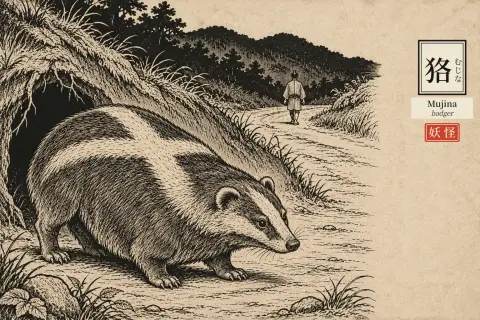
The first shapeshifter on record was a mujina
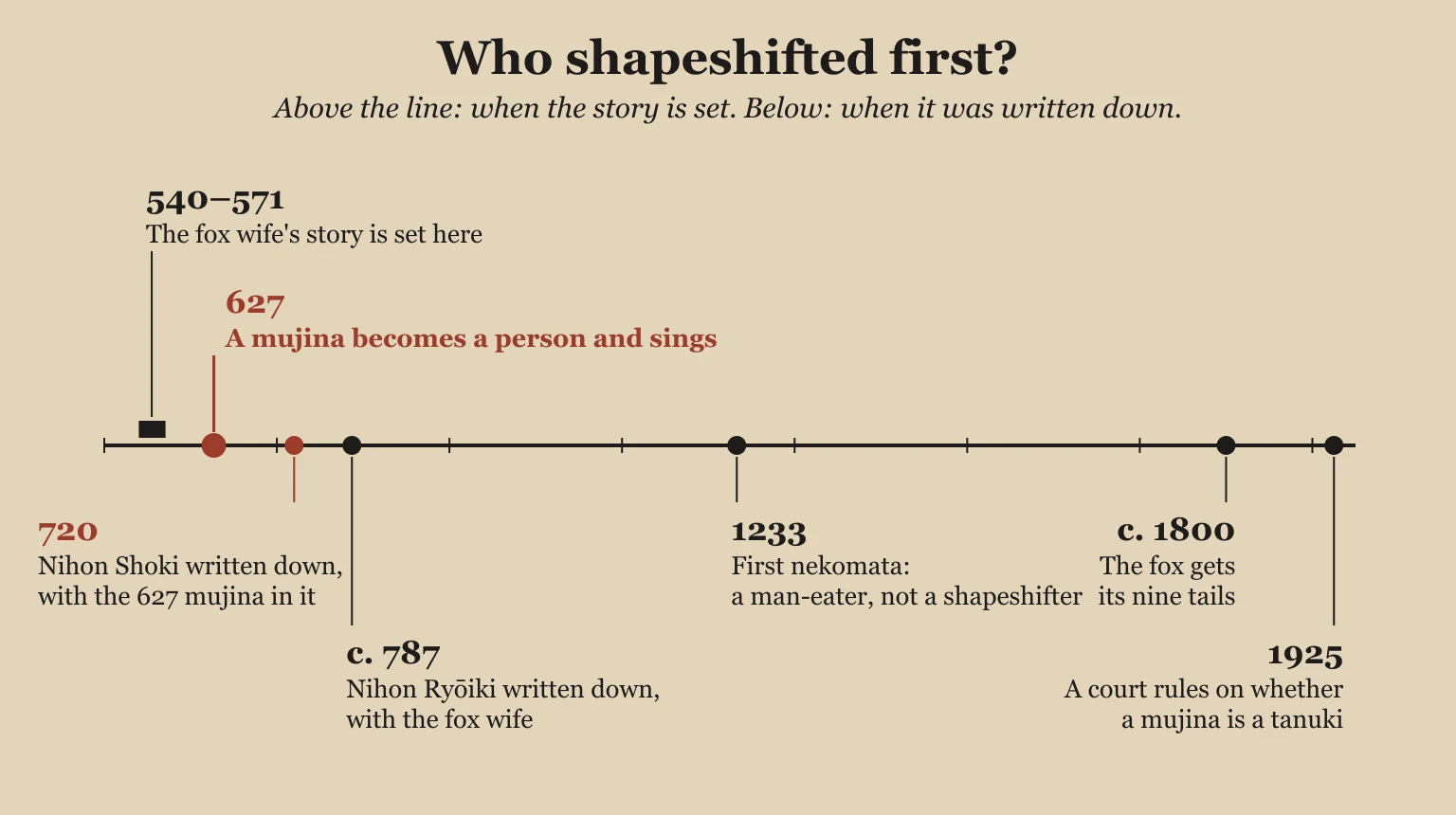
The oldest written record we found of an animal turning into a person is one line. It is in the Nihon Shoki, Japan's chronicle of 720. The animal is a mujina, an old Japanese word mostly used for the badger. The entry for the year 627 reads:
"In the second month of spring, there was a mujina in Mutsu Province. It became a person and sang."
That is all. No trick, no victim, no warning. A mujina became a person, and it sang.
So why do they change shape?
Short answer: they explained the night.
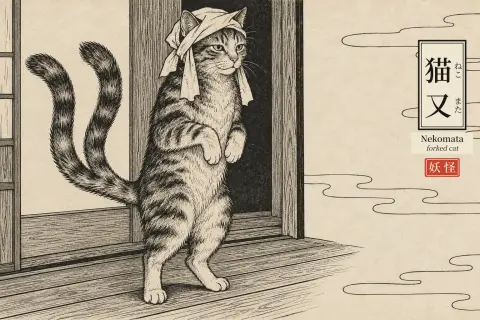
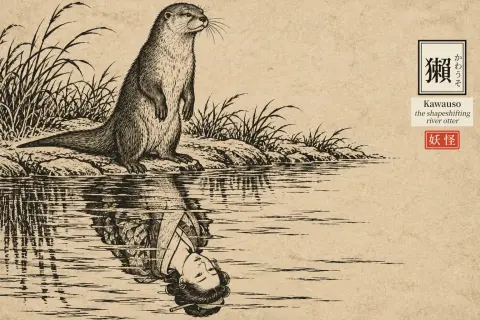
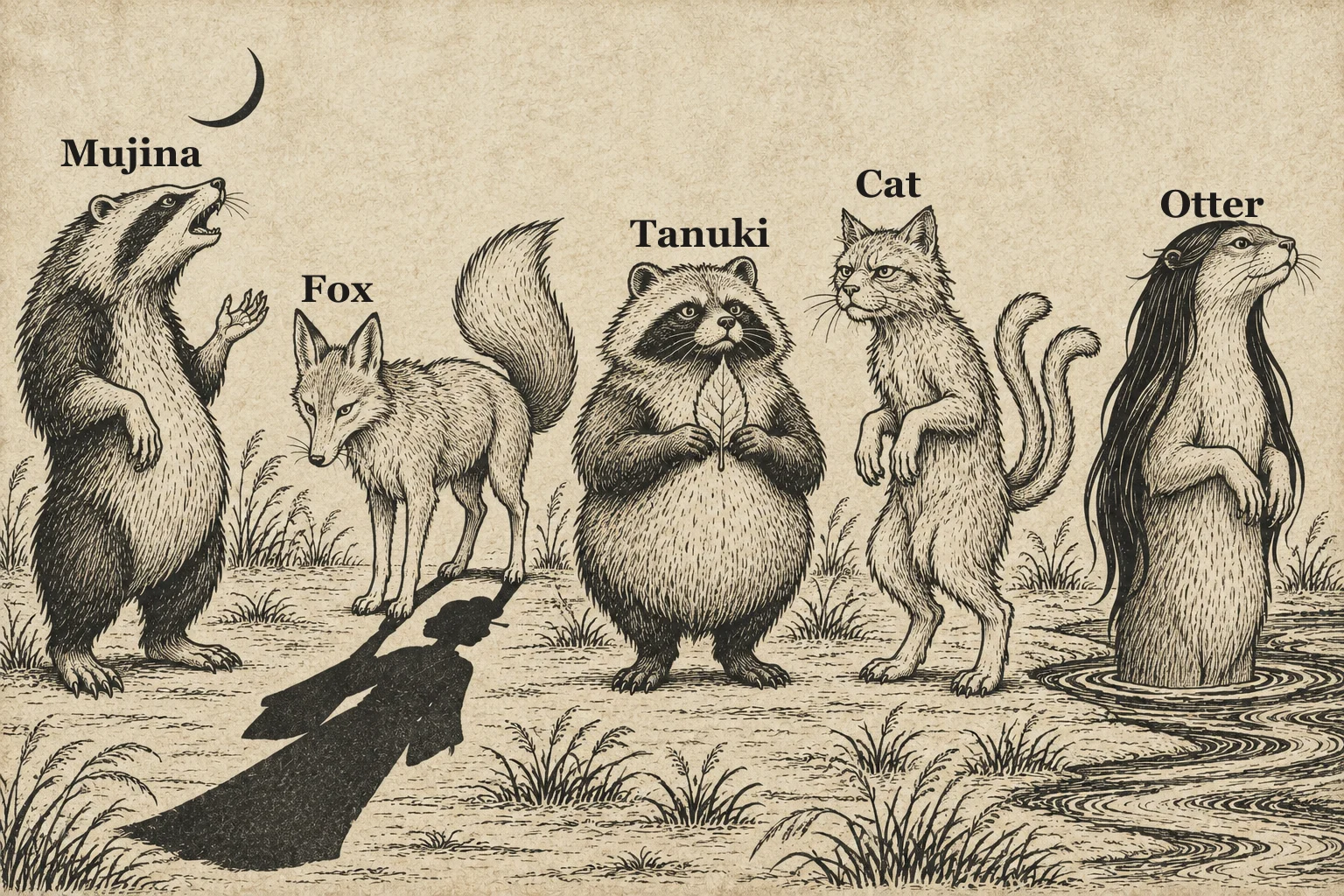
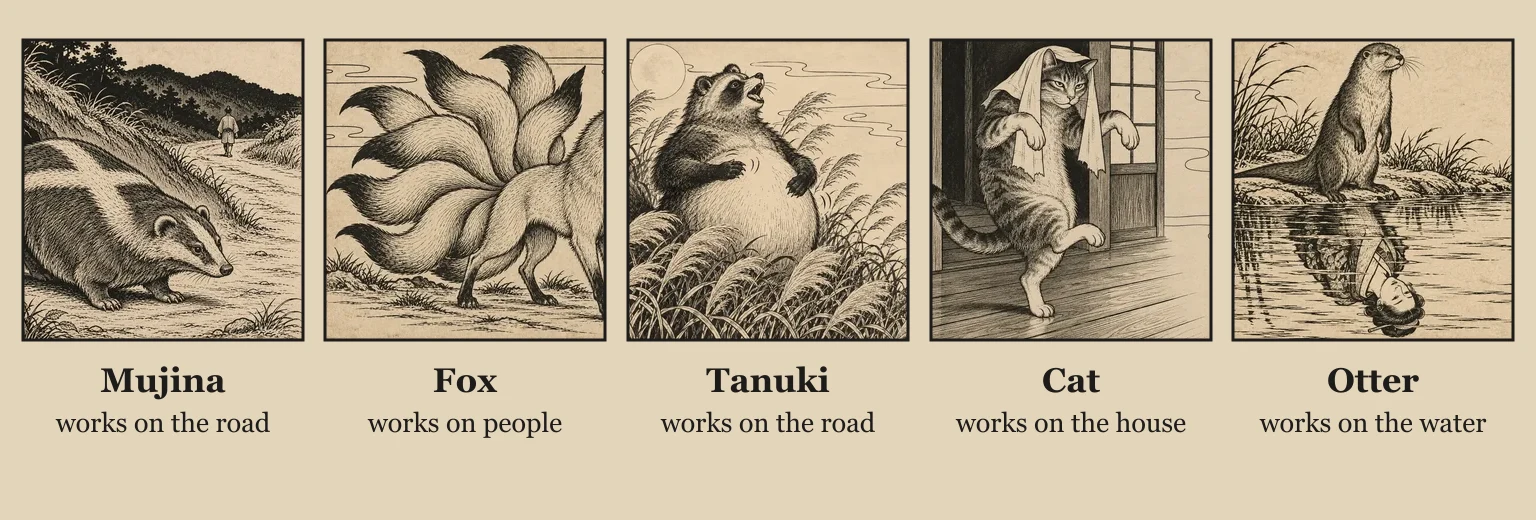
Line up the old stories, and each animal does a different job in disguise. The fox works on people's bodies and marriages. The tanuki and the mujina work on the road. The cat works inside the house. The otter works by the water.
Each animal was given a different kind of night. The rest of this page shows how that split looks, and why these animals got the work.
The fox story is set earlier, but written later
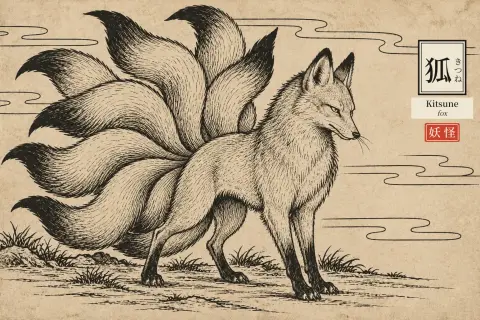
Japan's famous fox wife comes from the Nihon Ryōiki, a book of Buddhist tales. The monk Kyōkai put it together around 787 and kept adding to it until the 810s or 820s.
A man in Mino Province meets a beautiful woman in a wide field. They marry and have a child. Then the family dog barks at her, and she turns back into a fox. He calls after her: "Come and sleep." In Japanese that is kitsu-ne. The book says that is how the fox got its name.
Here is the twist. The tale is set in the reign of Emperor Kinmei, between 540 and 571. So inside the story, the fox changes shape first. But the mujina reached paper first, by almost seventy years.
Nobody could agree what a mujina was
The first shapeshifter on record is an animal Japan could not name.
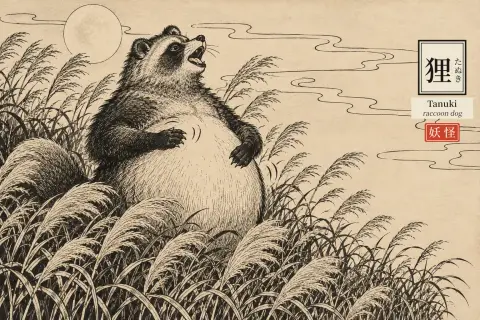
Mujina mostly means the Japanese badger. But for centuries it also meant the tanuki, the raccoon dog. English often calls the tanuki a badger too, which only adds to the mess.
In 1924, a hunter in Tochigi trapped two animals he called mujina. The police said they were tanuki, which could not be hunted after March 1. The case went to Japan's highest court. On 9 June 1925, the court found him not guilty.
The judges agreed that zoology counted the two as one animal. But many people, like the hunter, believed they were different. So he had not meant to break the law. Even Japan's highest court could not make the mujina and the tanuki the same animal in people's heads.
Who changes, and what for
| Animal | What it does in disguise | Oldest record we found |
|---|---|---|
| Mujina | Makes a road look like a river; turns horse dung into a steamed bun | Nihon Shoki (720), for the year 627 |
| Fox | Marries a man; enters a person's body and makes them ill or hungry | Nihon Ryōiki (c. 787) |
| Tanuki | Turns leaves into coins; drums on its belly in the hills at night | Medieval tales and Edo folk tales |
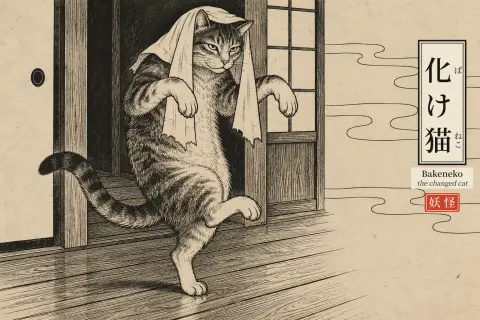
| Cat | Walks on two legs and talks; steals the dead from funerals | Meigetsuki (1233), but as a man-eater |
| Otter | Calls your name from across the river; appears as a woman | Village stories of Kaga and Noto |
Read down the middle column. The jobs barely overlap.
The fox is about people: a sudden illness, a strange hunger, a wife who leaves. The mujina and the tanuki are about the road home: a wrong turn, a drum with no drummer. The cat is about the house and the dead. The otter is about a voice over dark water.
This is our reading of the table, not a rule written in any old book. But it holds across every entry we checked.
Why these animals?
They share three things.
They lived close to people: in the fields, at the edge of the village, under the house. They moved at night. And people rarely saw them clearly.
A fox crossing a paddy at dusk. An otter splashing somewhere out of sight. A cat that disappears for three days and comes home as if nothing happened. An animal you only half see is an easy one to blame.
The cat came last. The Meigetsuki of 1233 records a nekomata in Nara that ate several people in one night. That is a monster, not a shapeshifter. The cat that stands up and talks in your kitchen belongs to the Edo period.
Abroad, the change runs the other way
Shapeshifting is not only Japanese. But look at which way it goes.
In European legend, the werewolf is a person who turns into a wolf. The danger is a human who becomes a beast. In Japan the change mostly runs the other way. The beast becomes a human.
Japan shares this with its neighbours. China has its fox spirits, and Korea its nine-tailed fox. One Chinese tale is very close to Japan's fox wife. In Renshi zhuan, written by Shen Jiji in the Tang dynasty and set in 750, a fox becomes a beautiful wife. Hunting dogs give her away. Some scholars think the Japanese story borrowed from it.
Europe's nearest match is the selkie of the Scottish islands. A seal takes off its skin, becomes a woman and marries a man. When she finds the skin again, she goes back to the sea.
What looks more Japanese is the cast. In China and Korea the fox is the star. Japan hands the job to humbler animals too, and lets some of them be funny.
The kanji is a person turned upside down
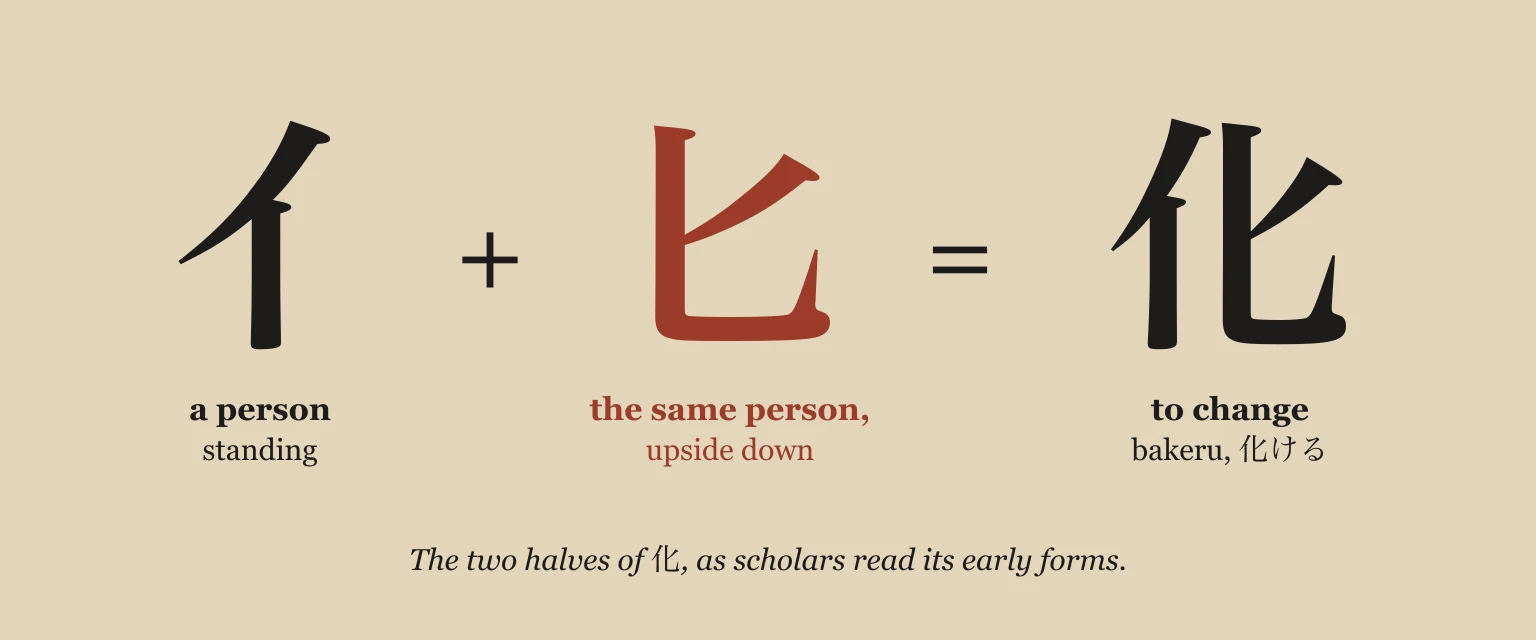
The Japanese word for this change is bakeru, written 化ける. A ghost or a monster is an obake or a bakemono: "a thing that has changed."
Look at the two halves of 化. The left half, 亻, is a person standing. Scholars read the right half, 匕, as the same person turned upside down. A person, flipped. That is what changing meant.
Age gives them the power
In almost every story, the power comes with age.
A fox grows more tails as it gets older. A cat's tail splits in two once it has lived too long. A mujina gains the power to bewitch only when it is old. One tanuki who spoke through a shop worker gave his age as 206.
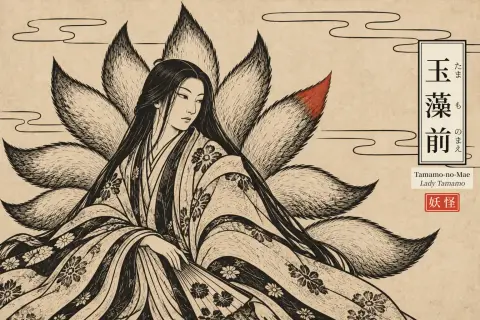
Even the famous nine tails are younger than you think. In the medieval Tamamo no Sōshi, the fox has two. Nine tails arrived around 1800, with late-Edo fiction.
Then why is the fox the famous one?
Because the fox had a shrine, and the mujina did not.
Foxes are the messengers of Inari, the kami of rice. Fushimi Inari Taisha says there are around 30,000 Inari shrines in Japan. Many villages had one, with stone foxes at the gate. We counted how often the fox turns up across our whole shelf.
A badger that sang once in 627 had no shrine, no festival and no clear name.
The fox did not invent shapeshifting. It just had better publicity.