In the twelfth century, a woman appeared at the imperial court in Kyoto so learned and so beautiful that no one could account for her. She knew Buddhist scripture, Confucian classics, and Japanese poetry better than the scholars sent to test her. She was given the name Tamamo-no-Mae, and within a few years she had become the favorite of Emperor Toba himself — and, according to the story that has circulated ever since, the reason he nearly died.
What does she look like?
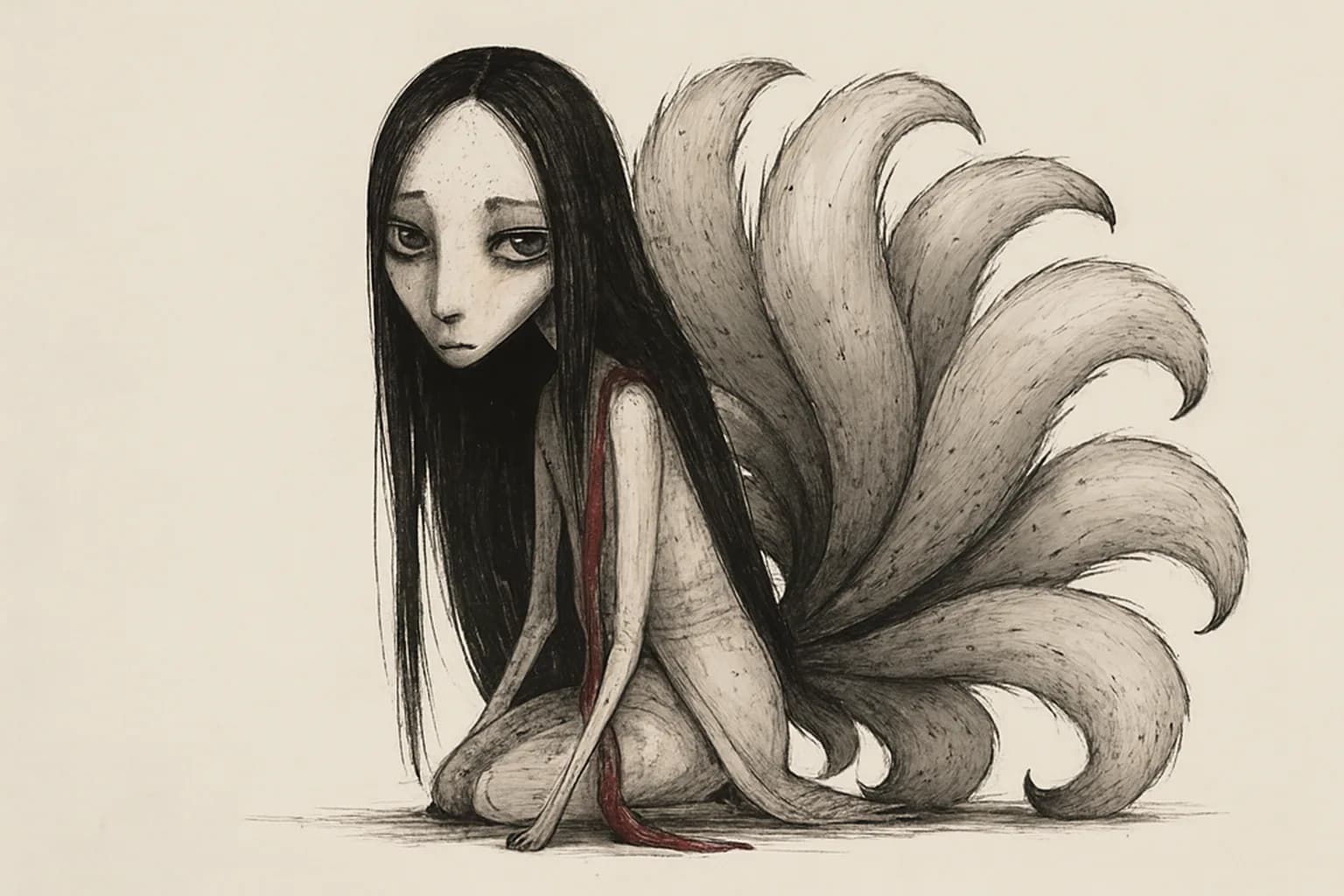
As a courtier, Tamamo-no-Mae is described the way any celebrated Heian-era beauty would be: pale skin, long black hair, faultless manners, an unnervingly complete education. There is nothing monstrous about her on the surface, and that is the entire point of the story — the danger is that she looks like exactly what she claims to be.
Underneath, she is a kyubi no kitsune, a nine-tailed fox spirit centuries old. When the disguise finally fails, artists show her true form breaking through: a white or golden fox with nine bushy tails fanned out behind her, sometimes still wearing the trailing court robes, caught mid-transformation between woman and animal.
The emperor's illness
Not long after Tamamo-no-Mae rose to prominence, Emperor Toba fell gravely ill with no physician able to explain why. The court eventually summoned the onmyoji (yin-yang diviner) Abe no Yasuchika, who determined through divination that the emperor's consort was draining his life force — that she was no woman at all. Confronted, Tamamo-no-Mae fled the capital, taking her fox form and running north to the moor of Nasu no Harano in what is now Tochigi Prefecture.
The court dispatched two warriors, Kazusa-no-suke and Miura-no-suke, to hunt her down. After a failed first attempt, the two men practiced mounted archery by chasing dogs, which stood in for the fox. Then they cornered and killed her.
Which emperor was it? The sources do not agree. The Noh play Sesshoseki names the retired Emperor Toba. The dictionary Kagakushu (1444) places her in the reign of Emperor Konoe, who was Toba's son. Both versions are still told.
The Killing Stone
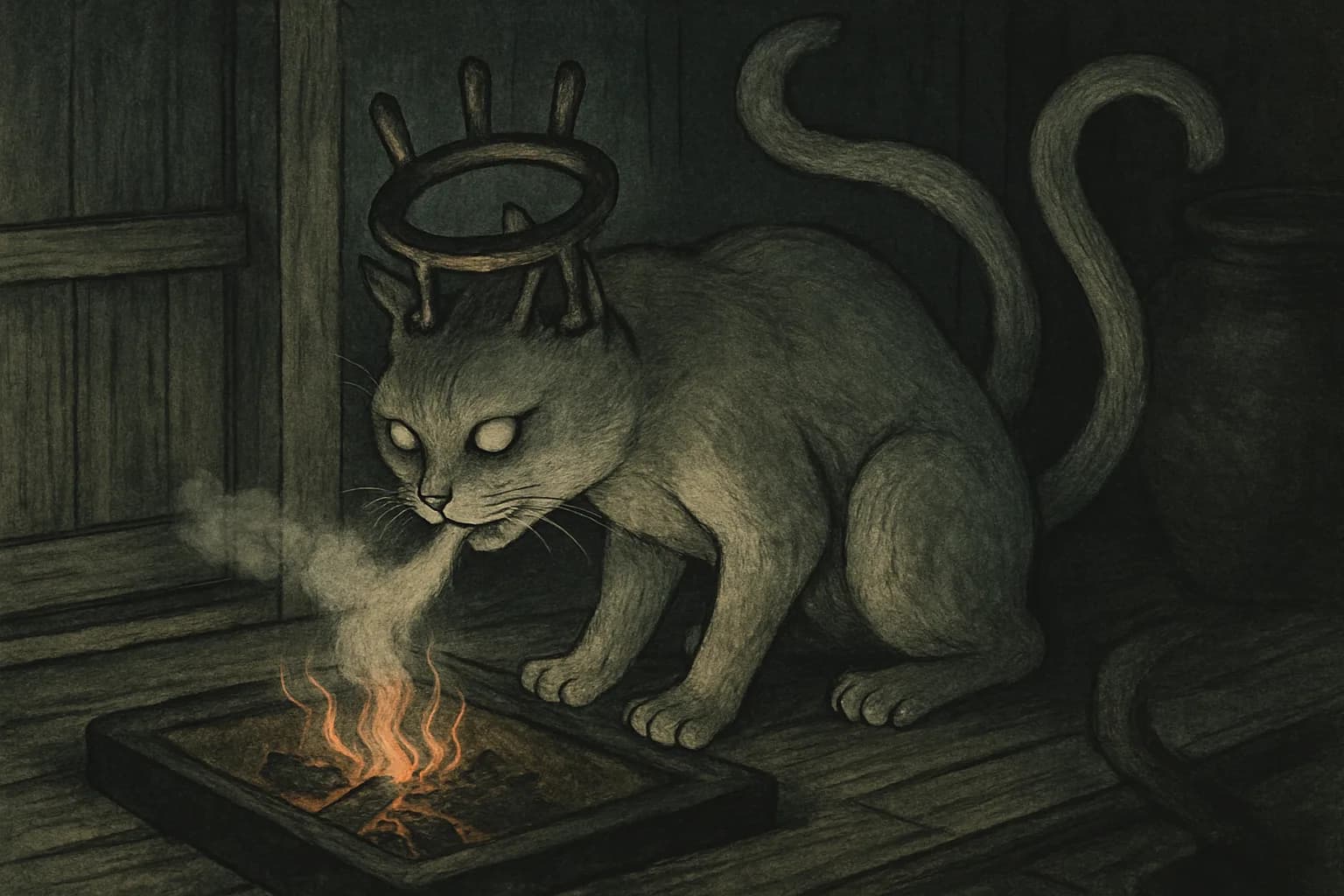
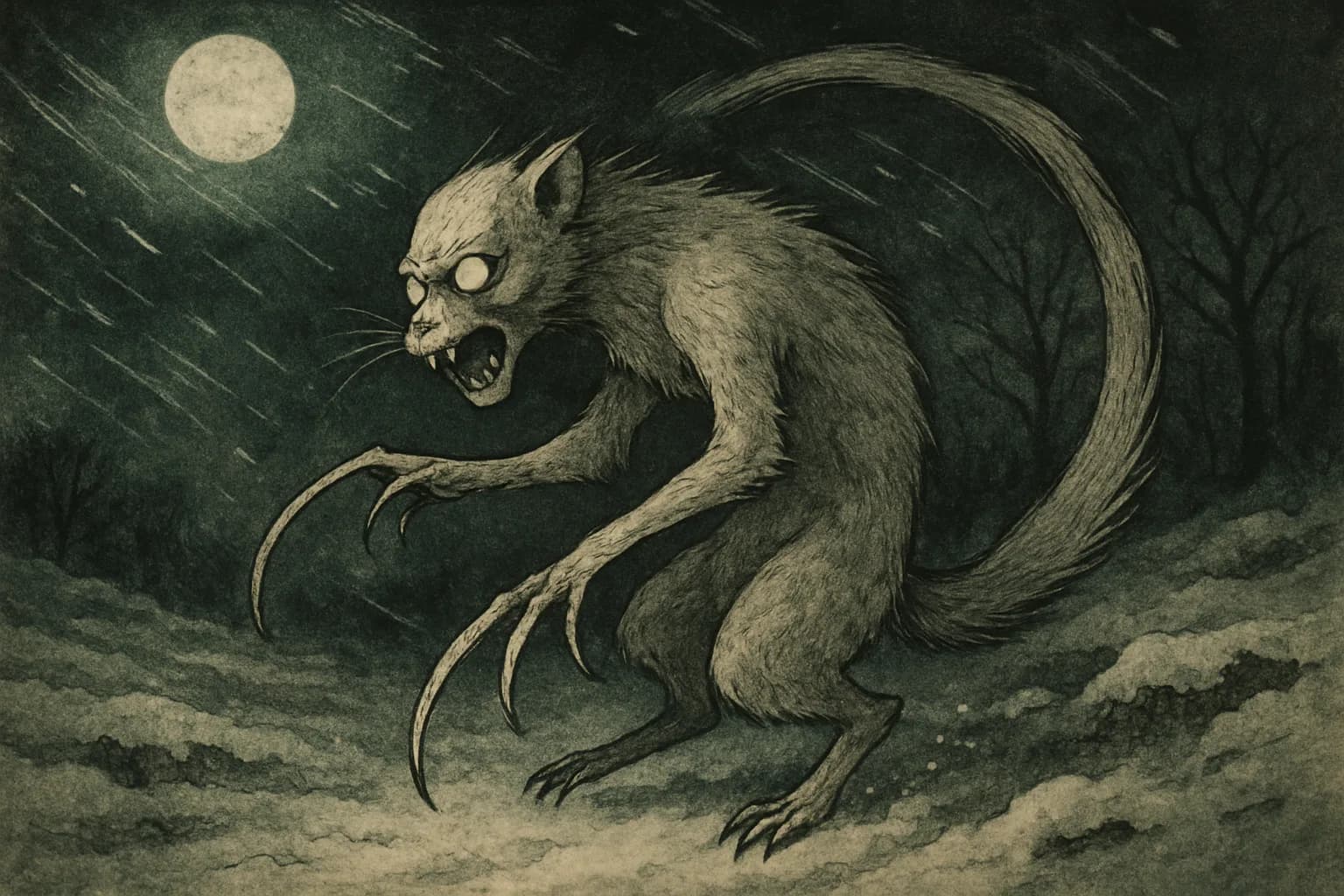
Death did not end her. Tamamo-no-Mae's rage and venom, the story goes, passed into a boulder on the spot where she died. This became the Sessho-seki, the "Killing Stone" — a rock that gave off poisonous fumes and killed any bird, insect, or traveler that came too close, for centuries.
The stone's curse was finally broken by a wandering Buddhist priest, Genno Shinsho, who struck it with his staff and performed rites to release the spirit trapped inside. In the Noh play Sesshoseki, sometimes attributed to Hiyoshi Sa-ami, the freed spirit confesses that Tamamo-no-Mae was only her latest disguise. In earlier lives, she says, she was a prince's consort in India and Baosi, queen of King You of Zhou, in China. A medieval prose tale, Tamamo no Soshi, also tells the Nasu story and briefly lists her past lives.
One account dates Genno's visit to 1385. Pieces of the stone are said to have flown to far-off places named Takada.
Her past lives in China and India
The full story of her past was written down in the Edo period. Takai Ranzan's Ehon Sangoku Yofuden (1803–1805) tells it in three countries.
- China, Shang dynasty. She is Daji, queen of King Zhou. The king's cruelty ends his dynasty.
- India, the kingdom of Magadha. She is Lady Kayo, wife of Prince Hanzoku. She pushes him to cut off a thousand heads. A healer named Kiba exposes her.
- China, Zhou dynasty. She is Bao Si, queen of King You. To make her smile, the king lights false warning fires. When a real attack comes, no one answers.
- Japan. As a 16-year-old girl, she sails to Japan on the envoy ship of Kibi no Makibi. Later she is born again as Mikuzume, raised by a childless couple. At 18 she enters court service.
The Noh play already named India and Bao Si. Daji came with the Edo novels.
How old is the legend?
The story was in writing by the late fourteenth century. It appears in the history Shinmeikyo from that time. The dictionary Kagakushu of 1444 mentions her too. A court diary, Sanetaka-ko ki, records a performance of the Noh play Sesshoseki in 1503.
The oldest copies of Tamamo no Soshi have no Killing Stone at all. In those versions, her body is stored in a treasure house. In others, it is set adrift in a hollow boat. The stone seems to have been added later.
Her shape changed too. Kagakushu calls her a white fox. The illustrations in Tamamo no Soshi show a fox with two tails. Toriyama Sekien already drew her with nine tails in Konjaku Gazu Zoku Hyakki (1779).
Was Tamamo-no-Mae a real woman?
The Edo novelist Kyokutei Bakin suggested a model: Bifukumon-in, born Fujiwara no Nariko. She was Emperor Toba's favorite consort. She was not from a top noble family. Even so, she became empress, and her son became Emperor Konoe. Bakin read the fox as a hidden comment on her rise and the court fights before the Hogen Rebellion of 1156. How much she really shaped the succession is still debated. Treat the link as a theory.
Where it comes from
Tamamo-no-Mae belongs to a much older East Asian tradition of the seductive fox spirit who topples rulers from the inside — a way of explaining a kingdom's collapse without blaming the king outright. Casting the blame on a bewitching outsider let storytellers criticize misrule while keeping the sovereign himself blameless, merely deceived. Emperor Toba's real reign was in fact troubled by succession disputes and factional strife that historians link to the later Hogen Rebellion, and the fox-consort legend reads, in part, as folklore's explanation for a court that seemed to be poisoning itself.
Her tails are a later addition than the legend itself. In Tamamo no Soshi, the medieval prose version of the story, the animal revealed at Nasu has two tails. Toriyama Sekien was drawing nine tails by 1779, but the nine-tailed figure everyone now pictures became fixed around 1800, in late-Edo popular fiction — above all Takai Ranzan's illustrated Ehon Sangoku Yofuden ("Illustrated Tale of the Bewitching Woman of the Three Countries"). These books added the Chinese consort Daji to her past lives and made her a nine-tailed fox. The medieval tellings had already given her a past in India and China. The Edo booksellers expanded it into full chapters and supplied the tails. The part of the legend that sounds most ancient is, in fact, the most recent.
The Sessho-seki itself is a real volcanic rock formation near Nasu, and its natural hydrogen sulfide fumes — genuinely capable of killing small animals that linger too long — almost certainly gave the legend its physical anchor.
Tamamo-no-Mae today
The Sessho-seki is still a tourist stop in Nasu, ringed with small Buddhist figures called jizo. In March 2022, the boulder split cleanly in two, reportedly along an old repair crack widened by rain and freeze-thaw cycles, and the event made international news as "the stone that seals an evil fox spirit has cracked open." Local officials said the crack was probably natural, and a prayer rite was held at the stone that month.
Her story is also one of the few yokai legends that plays out fully formed in the Noh repertoire, still staged today, and the nine-tailed fox has become a recurring figure in modern Japanese games, including as a playable spirit in Nioh 2 and a servant class in Fate/Grand Order — both drawing directly on the Nasu legend rather than inventing a new character. The ukiyo-e artists Utagawa Kuniyoshi and Utagawa Kunisada each produced prints of her transformation in the nineteenth century, and those images remain the visual template every later version copies.
Visiting the Killing Stone
The stone sits near the Nasu Yumoto hot springs in Tochigi. The poet Matsuo Basho visited in 1689 and wrote about it in Oku no Hosomichi. In 2014, the site was listed as a national Place of Scenic Beauty.
Every May, a torch parade in white robes and fox masks comes down to the stone. It is called the Gojinka-sai.
Several shrines also honor her. Tamamo Inari Shrine stands in Otawara, Tochigi. Kyubi Inari Shrine sits inside Nasu Onsen Shrine.
On the stage
The puppet play Tamamo-no-Mae Asahi no Tamoto opened in 1751. An expanded version followed in 1806. Its third act is still staged in bunraku and kabuki.
Quick answers
Did she always have nine tails? No. The medieval versions show a white fox or a two-tailed fox. Nine tails became standard in the Edo period.
Was she a real person? No. Some writers since Bakin have linked her to Empress Bifukumon-in, but that is a theory.
Did the Killing Stone really break? Yes. It split in two in March 2022. The town said it was most likely natural.