Most tanuki in folklore slip between shapes and vanish before trouble starts. Kinchō-danuki did the opposite. He trained for rank, built an army, and died leading it into battle. His name, 金長, pairs 金 (kin, gold) with 長 (chō, chief). The story told about him, the Awa Tanuki War, turned a dye shop's debt into the most retold tanuki legend in Shikoku.
What does it look like?
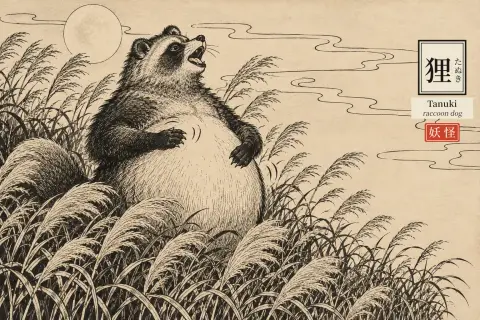
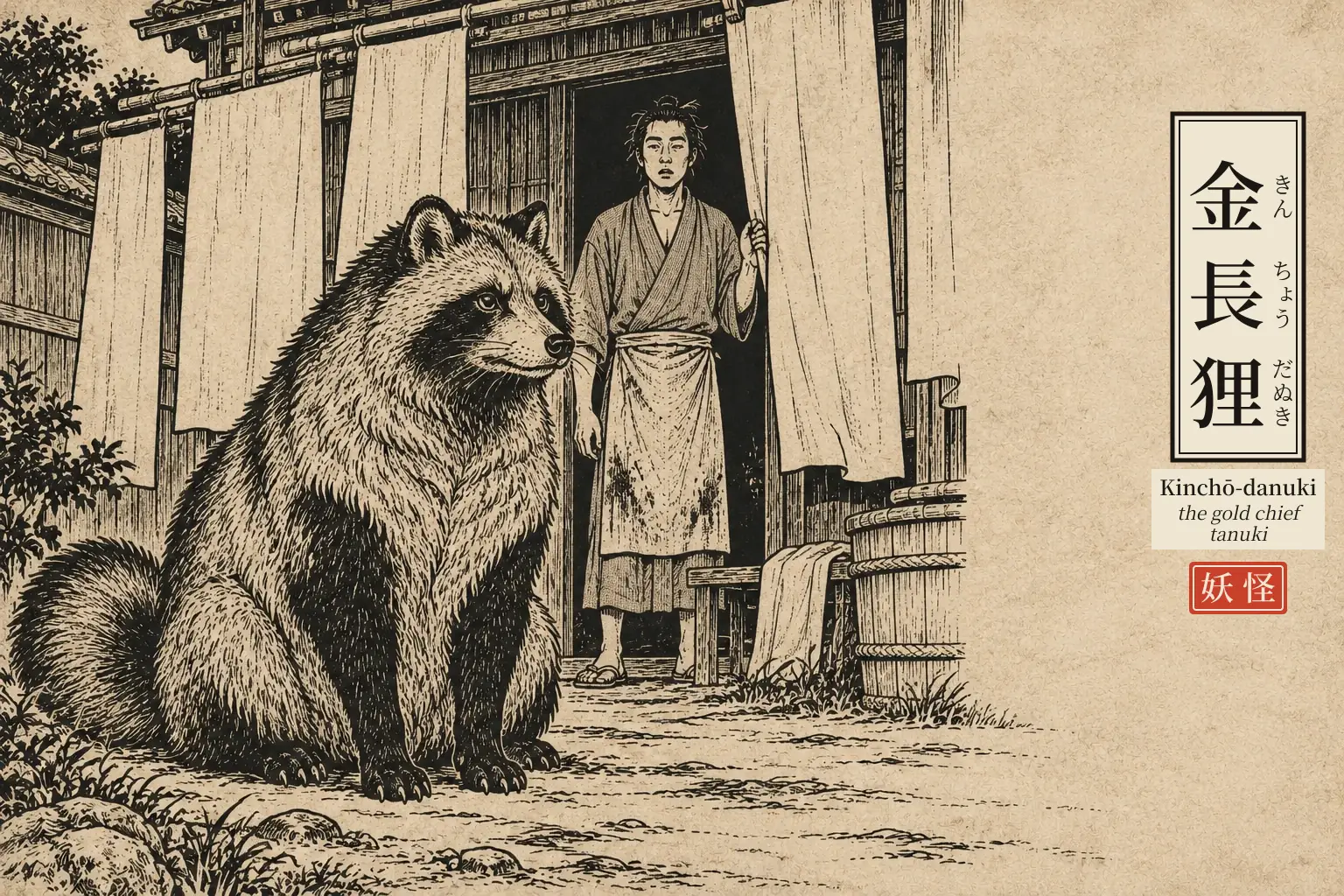
Kinchō looks like an ordinary tanuki who can pass as human or speak with a human voice. For most of the legend he has no body on stage at all. He acts by possessing a shop worker named Mankichi, and speaks only through him. The clearest modern picture of Kinchō is not from any old print. It is a bronze statue at Komatsushima Station Park, cast in 1993. It stands five meters tall and weighs five tons, sized to match the legend rather than any description of the animal.
A dye shop, a debt, and a borrowed voice
The story starts with a small kindness. Sometime in the Tenpō era (1830–1844), a dye-shop owner named Moemon saved a tanuki from a crowd that was bullying it. His shop, Yamatoya, began to prosper soon after. Then one of his workers, Mankichi, became possessed. Speaking through him, the tanuki gave its name: Kinchō, 206 years old, a senior tanuki of Higaino, now part of Komatsushima City. Through Mankichi's mouth, Kinchō cured illnesses and told fortunes for the shop's visitors. Word of him spread through the district.
Training under Rokuemon
Kinchō wanted more than fame. He wanted Shōichii, Senior First Rank, a title tanuki competed to earn. To get it, he trained under Rokuemon, the tanuki chief of nearby Tsuda, now part of Tokushima City. Kinchō excelled at the training. Impressed, Rokuemon tried to keep him there for good, offering his own daughter in marriage. Kinchō refused. He owed too much to Moemon, and he disliked Rokuemon's cruelty. Rokuemon, fearing Kinchō would become his rival, gathered his retainers and attacked Kinchō by night.
The Awa Tanuki War
Kinchō fought back with one ally, a tanuki named Taka (called Ōtaka elsewhere in the same legend) from Fujinoki Temple. Taka was killed, and Kinchō alone escaped back to Higaino. He rallied allies to avenge him. The war that followed is the one Tokushima still tells. Kinchō's side won, and Kinchō himself killed Rokuemon. But he had been wounded too, and he died soon after. Moemon, grieving that Kinchō died before earning his title, traveled to Kyoto himself. He petitioned the Yoshida Jingi Kanryōsho, the office that granted such ranks, until Kinchō received Shōichii after death.
One detail from the telling is stranger than the war itself. Before the final battle, people said Kinchō's army was mustering in a shrine grove. Villagers who went to watch at dusk heard rustling through the night. By morning, the grove was covered in tanuki footprints.
Accounts differ
Later versions add scenes the oldest telling does not have. In one, Rokuemon's daughter, Koyasu-hime, loved Kinchō and took her own life protesting her father's attack, hardening both sides' resolve. In another, the armies met across the Katsuura River with some 600 tanuki on each side, fighting for three days and nights. A third variant brings in an outsider: Shibaemon-tanuki of Awaji Island, who set out toward Awa but died on the road, bitten by a dog while disguised as a samurai watching a play, at Kannon-ji temple in Nikenya, Tokushima. Japanese Wikipedia notes that this death scene looks borrowed from Shibaemon-tanuki's own, separate legend at an Osaka theater.
Where it comes from
Moemon was a real, documented person. The possession of Mankichi is recorded as a genuine incident, separate from any battle. Historians think Meiji-era kōdan performers — tellers of staged historical narrative — later linked that real possession to an already-existing war legend. One theory traces the war legend itself to a Tenpō-era animal-gratitude tale, later combined with the real discovery of many dead tanuki on the Katsuura riverbed. Other theories read the "war" as a memory of something human. One points to a dispute between mountain ascetics of Mt. Tairyūji and Mt. Tsurugi. Another points to a fight over the riverside sand used in Tokushima's indigo dyeing, or to a quarrel over fishing rights between Tsuda and Komatsushima. If any of these are right, the fighting tanuki were always standing in for fighting people.
Go deeper
Books worth owning if this world pulls you in.
- The Book of Yokai →Michael Dylan FosterThe most readable scholarly introduction to yokai — where they come from, what they mean, and the major creatures.
- Japandemonium Illustrated: The Yokai Encyclopedias of Toriyama Sekien →trans. Hiroko Yoda & Matt AltThe complete Edo-period bestiaries that so many of these entries trace back to, in full English translation.
Some links are affiliate links; if you buy through them we may earn a small commission at no extra cost to you.
Kinchō-danuki today
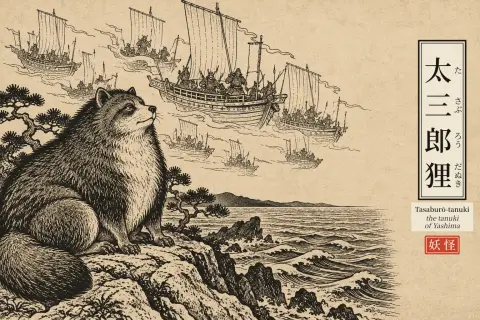
The kōdan performer Kanda Hakuryū made the legend famous on an Osaka stage in the late Meiji era, and a three-volume kōdan book followed in 1910. Film came next. The 1939 Awa Tanuki Kassen was such a hit that it is credited with saving its near-bankrupt studio, Shinkō Kinema — whose Kyoto chief later donated roughly a million yen toward building Kinchō a proper shrine. More tanuki films followed. Studio Ghibli's Pom Poko (1994) later cast a sixth-generation Kinchō in a central role among Shikoku's elder tanuki leaders, alongside Yashima's Tasaburō-danuki and Matsuyama's Inugami Gyōbu.
Komatsushima still trades on him: a sweet called Kinchō manjū, a post office renamed for him in 1989, and that five-ton statue at the station park. In 2017, when city redevelopment threatened to tear down his town shrine, a volunteer group fought to save it — posting under the names of two of his retainer tanuki, Kotaka and Kumataka (the first name's reading is not confirmed by any source).