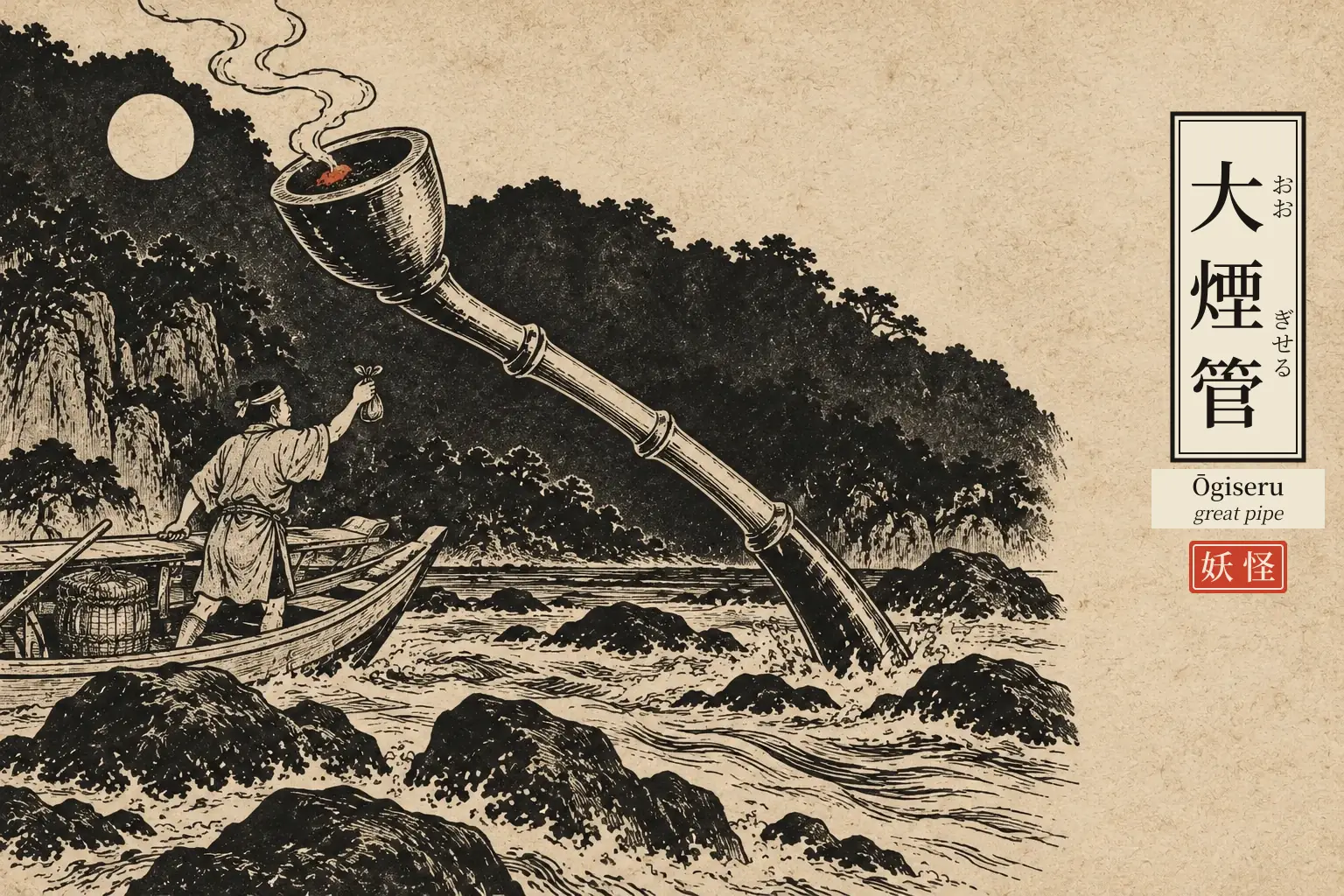
Ōgiseru (大煙管) is a tanuki from old Tokushima. On one dangerous shoal of the Yoshino River, it was said to appear late at night. It held out a huge smoking pipe. It asked for tobacco. Refuse, and your boat might not survive to morning.
What does it look like?
Ōgiseru is a bake-danuki, a tanuki (狸) that has learned to shapeshift. Its name comes from the thing it carries: a kiseru (煙管), a long smoking pipe. 大 (ō) means "great." So 大煙管 simply reads as the Great Pipe. The record gives only its pipe. It does not describe the tanuki's body, face, or size.
A toll paid in tobacco
The story is tied to one spot: Aoishi-se, a dangerous shoal on the Yoshino River. Character by character, the name reads as "blue-stone rapids" — though no source says that is actually why the spot carries it. Damaged boats and log rafts sometimes stopped there for a short time. That is when Ōgiseru appeared. It held out its pipe and asked for one thing: tobacco.
Boatmen who refused faced strange misfortune. Some said their boat was sunk outright. Those who obliged had to pack the bowl completely, and the bowl was enormous. Filling it took ten bags of tobacco, forty momme each. That comes to roughly 1.5 kilograms, far more than any real pipe needs. So local boatmen avoided mooring at Aoishi-se, even when their boat was damaged.
How to get past the Great Pipe
- Carry tobacco, and plenty of it. The bowl needs far more than any ordinary pipe holds.
- Fill it completely. A half-filled bowl does not satisfy Ōgiseru.
- Or skip Aoishi-se entirely. Many boatmen chose the safer course and avoided mooring there regardless.
Where it comes from
The earliest trace of Ōgiseru is a 1927 book, Awa no Tanuki no Hanashi (Tanuki Tales of Awa), by the Tokushima folklorist Kasai Shin'ya, published through Kyōdo Kenkyūsha. The same story later reappeared in a 1974 anthology, Nihon Minzokushi Taikei, edited by Ikeda Yasaburō and others. Kasai died in 1956, eighteen years before that reprint.
A dangerous shoal in the river got a toll collector, and the price was tobacco. Aoishi-se was a known danger spot for boats. The legend charges a toll and sinks the boats of anyone who refuses. That reads as a practical warning wearing a monster's shape. It gave boatmen one more reason to keep moving rather than risk a night moored at the shoal.
Keta's town has changed three times. In 1889, Keta joined two other villages to form Sanshō village. Sanshō merged with Kamo town in 1959, forming Mikamo town. Mikamo merged again in 2006, forming today's Higashimiyoshi, in Miyoshi District, Tokushima. Keta is still the name of the area today.
Go deeper
Books worth owning if this world pulls you in.
- The Book of Yokai →Michael Dylan FosterThe most readable scholarly introduction to yokai — where they come from, what they mean, and the major creatures.
- Japandemonium Illustrated: The Yokai Encyclopedias of Toriyama Sekien →trans. Hiroko Yoda & Matt AltThe complete Edo-period bestiaries that so many of these entries trace back to, in full English translation.
Some links are affiliate links; if you buy through them we may earn a small commission at no extra cost to you.
A quiet corner of Shikoku's folklore
Ōgiseru never grew into a mascot the way the kappa, or even the tanuki itself, did. Japan's own online encyclopedia is not entirely sure the entry belongs. The Japanese Wikipedia article on Ōgiseru carries a notice, dated December 2019, flagging it for resting on a single source. Outside that page and Kasai's book, the Great Pipe of Aoishi-se is rarely retold.