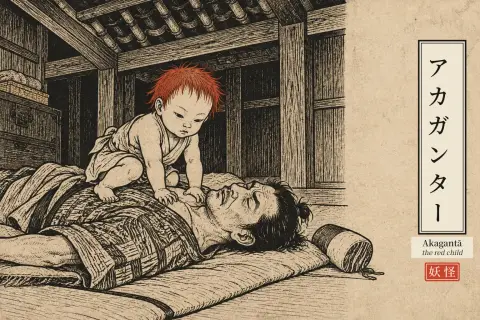
Most Japanese house spirits keep their distance. The aka-shaguma does not. Accounts from Ehime and Tokushima agree on one thing: a red-haired child moves into your home, uninvited. What it does next depends on where you live. In Ehime it raids the kitchen at night. In Tokushima it tickles your feet while you sleep. In the mountains of Kagawa, people said it could also fly.
What does it look like?
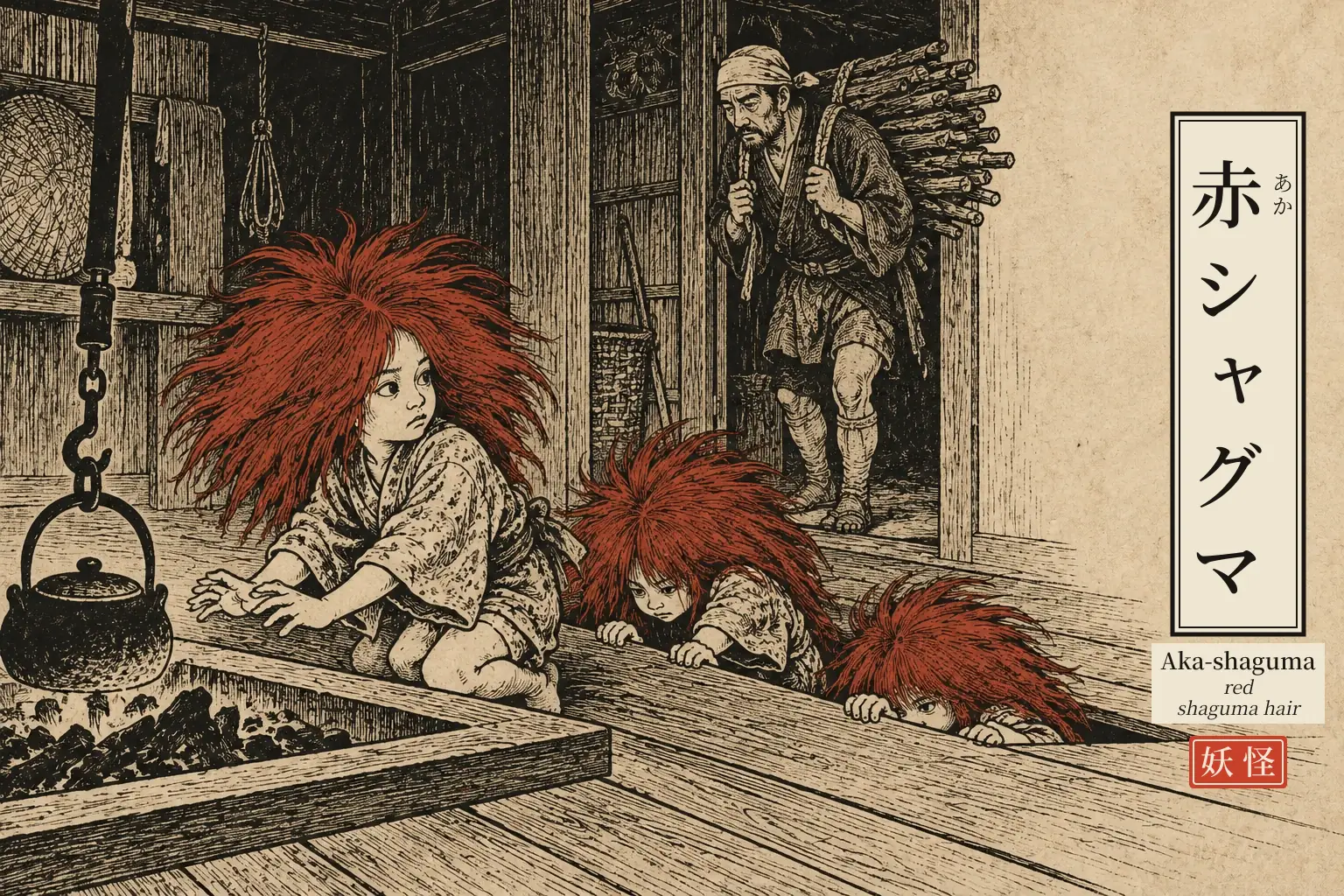
Most sources describe a child-like yokai with red hair. The Kagawa mountain version is different. It flies, shouts, and shows huge teeth. Its own name tells you the color. Shaguma is a real Japanese word. It means yak-tail hair dyed red. People once used that hair for ritual whisks, for wigs, and for the bristling crest on a samurai helmet. Aka (赤) just means red. The name repeats itself: red, and red again.
One telling, from Hiromi-cho (now Kihoku-cho) and the city of Uwajima, gives it an alternate name: Kobōzu, "little novice monk." In that version, a man comes home after working in the mountains. His house is dim inside. At the hearth, several aka-shaguma are warming themselves. The moment they notice him, they vanish under the floor.
A guest no one invited
The behavior changes somewhat by province, though.
In Ehime, around Kanbe village (now part of Saijō City), aka-shaguma settled into ordinary houses. Once everyone was asleep, it started a racket in the tatami guest room and raided the kitchen for food. One story claims a mine engineer built his house there around 1899 or 1900, on a hill where diggers had turned up human bones and old pottery. Rumors said it had been a graveyard. He built anyway, and once the house stood, people kept saying aka-shaguma appeared in it.
Across the border in Tokushima, the trick is gentler but creepier. At night it slips out from under the household's Buddhist altar and tickles the feet of sleeping residents. One story tells of an old house that nobody wanted to live in, because people said it was haunted. An old woman bought it anyway. The rumor turned out to be true. Aka-shaguma showed up at night and tickled her, and in the end she moved out.
Kagawa adds something stranger. There, people met it outdoors. They said it roamed the mountains and flew through the sky, shouting. A Kagawa folklore journal also printed a tickling story. But its village, Ashiro, sits across the prefecture line. Ashiro is in Tokushima's Miyoshi District, now the town of Higashimiyoshi. There, a household was kept awake all night by tickling. The next day, one of the men saw an aka-shaguma standing in his field. He ran home and fainted.
Caught in the mountains
Kagawa has one more story, and it's the grimmest of the lot.
In what's now Mannō Town, a young man was hired for farm work. His employer never gave him any real work. He just let him idle, and the young man found that strange. Then a villager died. The employer dug up the grave. He had the young man carry the corpse into the mountains. There, he used the body as bait, luring a mountain aka-shaguma close enough to shoot it dead.
The summary does not say why he wanted to kill it.
Where it comes from
The earliest print record we found is a 1922 article in the folklore journal Minzoku to Rekishi, titled "Iyo no Aka-shaguma." Regional folklore journals kept adding to it for decades after: Iyo no Minzoku in the 1980s, Kagawa no Minzoku and Sanuki Minzoku earlier still.
Some accounts go further. They call it a kind of companion to the zashiki-warashi, the fortune-bringing child spirit of Tōno. Japanese Wikipedia calls this one theory. A 1956 Miyagi prefectural history goes further. It says the two are almost the same. Still, none of the stories we found credit aka-shaguma with bringing luck. Most of the house stories share one thing: mischief at night, and the sense that the house isn't fully yours.
Go deeper
Where Japanese ghosts come from.
- Yūrei: The Japanese Ghost →Zack DavissonWhere Japanese ghosts come from, told through old paintings, kabuki and ghost stories.
- Kwaidan: Stories and Studies of Strange Things →Lafcadio HearnThe classic 1904 collection of Japanese ghost stories that shaped how the West first met kaidan.
Some links are affiliate links; if you buy through them we may earn a small commission at no extra cost to you.
Where the tale still lives
Its afterlife is quiet. Small regional folklore journals kept collecting these accounts village by village, through most of the twentieth century. Mizuki Shigeru's own yokai encyclopedia, Yōki-ka, folded the Kobōzu telling into print as late as 2004.
For a yokai this local, that counts as its own kind of survival. It just became a story that regional folklorists refused to let go.