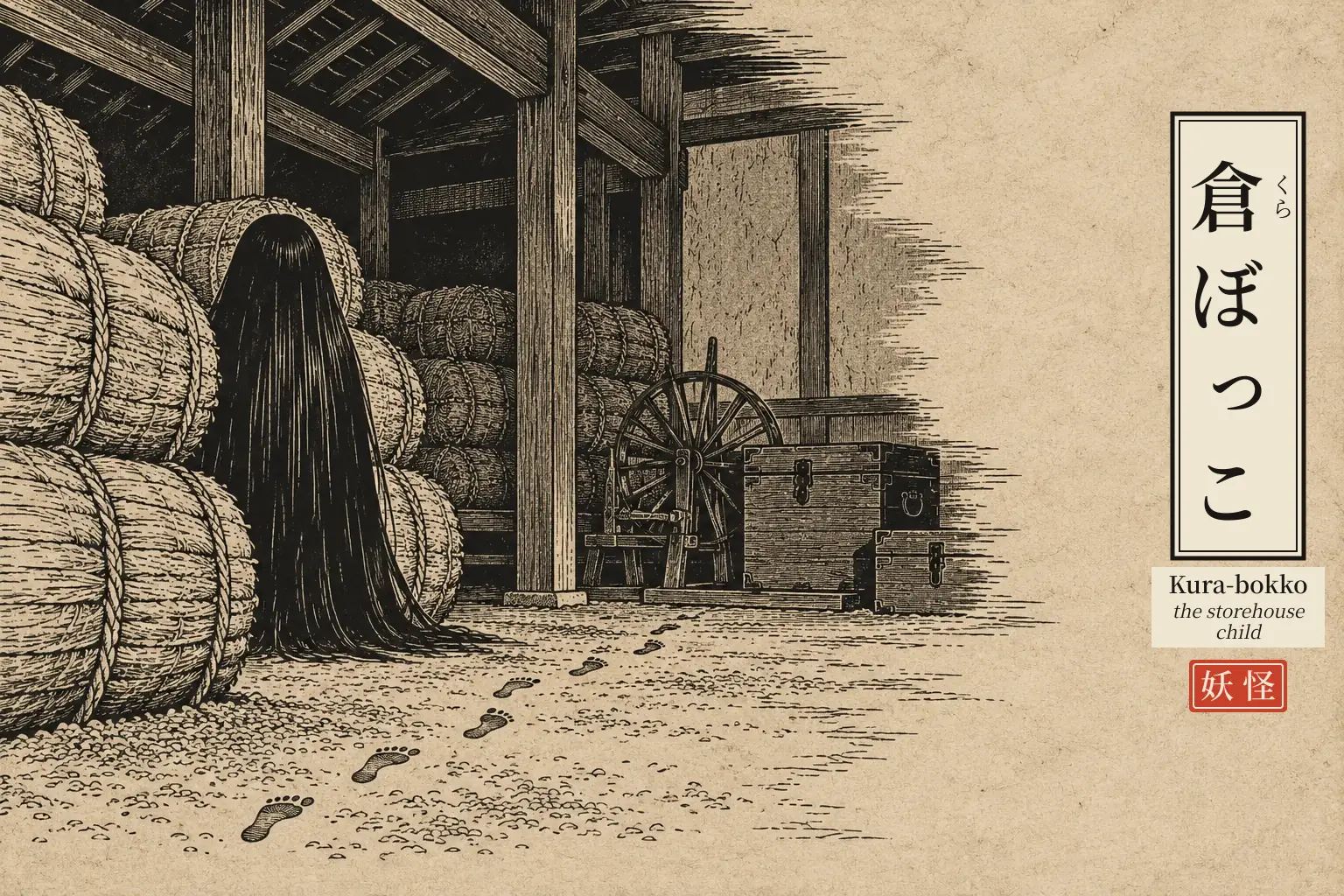
Some households in old Tōno had a trick for checking on a resident they could never see. They scattered rice husks across the storehouse floor overnight. In the morning, small footprints sometimes showed in the husks. That was the kura-bokko, the storehouse's own child, proving it was still there without ever showing its face.
What does it look like?
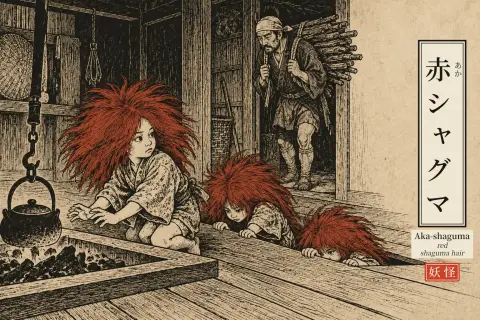
Accounts don't agree on much, and most people never saw it at all. When a shape is given, it is child-sized, roughly the height of a young boy or girl. Some tellings describe it as covered in fur or body hair from head to foot. Others give it hair so long that it hangs over its whole body, hiding the shape underneath. One separate story, set far from Tōno, describes it taking the form of a woman with hair hanging so low that her face could not be seen at all. Across every version, the one constant is that it almost never lets itself be seen clearly.
A spirit you hear, not see
The kura-bokko keeps to the kura, the family storehouse where rice, tools, and valuables were kept apart from the main house. It is harmless. Most tellings go further and call it protective. Its presence is said to keep a household's fortune steady. If it leaves the storehouse for good, the family's luck is said to decline with it — the same bargain told about its better-known relative, zashiki-warashi, more commonly pictured in the parlour, while this one keeps to the grain sacks.
Mostly, you would only know it was there by sound. People reported noises from inside a locked storehouse at night: the whir of a spinning wheel, or something like festival music, with no one inside to make it.
Even the kanji shift. The name appears written as both 倉ぼっこ and 蔵ぼっこ, two different characters for "storehouse" with the same reading, kura-bokko. The name shifts further by source. Yanagita Kunio's folklore collection calls it Okura-bokko, "the honored storehouse child." The folklorist Sasaki Kizen, writing separately, calls the same kind of spirit Kura-warashi, swapping in warashi, the Tōhoku dialect word for child also used in zashiki-warashi's own name. Both names point at the same idea: a child living where the house keeps its wealth.
Two records, two households
The rice-husk story in the opening comes from Yanagita's Tōno Monogatari Shūi (1935), the enlarged sequel to his famous Tōno Monogatari. It is the clearest written account tied to Tōno itself.
Sasaki Kizen's essay "Ōshū no Zashiki-warashi no Hanashi" records a second, livelier account from a sake shop. Someone entering the storehouse there heard a child's voice call out "hoi, hoi," followed by other strange noises, with no child anywhere to be found.
A third story in the same essay moves the setting to Honjo, now Sumida Ward in Tokyo. A man recorded only by the name 梅原宗得 kept a storehouse with one of these spirits living inside. Workers who felt a sudden urge to use the toilet took it as a warning sign and hurried outside before the spirit could appear. The same storehouse spirit was also treated as a guard against fire. During one nearby blaze, it is said to have appeared as a long-haired woman, carried the household's goods out of danger, and saved them before the flames arrived.
Where it comes from
We found no Edo-period print of a kura-bokko, the way there is for many other yokai. The oldest written trace is an Edo-period account from Honjo, in Edo. It was a written record, not a woodblock print. Most of what we know comes later, from folklorists who wrote down Tōno storytellers. That puts it in the same category as zashiki-warashi itself: a household spirit known from storytellers' accounts.
The Japanese Wikipedia entry for zashiki-warashi treats the storehouse-dwelling kind as one regional branch of a wider belief, alongside versions that live in the earthen-floored entryway or that warn of floods with long, thin arms. Seen this way, kura-bokko isn't a separate invention. It's the household guardian moved from the room where guests sit to the room where the family's actual wealth sits.
Go deeper
Where Japanese ghosts come from.
- Yūrei: The Japanese Ghost →Zack DavissonWhere Japanese ghosts come from, told through old paintings, kabuki and ghost stories.
- Kwaidan: Stories and Studies of Strange Things →Lafcadio HearnThe classic 1904 collection of Japanese ghost stories that shaped how the West first met kaidan.
Some links are affiliate links; if you buy through them we may earn a small commission at no extra cost to you.
Kura-bokko today
The clearest modern trace sits far from Tōno. A bronze statue of kura-bokko stands among the bronze yokai figures lining Mizuki Shigeru Road in Sakaiminato, Tottori — a street that commemorates hundreds of yokai from across Japan's folklore, many of which, like this one, come from existing tradition rather than Mizuki Shigeru's own invention. Beyond that statue, the kura-bokko has mostly stayed what it was in Tōno: a presence known through sound and footprints, rarely glimpsed and never confirmed.