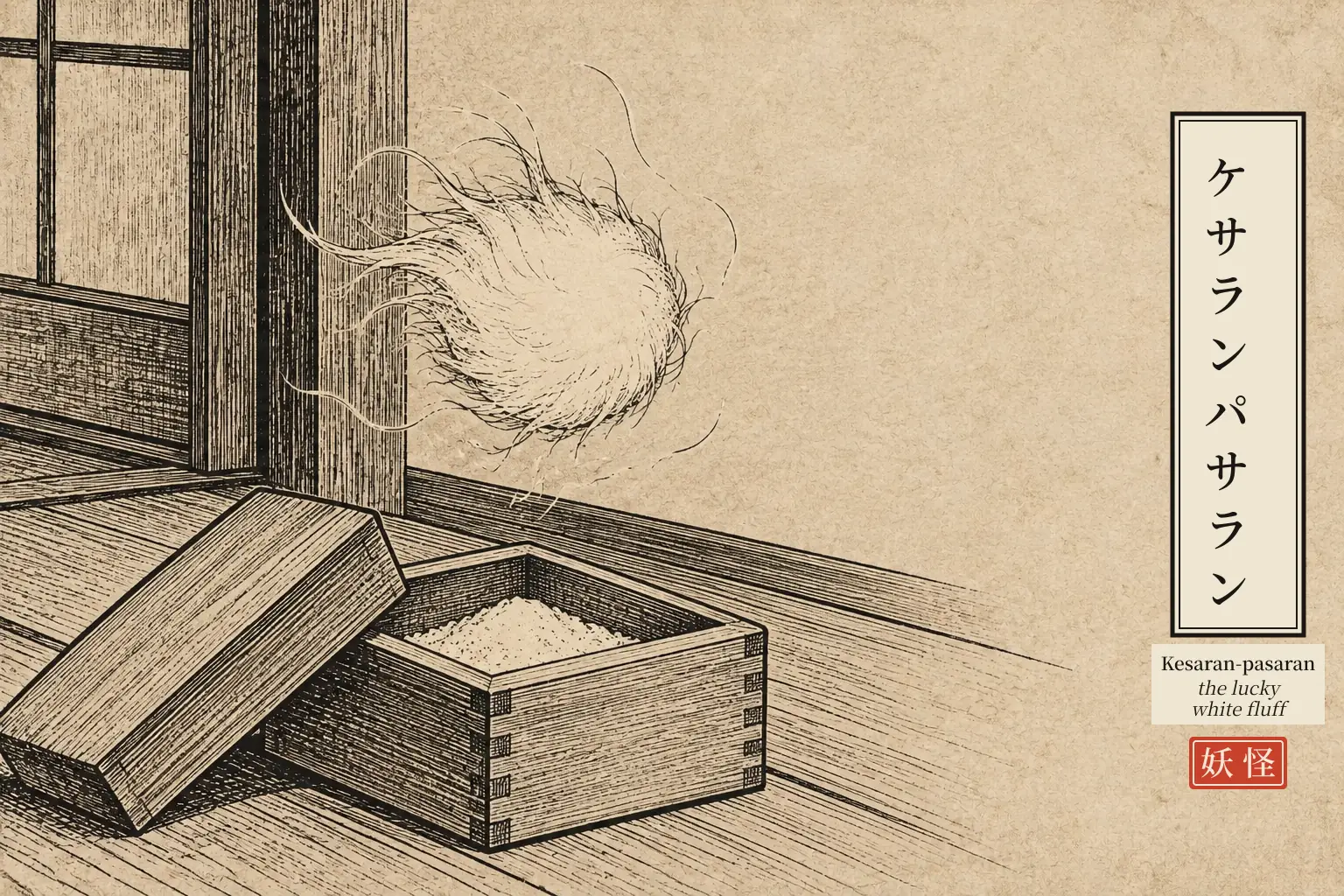
A kesaran-pasaran is a small white puff of fluff, soft as a dandelion head or the tip of a rabbit's tail. Find one, and Japanese folklore has clear instructions. Keep it quiet. Put it in a wooden box. Feed it face powder. Do that, and it is said to bring good luck. Almost nobody agrees on what the thing actually is — not even the two zoos that now display specimens of their own.
What does it look like?
Descriptions agree on the shape and little past that. It is a soft white ball, somewhere between an azuki bean and a chicken egg in size, according to the reference work Nihon Yōkai Daijiten. It drifts and flutters on the air rather than falling straight down. Western folklore has a rough equivalent: wandering strands of fluff that people call gossamer, or angel hair. Each kesaran-pasaran is said to carry a small amount of yokai power. Whether it counts as a plant or an animal is said to be unclear. It is sometimes filed as an unidentified creature (UMA) rather than a true yokai.
How to keep one
In Tōhoku, belief holds that kesaran-pasaran fall from the sky with thunder, right before a storm. Catch one, and you are supposed to tell almost nobody. Some families say they have kept one quietly for generations, passing the box down without talking about it much.
Keeping one has its own rules. Use a box made of kiri, paulownia wood, with a hole poked in the lid. Without the hole, the puff is said to suffocate. Feed it oshiroi, white face powder, choosing a kind with no scent or dye. Done right, it is said to multiply inside the box and bring its owner happiness. Look at it more than once a year, though, and the luck is said to fade away.
So what actually is it?
Ask what a kesaran-pasaran really is, and the answers scatter in different directions.
| Theory | What it says |
|---|---|
| Animal | Shrunken fur and skin left over after a predator eats a small animal, such as a rabbit — or an animal's gallstone. Some compare it to snow fleas, or to the woolly young of the planthopper aobahagoromo. |
| Plant | Clumped seed-fluff from a flower, such as a thistle, a pasque flower, or milkweed. It is often found on loquat trees, which earned it the nickname "spirit of the loquat tree." |
| Mold | A white, cottony mold. This is offered as the reason feeding it face powder seems to make it grow. |
| Mineral | Compared to okenite, a mineral. |
Two public institutions have put their own specimens on display, and each gives a different, ordinary answer. At the Kamo Aquarium in Tsuruoka, Yamagata, a cotton-like ball found under a beech tree near Mt. Gassan around 1990 is labeled a pellet. It is fur that a raptor, such as an eagle, coughed back up after eating a rabbit or some other small animal. At Himeji City Zoo in Hyōgo, a specimen has been on display since around 2010. The explanation there is similar: a clump of feathers a bird of prey could not digest, shown so visitors can learn about raptor biology.
No specimen has settled the matter for everyone. "Kesaran-pasaran" may never have named one single thing.
Where the name comes from
Nobody fully agrees on the word itself, either. Proposed origins include the Spanish phrase que será, será; a term said to come from Sanskrit; the dry, rustling sound of feathers; and a Tōhoku dialect phrase that roughly means "I have no idea what this even is."
That last guess might be the most fitting one. The folklorist Iikura Yoshiyuki, in a 2006 study, traces documented use of the name back to reports in the folklore journal Minkan Denshō, in the 1950s. One contributor at the time connected it to a very different object: the heisarabasara described in the 1712 encyclopedia Wakan Sansai Zue. That book describes a white ball said to form inside an animal's liver or gallbladder, used in Mongolia for rain prayers and, its author claimed, used in the Netherlands against smallpox. The link was never settled, and was later walked back in the journal itself.
What did happen, starting in the late 1970s, was a boom: the name became widely known across Japan. Iikura's reading is that the catchy name did most of the work. It took a scatter of odd, half-noticed things — tufts of fluff, bits of regurgitated fur, clumps of seed-down — and gave them all one name to be reported under. By the boom's own account, much of what people were finding and calling kesaran-pasaran turned out to be ordinary flower seed-fluff.
Go deeper
Books worth owning if this world pulls you in.
- The Book of Yokai →Michael Dylan FosterThe most readable scholarly introduction to yokai — where they come from, what they mean, and the major creatures.
- Japandemonium Illustrated: The Yokai Encyclopedias of Toriyama Sekien →trans. Hiroko Yoda & Matt AltThe complete Edo-period bestiaries that so many of these entries trace back to, in full English translation.
Some links are affiliate links; if you buy through them we may earn a small commission at no extra cost to you.
Kesaran-pasaran today
The belief has outlasted the boom. People still say they keep kesaran-pasaran in boxes, still feed them powder, still pass them down without talking about it much. The two specimens on public display, in Tsuruoka and in Himeji, make an odd kind of peace with the mystery. They sit labeled plainly as a raptor's pellet and a raptor's cast feathers — and are still kept, and still shown, under a name nobody has ever managed to pin down.