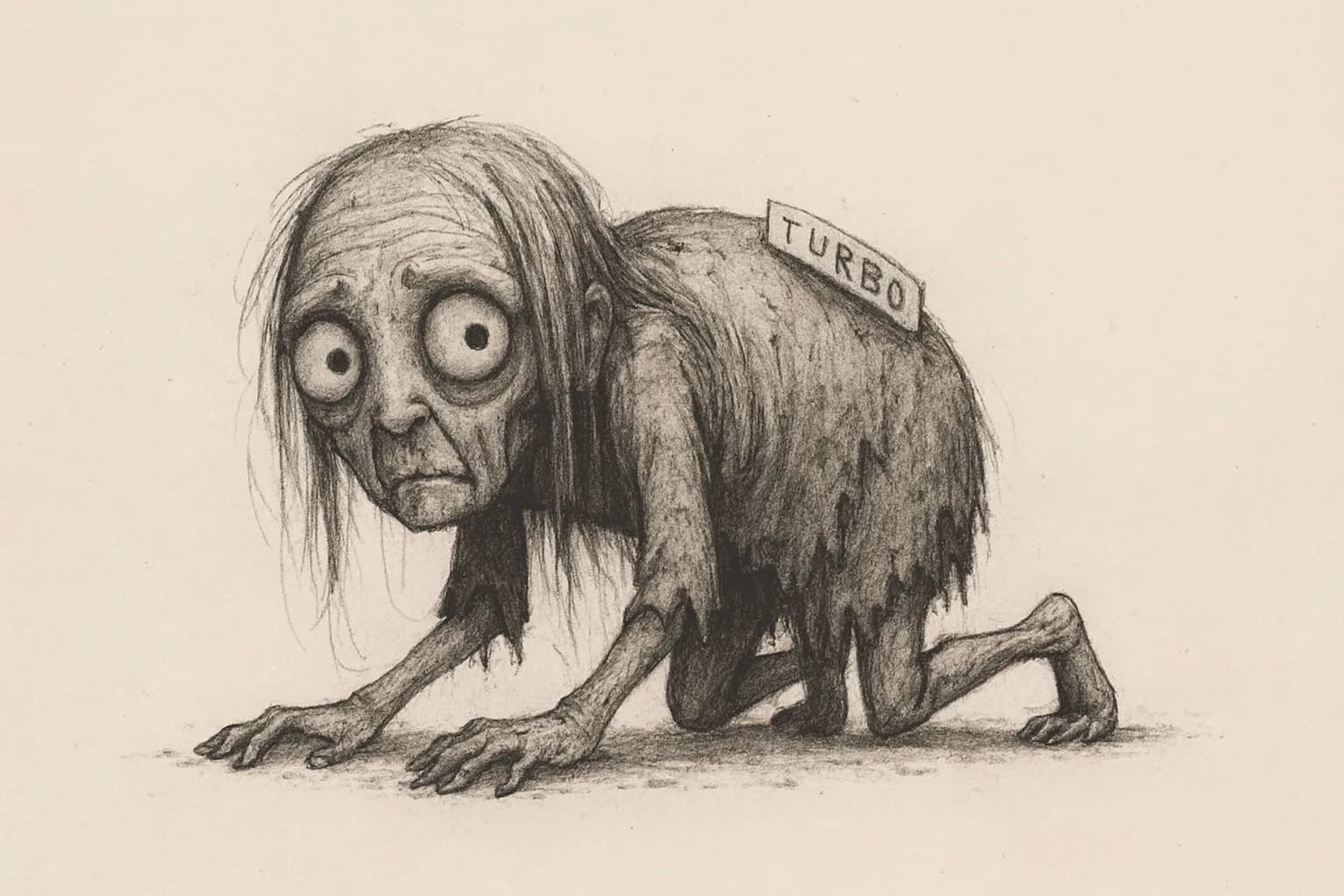
You are driving through a tunnel at night. It's a Japanese mountain expressway. Something raps on your window. You glance over. An old woman is running alongside your car on all fours. She is staring back at you, matching your speed, whatever it is. That is the core of the story told about Turbo Baba, one of Japan's best-known modern highway yokai. In the version filed under her name, a strip of paper reads "Turbo." It is stuck to her back, as if to explain how.
What does she look like?
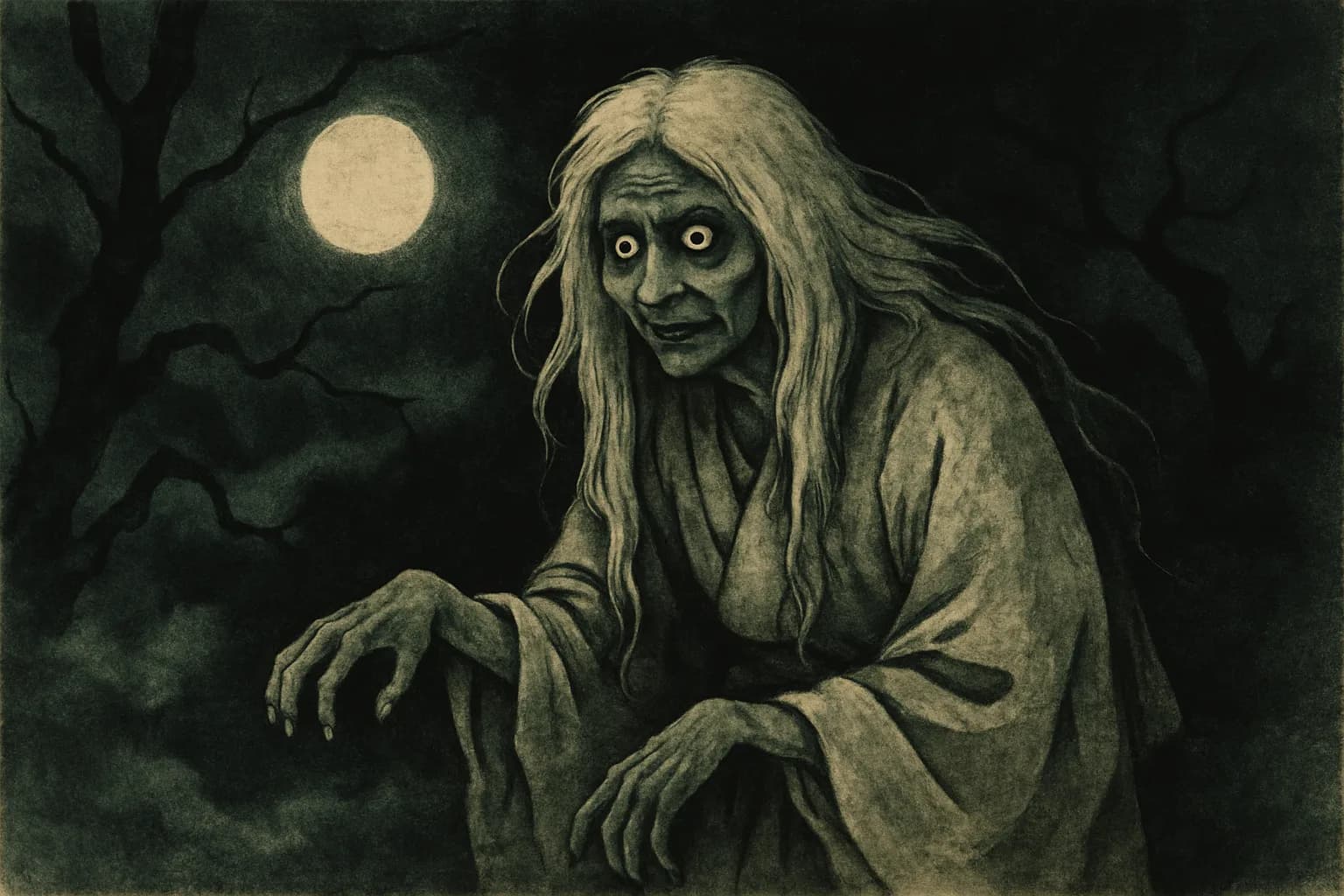
Turbo Baba is an elderly woman. She moves on all fours, like an animal, instead of walking upright. She keeps level with a moving car rather than falling behind. In the account most often cited under her name, a paper tag rides on her back. It carries the word that gives her her name. The core tunnel story adds one more detail. Before you see her, she announces herself. She taps on the glass from outside, while the car is still moving.
There is no older print of her. No painted scroll, no woodblock image. She belongs entirely to the era of expressways and tunnels. Her "look" survives only in the stories drivers told each other.
Other names for the same chase
Turbo Baba is only one name among many for the same basic figure. The variation is part of the legend. The "baba" or "baachan" (granny) half of the name shifts by region, into basan or babaa. The "turbo" half has its own synonyms: Dash Baba, Jet Baba, Hyper Baba, and Light-speed Baba, said to have first appeared around 2003. Collectors of these stories treat Jet Baba as Turbo Baba's predecessor. Hyper Baba, in turn, is a stronger version of Turbo Baba herself. It's a lineage of the same joke, each entry pushed a little faster than the last.
Other versions are simply named for a speed limit. There is a 40 km Baba, a 60 km Baba, an 80 km Baba, and a 120 km Baba. Each one is defined by how fast you'd need to drive to outrun her.
A nationwide family of running grannies
Look past the name "Turbo" and the same basic figure turns up all over Japan. Each local telling adds its own twist. In Yamagata, an 80-year-old woman overtakes cars doing 80 kilometers an hour. In a Hokkaido mountain tunnel, a woman bares bright red teeth and keeps pace with a motorcycle. She vanishes only once the rider clears the tunnel. On the coast of Miyazaki, drivers report only the sound of a tricycle pedaling behind them — and rarely, the old woman riding it, at impossible speed. In Osaka's Namba district, catching up to her is said to be fatal. Near a mountain tunnel on the Aichi-Shizuoka border, a woman in a kimono and wooden sandals chases cars on foot, and a crash there gets blamed on her. On a mountain road elsewhere in Aichi, a different pursuer, hopping rather than running, is said to be the ghost of a woman killed in a motorcycle accident.
Not every variant is a runner. One tells of a tiny old woman, just 30 centimeters tall, near a mountain pass in Kyoto. She outruns bicycles, but is also said to look after orphans. Another haunts a school gym at two in the morning: a kimono-clad woman, sinking basketball shots through a hoop. Almost all of them share one setup. A car or bike, alone on a road at night. And something old and impossible, keeping pace with it.
Why the countermeasures rarely work
A kappa can be bowed to. A fox spirit can be bargained with. Turbo Baba and her relatives don't really offer an escape. A few tellings suggest you can out-drive her, if you hold a high enough speed. That advice is itself part of the joke — there is almost always a faster-named version waiting to make it fail. Other variants skip the escape entirely. In one, the only instruction given is to keep driving seven kilometers after she lands on your hood.
Where it comes from
Turbo Baba belongs to a genre Japanese folklorists call modern, or urban, yokai. These are kaidan-style stories with no pre-modern source. Nobody signed this one, and nothing dates exactly when it began. What the sources do show is dozens of near-identical versions, each with its own name, speed, or object for her to carry. That alone marks her as an oral legend: retold and reinvented at the same time, rather than written once and copied.
Several versions are named for a speed limit instead of a place. That habit ties them directly to road signs and a driver's own speedometer. The earliest print versions researchers have traced only collect these oral reports. They do not claim to be first. That may be why no two sources agree on exactly how fast she's supposed to be.
Turbo Baba today
The legend crossed into mainstream pop culture in 2024. Yukinobu Tatsu's manga Dandadan — serialized since 2021 — was adapted into an anime by Science Saru that year. A character named Turbo Baba appears in its very first episode, explicitly modeled on this same urban legend and introduced under aliases like "100 km Baba," voiced by Mayumi Tanaka. In the show she's reimagined as a far more central figure than any single highway account ever made her. She is powerful enough to curse the hero, and later, to lend him her speed. The adaptation gave an anonymous roadside story, shared for decades without an author, its first widely recognized face.