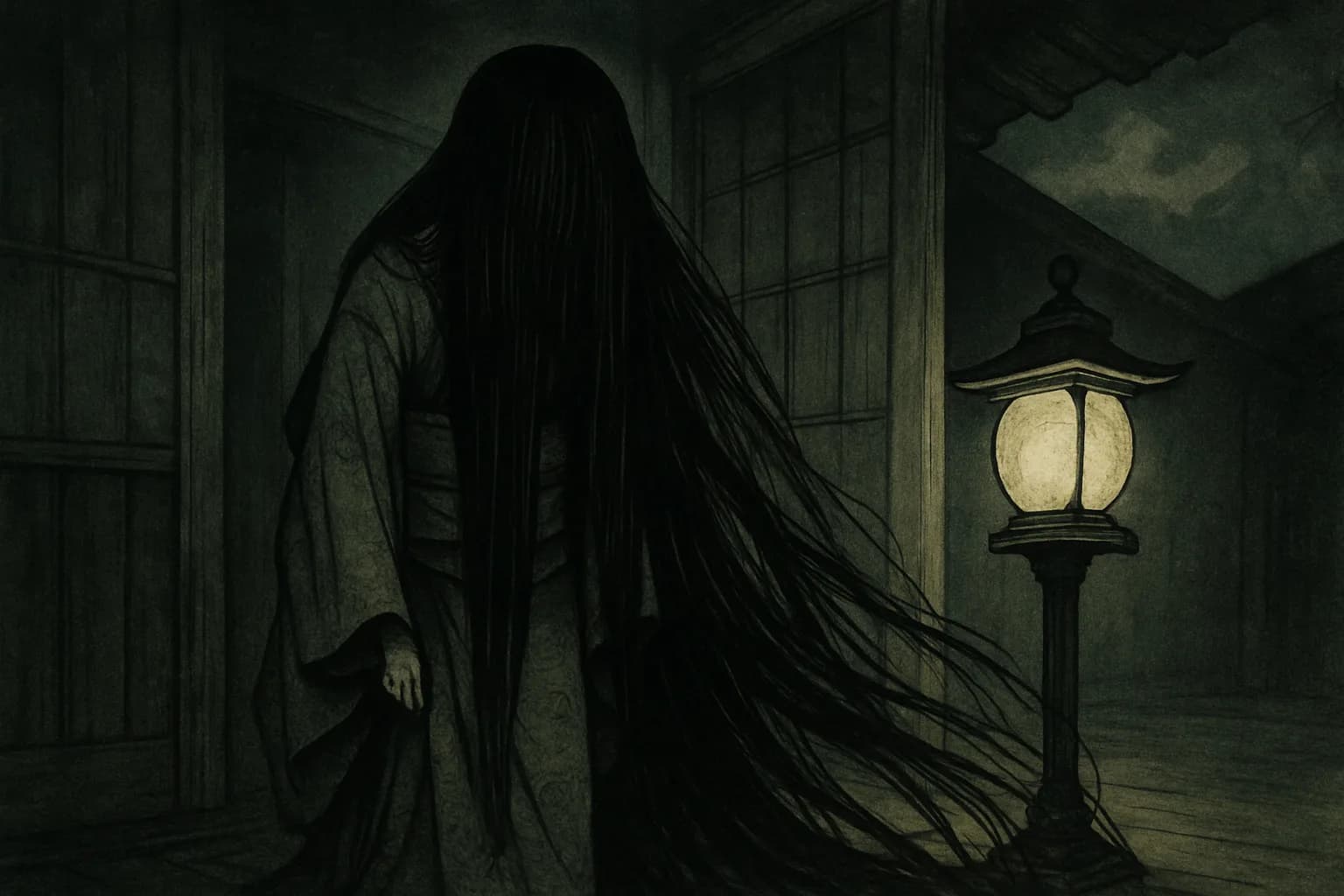
In one widely told version, the setting is a school's third floor, the girls' toilet, the third stall. Knock on its door three times. Ask, out loud, "Hanako-san, are you there?" If you are unlucky, a small voice answers from inside: hai — yes. That is the ritual, in its simplest form. It needs no shrine, no priest, and no century-old text. It only needs a school with working plumbing, which is why some version of it has spread into nearly every one.
What does she look like?
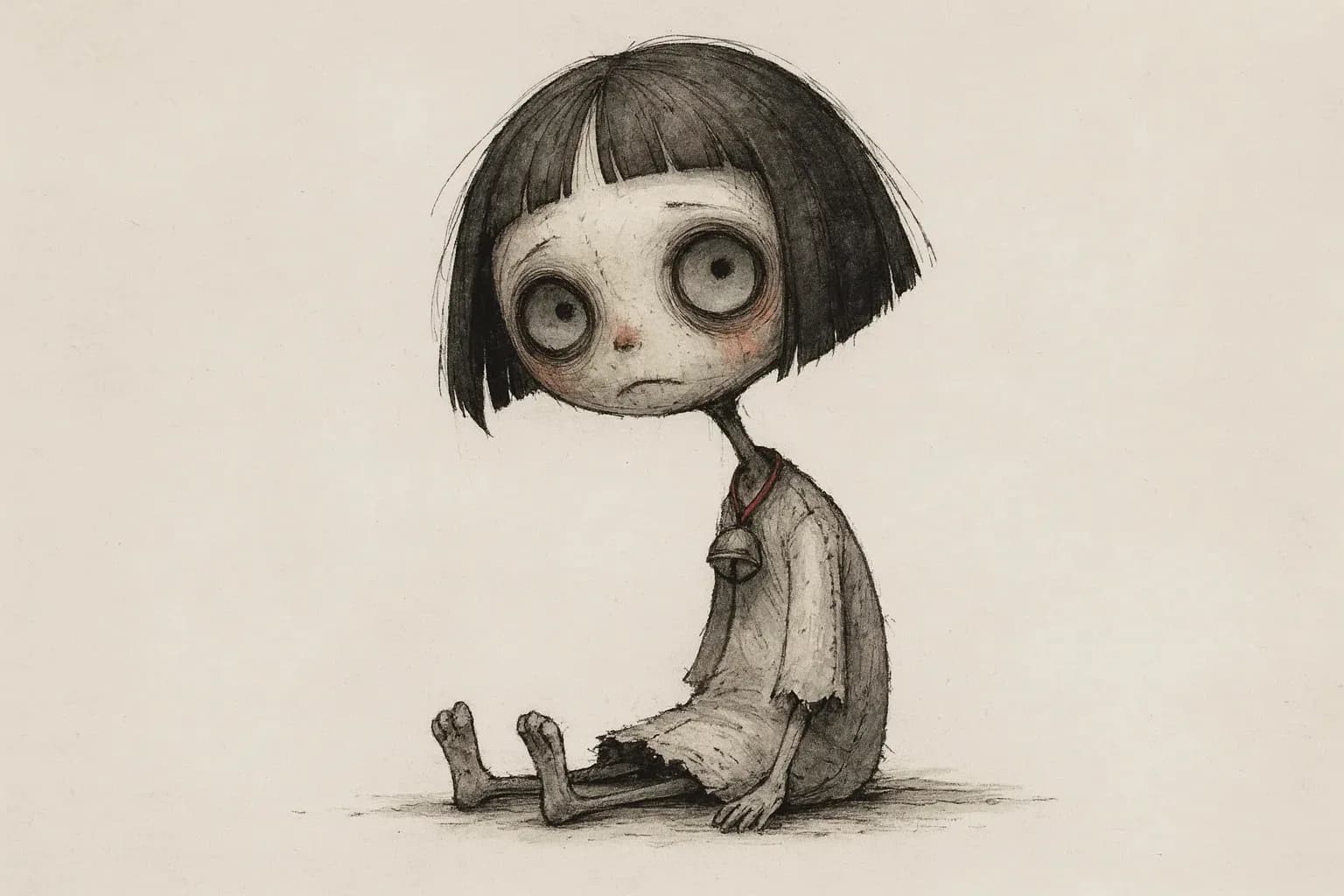
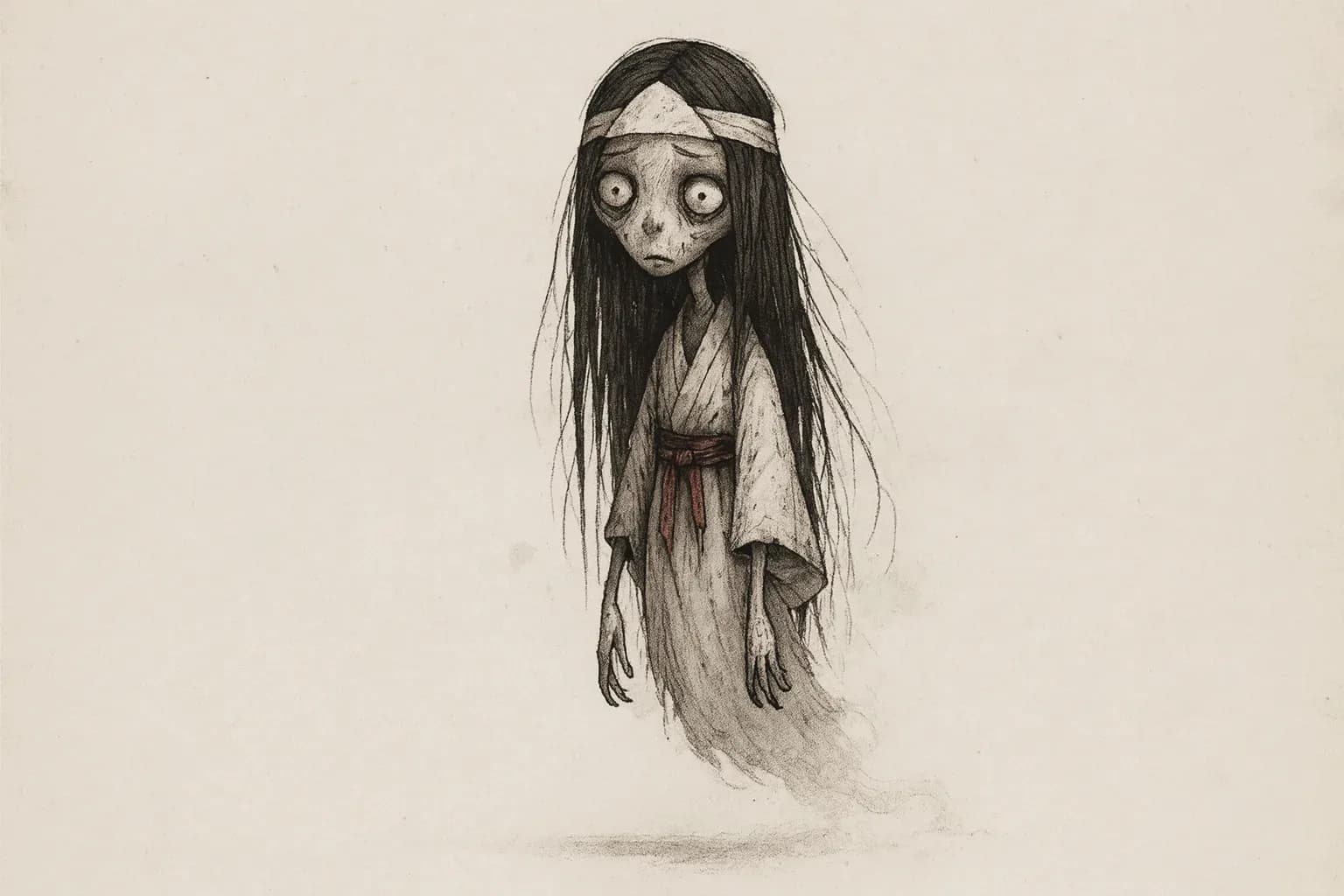
The classic Hanako-san wears a red jumper skirt, the kind held up by shoulder straps. Her hair is cut in a short, straight bob called okappa. Some versions add a plain white blouse underneath. Beyond the skirt and the hair, her exact look is not fixed. Her face, her height, even her age shift from telling to telling. She is less a described monster than a shape every storyteller fills in themselves.
The knock, and what answers
The most common version of the ritual sends a child to the school's third-floor toilet after hours. They knock on the third stall three times and ask for Hanako-san by name. A faint voice says yes. Open the door, and a red-skirted girl is standing there. She pulls the child in.
Other versions skip the knocking. A child calls out, "Let's play," and the voice asks, "What shall we play?" Answer "the strangling game," in one telling, and that is exactly what happens next. A gentler escape exists too: show Hanako-san a test with a perfect score of 100, and she is said to scream and vanish.
None of this is standardized. That is the point. A ghost with no single canonical script is a ghost every school can localize for itself — and across Japan, they did.
A rumor with a thousand local accents
In Yamagata, children call to her on the way out of the toilet; an ugly-sounding reply means trouble is coming. Another Yamagata telling throws out the girl entirely: Hanako-san's real form, in this version, is a three-headed lizard roughly three meters long, using a child's voice to lure prey before eating it.
In a Kurosawajiri schoolhouse in Iwate, the story skips the girl altogether. Enter the third stall, and a voice announces "Third Hanako-san" — then a large white hand rises through a hole in the floor. In Yokohama, the girls' toilet keeps Hanako-san, but the boys' toilet has its own ghost, called Yōsuke-san; callers there are told they have three seconds to run. A Hyōgo version turns the whole school into a haunted family tree: Hanako's father, mother, sister, and brother each claim a different stall, and a ghost boyfriend named Tarō is said to shoot baskets in the gym at night.
The name itself isn't even fixed. Children in Nagano call out to "Yukiko-san" in their own third stall. In Chiba, students circle a second-floor stall three times, call for "Mii-chan," and flush. Scholars who have collected these variants suspect every regional Hanako is effectively a cousin of every other — the same rumor, told by a new set of schoolkids, with the serial numbers filed off.
Where it comes from
Nobody wrote Hanako-san. Researchers trace the legend to an oral rumor called "Sannome no Hanako-san" — "the Third Hanako-san" — that was already circulating by around 1950. It stayed mostly local for thirty years. Then, sometime in the 1980s, it went national, passed child to child. By the 1990s, during a nationwide surge of interest in the occult, she had reached film, manga, and anime.
Nobody agrees on who she was in life, either. One story says a molester chased a girl into a school on a holiday and killed her in the third stall. Another says she was abused by her father, and that her bob haircut hides old wounds. A third places her death at a library window in Fukushima. A fourth skips tragedy altogether: a girl who delivered persimmons to a nursing home, killed in a traffic accident, her ghost settling into the tree she used to pick from. One account even supplies a full biography — born 1879, real name Hasegawa Hanako, disliked milk, fond of table tennis — treating a rumor like a census record. None of these is the "true" story, because a rumor this old and this scattered was never given one.
One theory reaches further back than any of them. From the Edo period into the early twentieth century, Japanese households honored a toilet god, offering red-and-white dolls or flowers at the outhouse. That worship faded after the war — but plastic flowers still sit in toilets across the country, an old habit nobody remembers the reason for. Hanako's red-and-white clothes, and a name that literally means "flower child," may be the last trace of a god nobody prays to anymore.
Hanako-san on screen
The legend has outgrown the school hallway. A 1995 film from the studio Shochiku cast her against type: not a killer, but a protector, saving children from a real-world attacker by the story's end. A theatrical anime version followed in 1996. A supposed sequel in 1998, despite the name, told an unrelated story about an evil doll posing as her. A 2007 direct-to-video release gave her yet another backstory: a bullied student who took her own life. Live-action films returned to her in 2013 and again in 2016 — the second one pitting her directly against Yokohama's Yōsuke-san, two regional rumors finally made to share a screen.
Every version disagrees with every other version. A ghost born from an unsigned rumor was always going to stay that way.