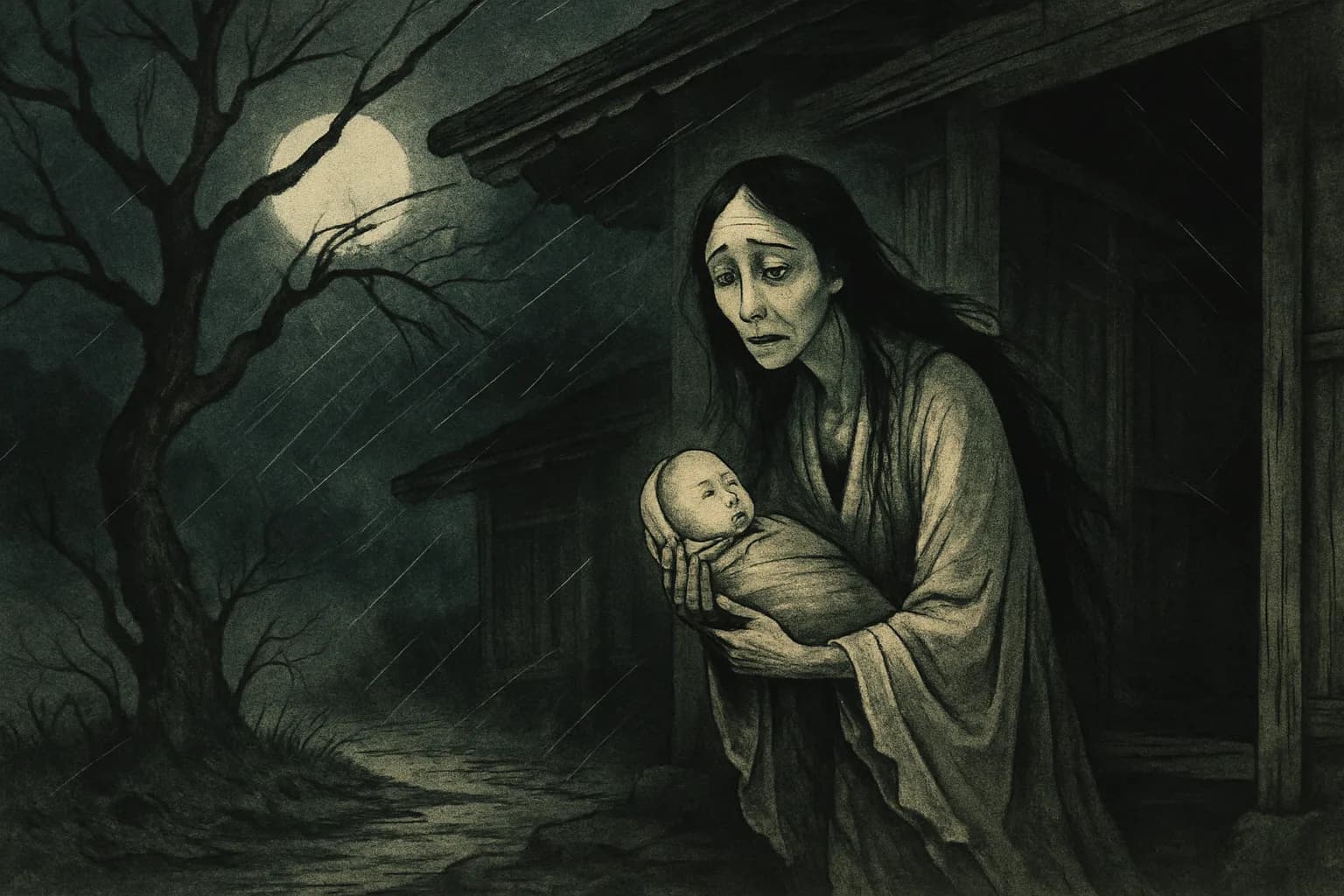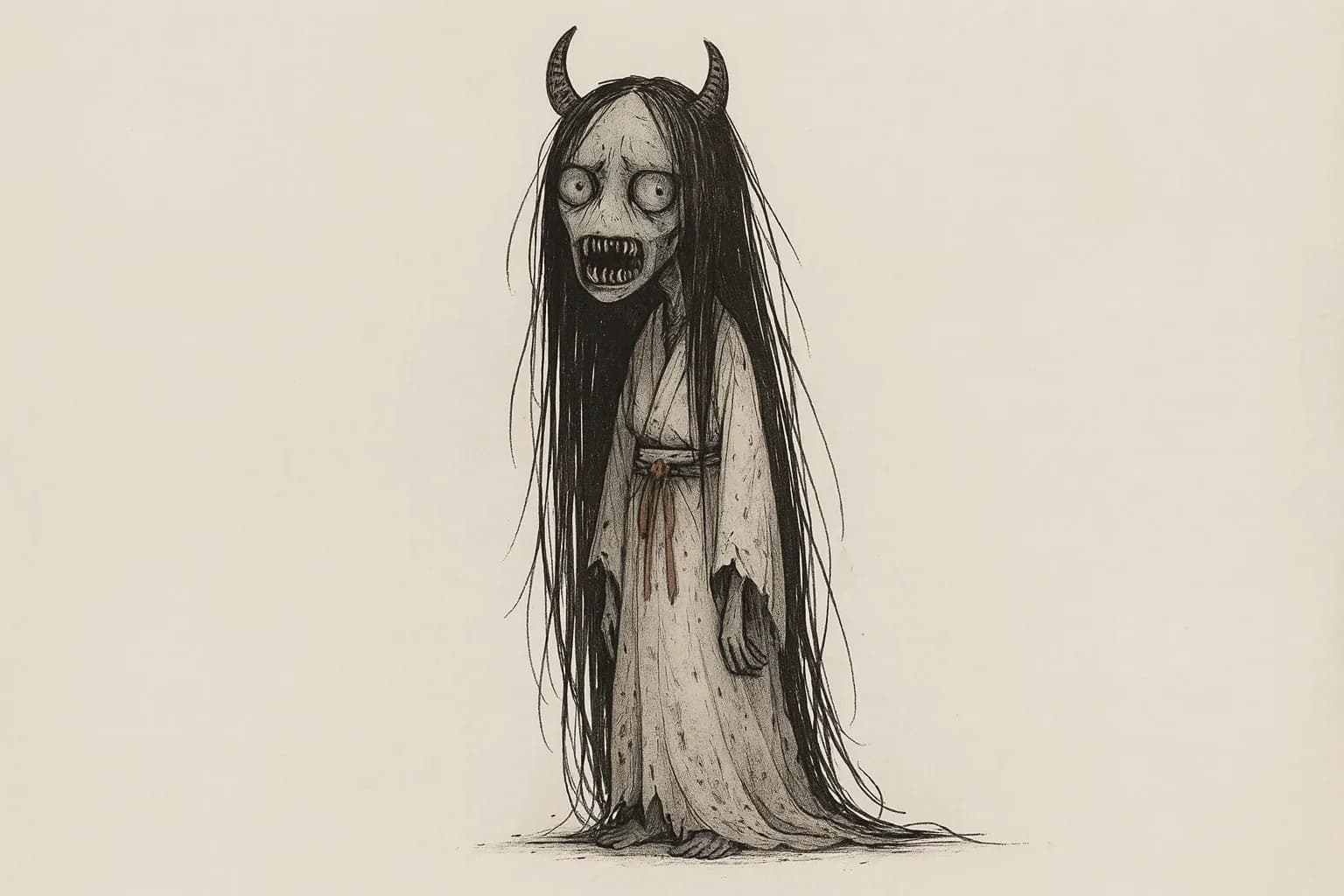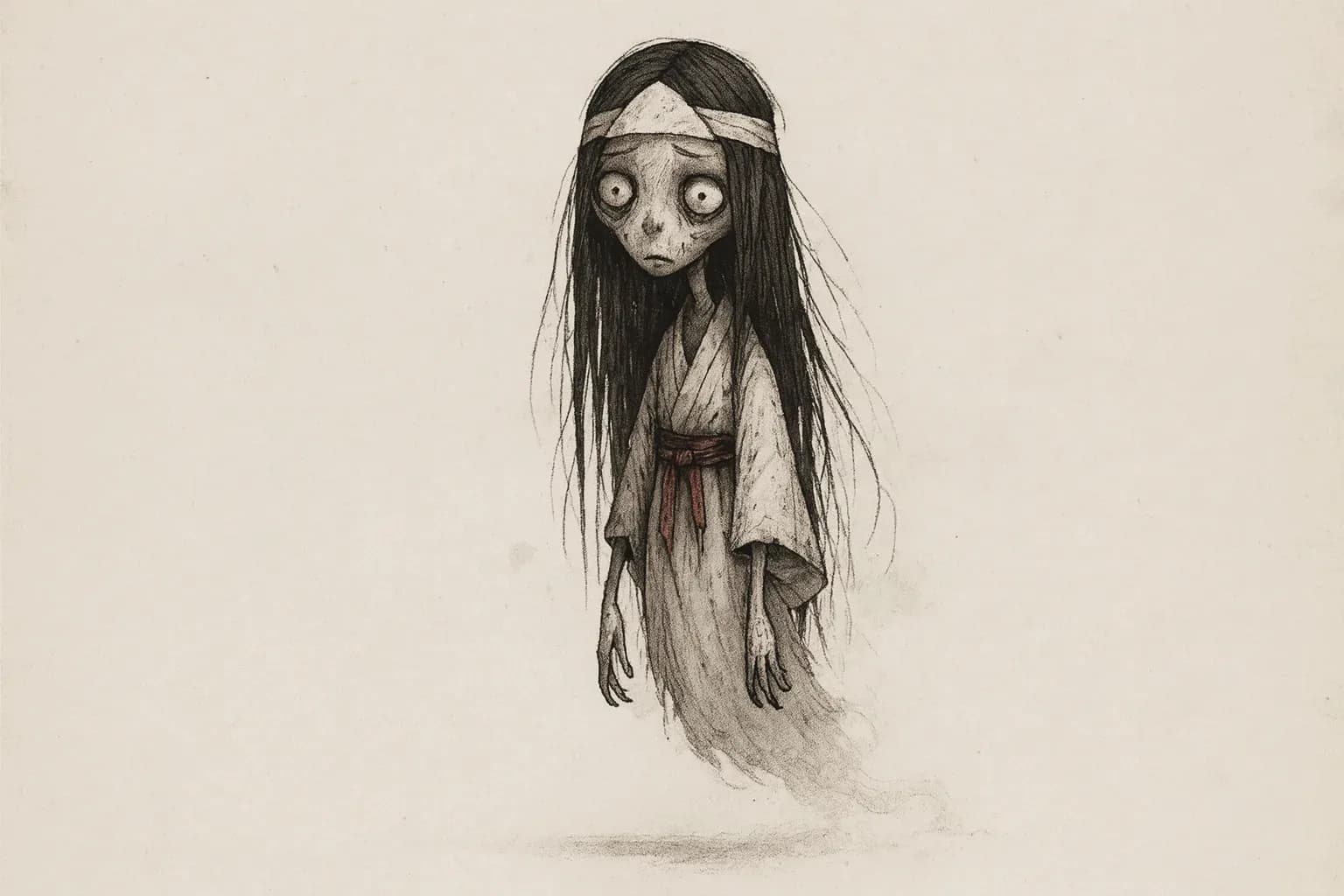
Every culture has ghosts, but few have standardized one down to the last detail the way Japan has the yurei. Ask any Japanese schoolchild to draw a ghost and you'll get the same figure a woodblock artist would have drawn two hundred and fifty years ago: a white burial robe, long black hair hanging loose, arms bent limp at the wrist, and nothing at all below the knees. That image didn't drift into place by accident. It was assembled, piece by piece, out of real funeral customs, and then locked in by a handful of painters and playwrights who all happened to be working around the same few decades of the eighteenth century.
What does a yurei look like?
The white robe is a shini-shōzoku, the burial kimono a corpse was dressed in for its funeral — so a yurei, in effect, is still wearing its own grave clothes. Many depictions add the hitaikakushi, a small white triangular cloth tied across the forehead, another genuine piece of Edo-period funerary dress rather than an invented prop. The hair is worn down and undone because Edo-period women bound their hair up in life; loosened hair on a woman was itself already a small sign that something was wrong, and death was the final, permanent version of that disorder. The hands droop forward from limp wrists, and — the detail everyone remembers first — the legs and feet simply aren't there. The figure seems to hover, trailing off into mist below the knee, as if it belongs to this world only from the waist up.
That legless silhouette is not ancient. It's generally traced to the painter Maruyama Ōkyo, whose mid-eighteenth-century hanging scroll of a footless female ghost — often called Yūrei-zu, "The Ghost of Oyuki" — is the image credited with popularizing the look. Toriyama Sekien then folded yurei into his own catalogue of the supernatural in Gazu Hyakki Yagyō (1776), and by the time ukiyo-e print culture caught up, the footless, white-robed figure was simply what a ghost looked like in Japan, full stop.
Why a yurei rises at all
A yurei is not a wandering soul by default — in the folk cosmology, a person who dies well, is properly mourned, and has their funeral rites correctly performed passes on and stays gone. A yurei is what happens when that process breaks: a sudden or violent death, a grudge left unsettled, grief too strong to let go of, or rites nobody performed because the body was never found. The tie holding the spirit here has a name, shūshin — attachment — and until it's resolved, the dead don't leave.
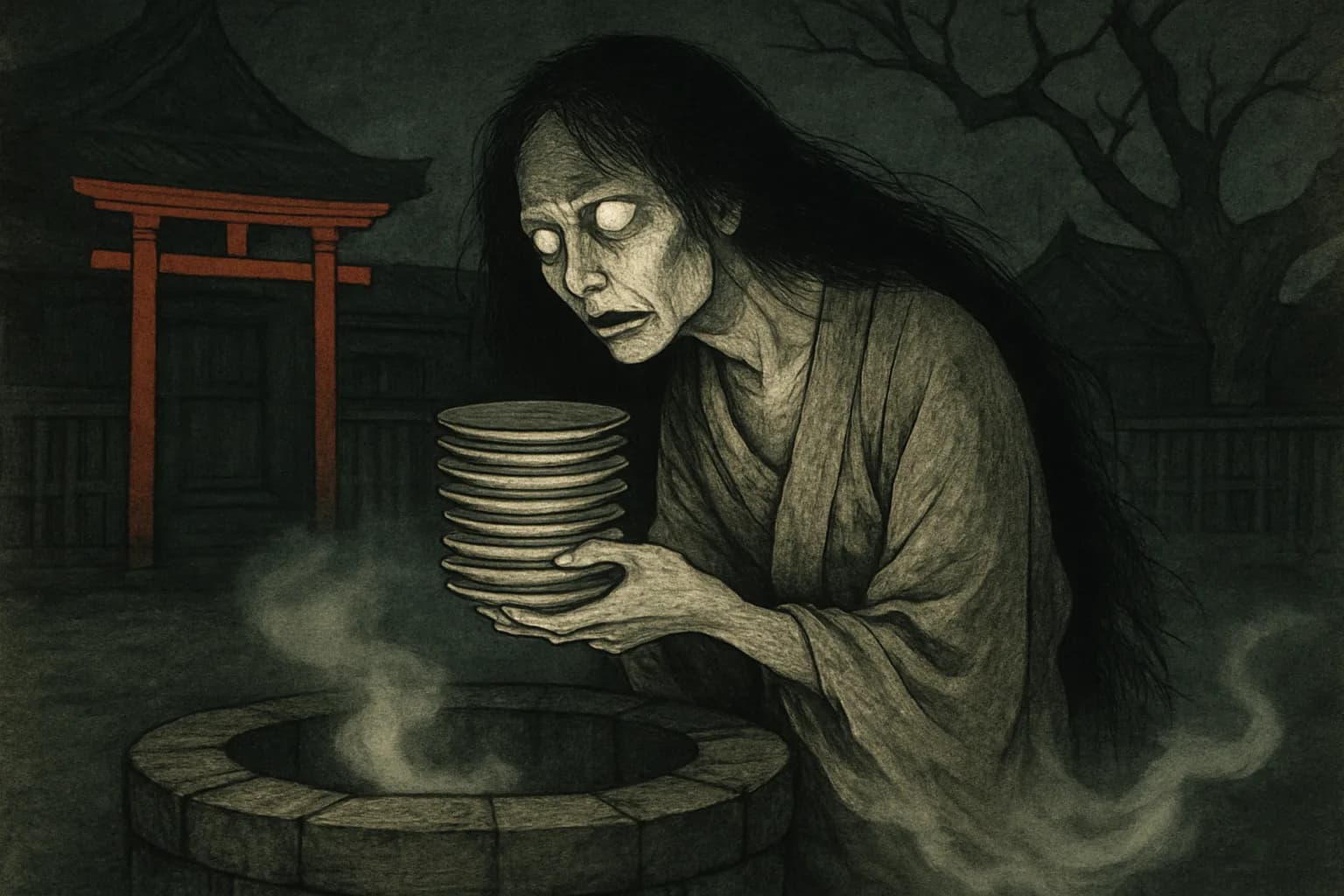
This is also why yurei folklore sorts itself so cleanly by motive. A spirit that lingers out of sorrow or longing is simply a yurei. One that lingers to make someone pay is an onryō — a vengeful ghost — and Japanese theater has never gotten tired of them. The most famous is Oiwa, of Tsuruya Nanboku's kabuki play Yotsuya Kaidan (1825): poisoned and disfigured by her husband, she comes back with a ruined face and does not stop until his new life is destroyed along with him. Okiku, the plate-counting ghost of Banchō Sarayashiki, is the gentler cousin of the same idea — a servant wronged and killed, doomed to count to nine forever because the tenth plate she's accused of breaking was never really lost.
Related, but not the same, names
Yurei is the everyday word, but two older, more formal terms overlap with it in classical texts and are worth knowing if you read further. Bōrei (亡霊), "departed spirit," is close to a plain synonym and turns up often in more literary or historical writing about the dead. Shiryō (死霊), "dead spirit," is used more specifically in contrast to ikiryō (生霊), the living spirit of someone whose intense jealousy or rage detaches and goes haunting while its owner is still alive — a distinction Heian-era court literature, including The Tale of Genji, already draws in detail. None of these are regional nicknames for one folk creature the way kappa has a dozen local names; they're overlapping vocabulary for the same broad idea of a spirit unmoored from a body, sorted by exactly what's wrong with it.
Where it comes from
Buddhist and Shinto funeral practice both assume a soul needs help finishing its transition — sutras chanted, a proper grave, memorial rites repeated on a schedule for years afterward. A yurei is folklore's picture of what happens when that machinery fails, and it's telling that the classic cases are disproportionately women: wives, servants, and lovers who had the least power in life and, in death, finally get to be the one with something over someone else. Noh theater's mugen ("dream") plays, where a spirit reappears to tell the traveler who meets it exactly what went wrong, were doing this same work a good three centuries before Sekien ever put brush to paper — the ghost returns not to attack, but to be heard.
Yurei today
The image barely changed once the Edo period fixed it, which is exactly why it survived into film. Sadako climbing out of the well and the television in Kōji Suzuki's Ringu (adapted 1998) and Kayako in the Ju-On series both draw directly on the shini-shōzoku and loose black hair rather than inventing anything new — Japanese horror cinema's global reputation rests substantially on a costume design that's older than the country's constitution. Summer is still, informally, ghost-story season: kaidan storytelling nights and horror films alike cluster around Obon, when the dead are already thought to be closest to the living, and a yurei never has to travel far to make an appearance.