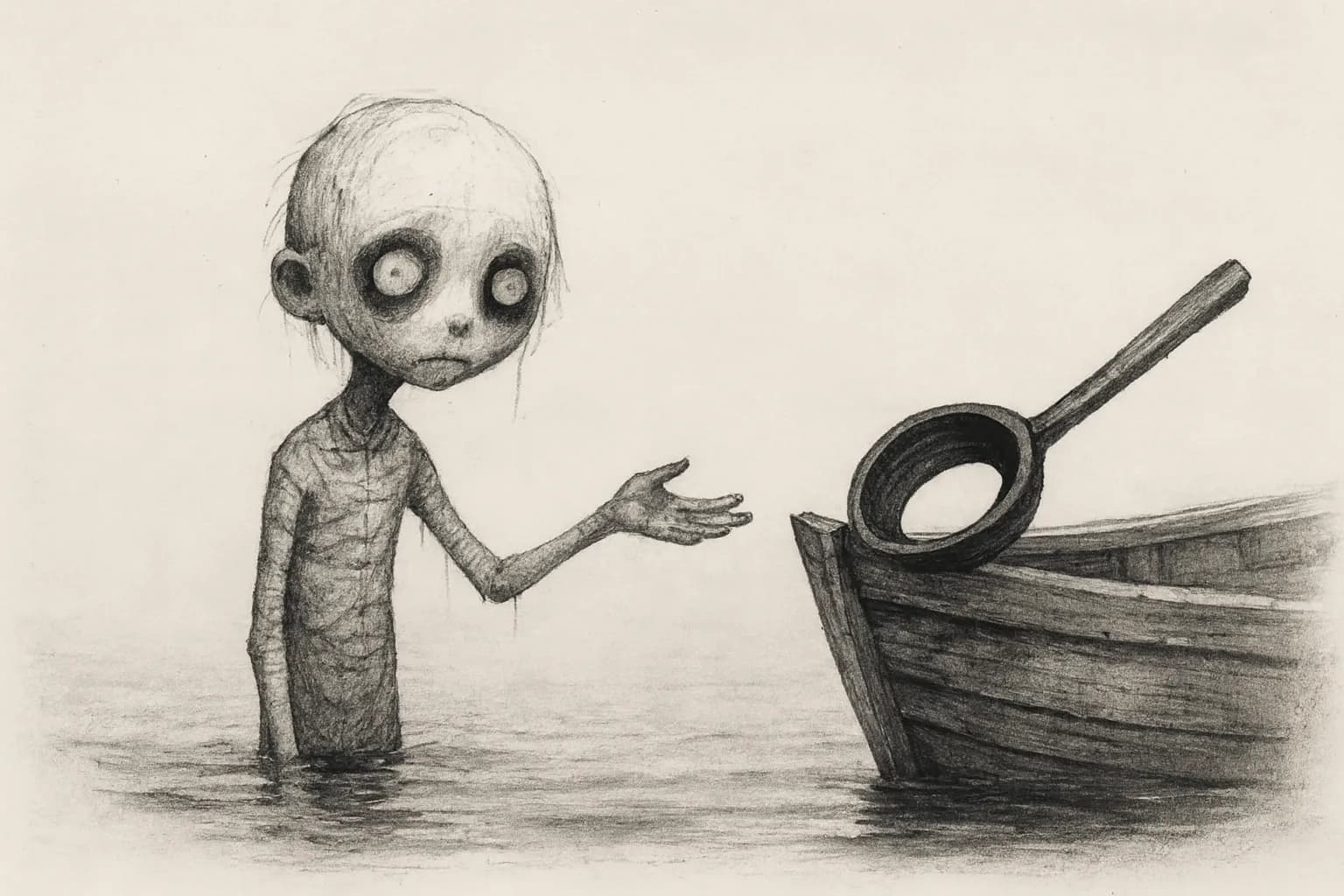
A becalmed boat, a moonless sky, and a voice carrying across water that shouldn't carry a voice at all — that is how most funayurei stories begin. The request is always small and always the same: hishaku o kashite kure, lend us a ladle. Sailors who grew up on this coast knew the polite thing to do was refuse.
Who they are
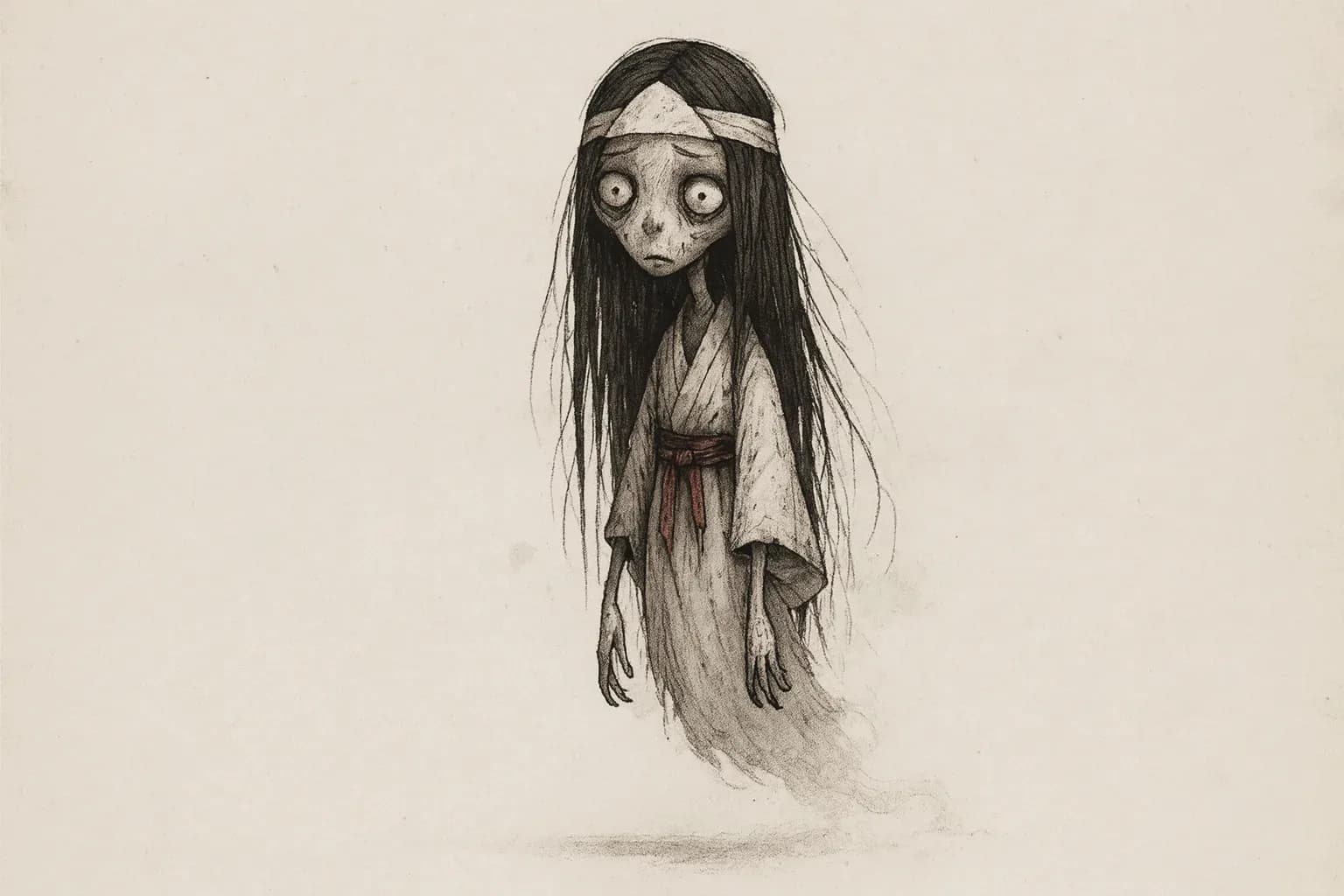
Funayurei are the dead who did not get to finish dying properly — sailors, fishermen, and passengers lost in wrecks, storms, or drownings, whose bodies were never recovered and whose funeral rites were never performed. Unmoored in the most literal sense, they linger at the site of their death and crew phantom versions of the ships that sank them. Some tellings describe a single pale figure standing waist-deep in the water beside a boat; others describe a whole ghost vessel, sails set, gliding toward a living crew with no wind to move it.
Either way, the goal is the same: company. A funayurei wants more hands on its side of the water, and it recruits by drowning.
The request that sinks you
The trap is built into the folklore's own rules of politeness. A funayurei surfaces beside a boat and asks, plainly, for a hishaku — a wooden dipper used for bailing water. Hand one over in good faith and the ghost puts it straight to work scooping seawater over the gunwale, again and again, faster than any crew can bail back out, until the boat goes under and joins its fleet.
The counter-move, passed down through generations of coastal households, is to give the ghost a hishaku with the bottom knocked clean out. It can dip the ladle all it wants; nothing stays in it, and the boat stays afloat. Some versions of the story add a second layer of caution: never answer the first hail from open water at all, because acknowledging the voice is itself an invitation.
When they rise
Funayurei were not thought to appear at random. Sailors watched for the conditions that made an encounter likely: a flat, windless sea gone strangely quiet, thick fog, rain with no thunder behind it, or a night with no moon to mark the horizon. Many communities also linked sightings to the Obon festival in midsummer, when the dead in general were believed to cross back toward the living — a season when a fisherman's family was especially reluctant to see him put out to sea after dark.
Other precautions layered folk religion onto the fear: scattering the five grains — rice, wheat, beans, and the like — across the water, extinguishing a lantern rather than letting a ghost fix on its light, or simply turning the boat and running before the hail was answered.
A regional face
The core belief holds along nearly the entire Japanese coastline, but it wears different names depending on the sea. Around the Seto Inland Sea, similar ghost-ship apparitions are known as ayakashi, a term that in other regions covers strange sea-lights or omens more broadly. Elsewhere the ghosts are folded into local variants of funa-obake or described simply as the crew of a named wreck still working the water where it went down — a funayurei story is often, underneath the ladle and the fog, a memory of one specific bad night for one specific boat.
Where it comes from
The folklorist Yanagita Kunio, whose decades of fieldwork across Japan's coastal villages did more than anyone to record this material systematically, catalogued funayurei among the beliefs sailors carried well into the twentieth century — evidence that this wasn't a fading Edo-period curiosity but a live superstition among working fishermen. Read plainly, funayurei folklore is a way of processing a real and constant danger: drowning at sea, often with no body to bury and no grave to visit. A ghost that wants company is a shape given to an old, practical grief — the guilt of the living who survived a wreck that others didn't, and the fear that the sea keeps what it takes.
Funayurei today
Ghost ships and drowned crews remain a reliable engine of Japanese horror fiction, showing up in kaidan anthologies, horror manga, and coastal ghost-story collections aimed at tourists as often as scholars. The bottomless ladle survives as the detail every retelling keeps, because it is the rare piece of yokai folklore that reads less like a myth and more like actual maritime advice: keep a spare bailer aboard, and never be too quick to hand your only one to a stranger in the water.