A strong north wind meant the isonade might be near. This shark-shaped sea monster haunted the coast off Hizen-Matsuura, gliding up to a boat in near silence. Its name, isonade (磯撫で), means "stroke the shore." By the time anyone noticed, its tail was already in the water beside them.
What does it look like?
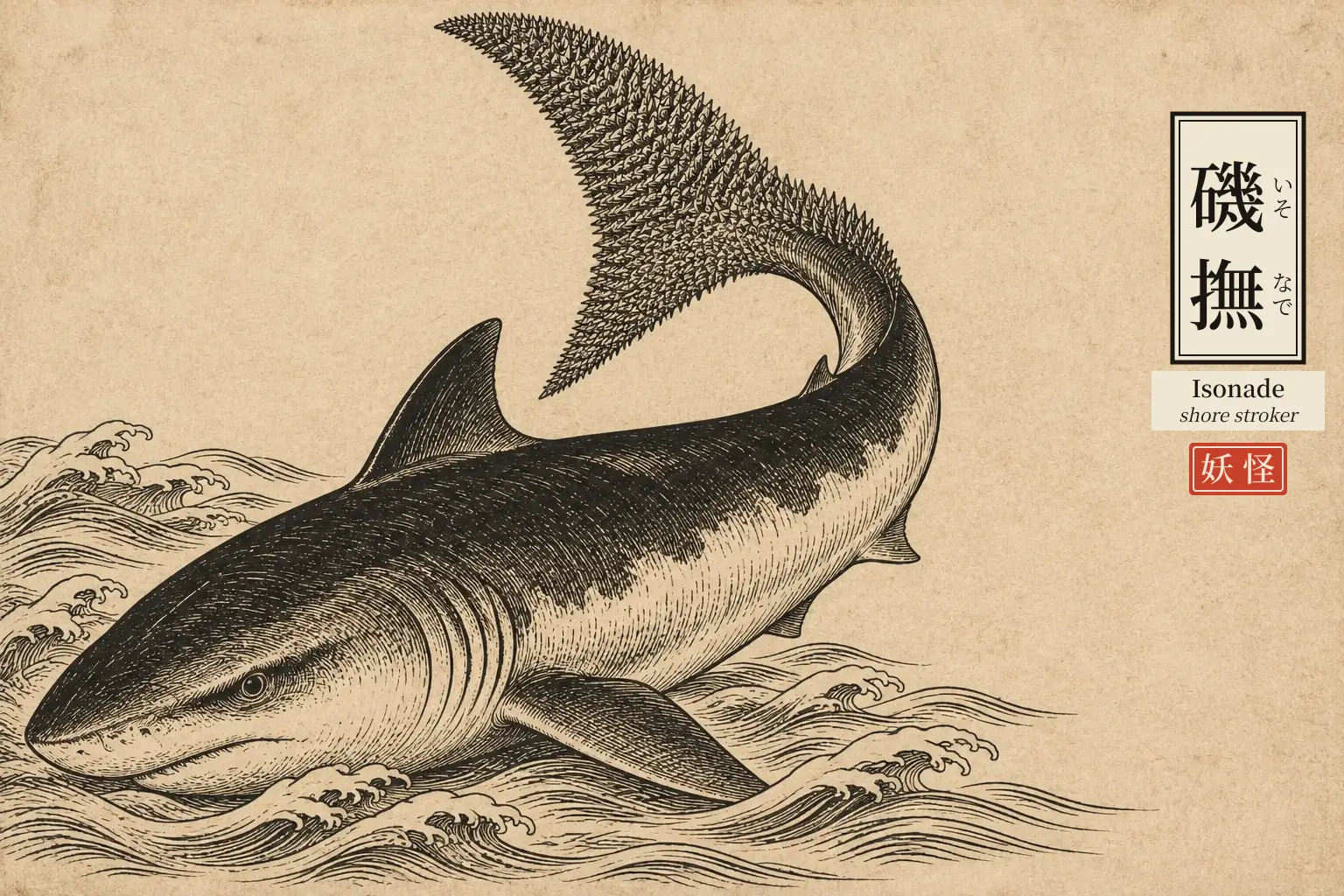
Old accounts describe the isonade as shaped like a shark. That much is simple. The strange part is its tail.
The tail fin carries countless fine spines. Writers compared them to an oroshigane — a metal kitchen grater. A person caught by that tail was pulled straight under the water.
How it hunts
The isonade waits for a strong north wind. Then it comes to a boat almost without a sound. It does not thrash. It glides across the surface, as if stroking it.
Sailors reported only one warning sign: a shift in the color of the sea, or a sudden gust of wind. Then the spines hooked into a person's body. The isonade pulled its victim under the water, and ate them there.
Another name, in an old medical text
Not every old writer called it isonade. The old text Honzō Ikō (本草異考) names the same creature Ōguchi-wani (巨口鰐) — "big-mouth wani." Wani is an old word for shark. Two writers, two names, one animal.
Where it comes from
A body on the shore needed an explanation. In Kumano, in Mie Prefecture, people had one ready. If someone turned up dead by the water, with no obvious cause, locals said: 磯撫でに撫でられたのだろう — "it must have been stroked by an isonade." The explanation and the name worked together. A death with no visible cause became a death with a cause.
The folklorist Tada Katsumi has offered two guesses about where the image began. One is the orca. But orcas do not have spiked tails, so that detail has to come from somewhere else. The other guess is the saltwater crocodile. From the Muromachi period on, Japanese sailors traveled through Southeast Asia and could have seen them there. A crocodile's ridged back could easily become a monster's grater-like tail.
Go deeper
Books worth owning if this world pulls you in.
- The Book of Yokai →Michael Dylan FosterThe most readable scholarly introduction to yokai — where they come from, what they mean, and the major creatures.
- Japandemonium Illustrated: The Yokai Encyclopedias of Toriyama Sekien →trans. Hiroko Yoda & Matt AltThe complete Edo-period bestiaries that so many of these entries trace back to, in full English translation.
Some links are affiliate links; if you buy through them we may earn a small commission at no extra cost to you.
A cousin in Shimane
Western Japan has at least one close relative. In Yunotsu, once part of Nima District in Shimane Prefecture, people told of the kagewani (影鰐). Yunotsu is now part of Ōda City. Kagewani means "shadow wani."
The kagewani did not need to touch anyone. It swallowed the reflection of a sailor's shadow on the water. Lose your shadow, and you were certain to die.
One story ties the kagewani to an ordinary stroke of bad luck. A boatman shot one. Its bone later pierced a man's foot on a beach and killed him. In the story's own logic, the creature could still reach him on land.
Isonade today
The isonade has no mascot status to speak of; today it appears mainly in scholarly yōkai compendia. Folklorist Murakami Kenji included it in his Yōkai Jiten in 2000. Mizuki Shigeru catalogued it too, in 2004, in the fifth volume of Yōkaika. He noted the irony himself: sailors who go out to catch fish end up caught by one instead.
That line is the clearest judgment anyone has passed on the isonade. It is not a trickster like the kappa, and it does not reward good manners. It is simply a predator with a name, waiting under a shift in the sea's color.