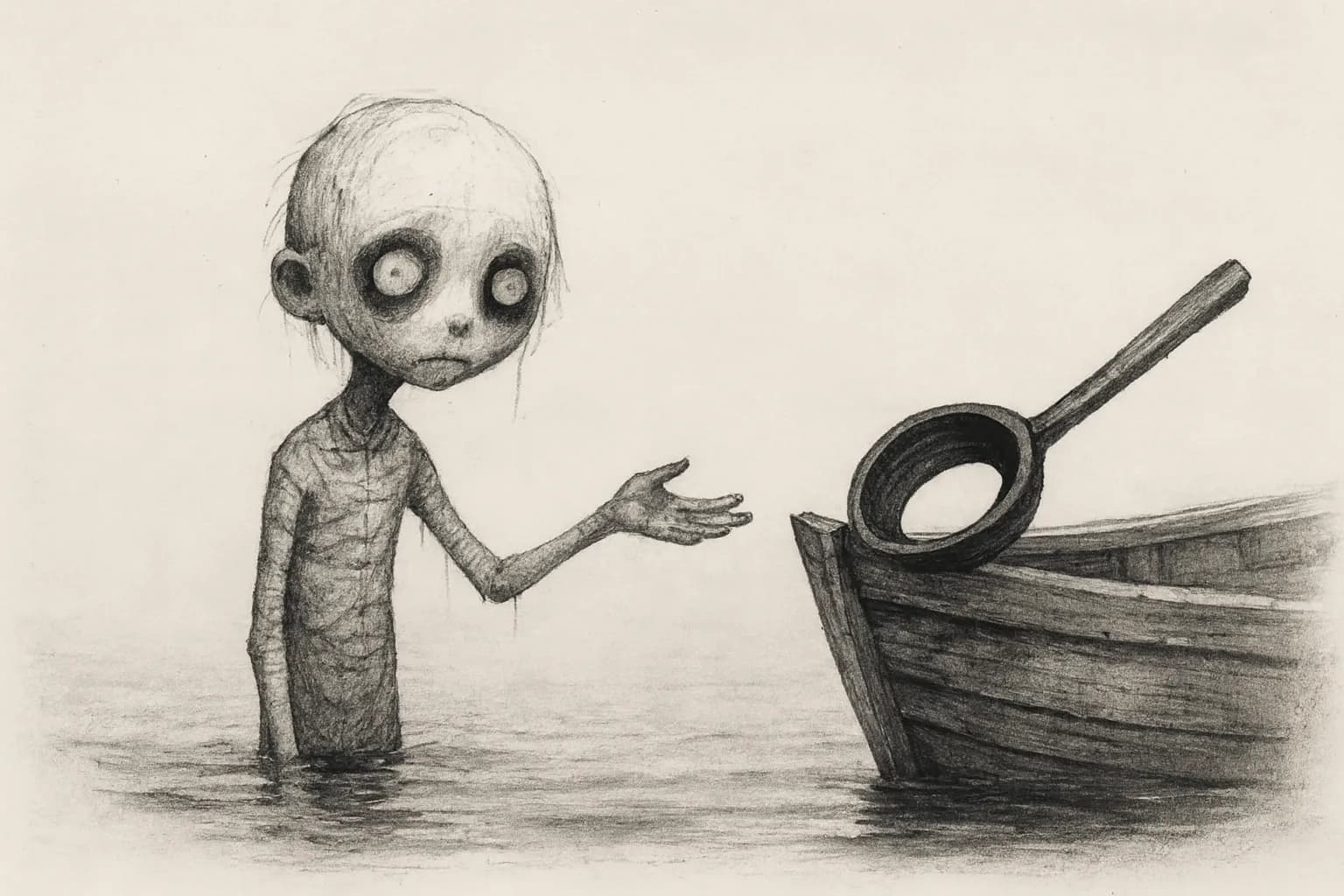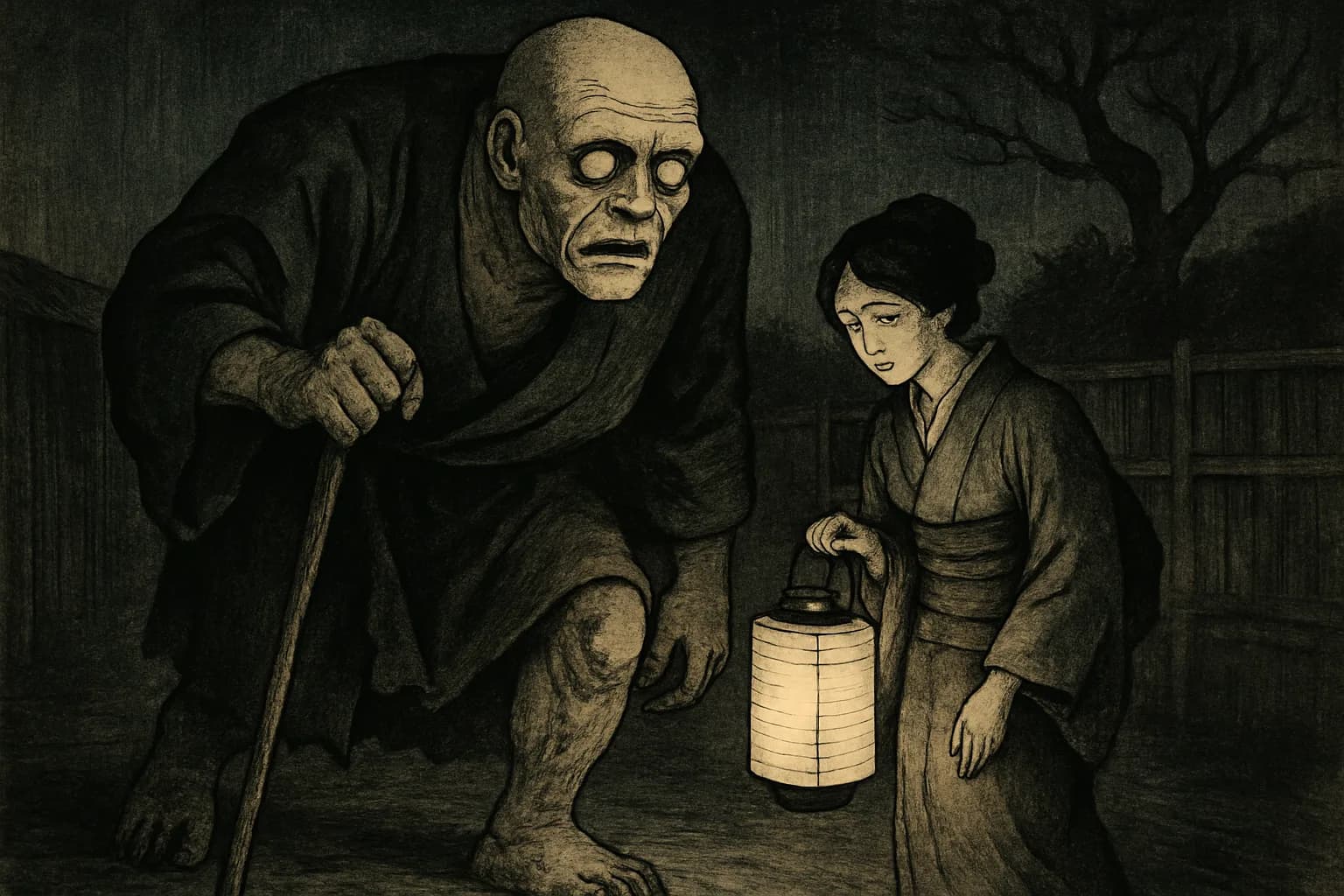
Picture the zatō of old Japan: a blind traveling entertainer, cane in hand, plucking a biwa and reciting the Tale of the Heike from village to village, forever navigating roads he could not see. Now picture one who never made it to land at all — a figure the size of a hill, wading chest-deep through open ocean at night, cane sweeping through black water instead of dirt. That is Umizato, "the sea zatō," and the joke folded into his name is also the whole of his menace: he is a blind man's hazard, scaled up to the size of the sea itself.
What does it look like?
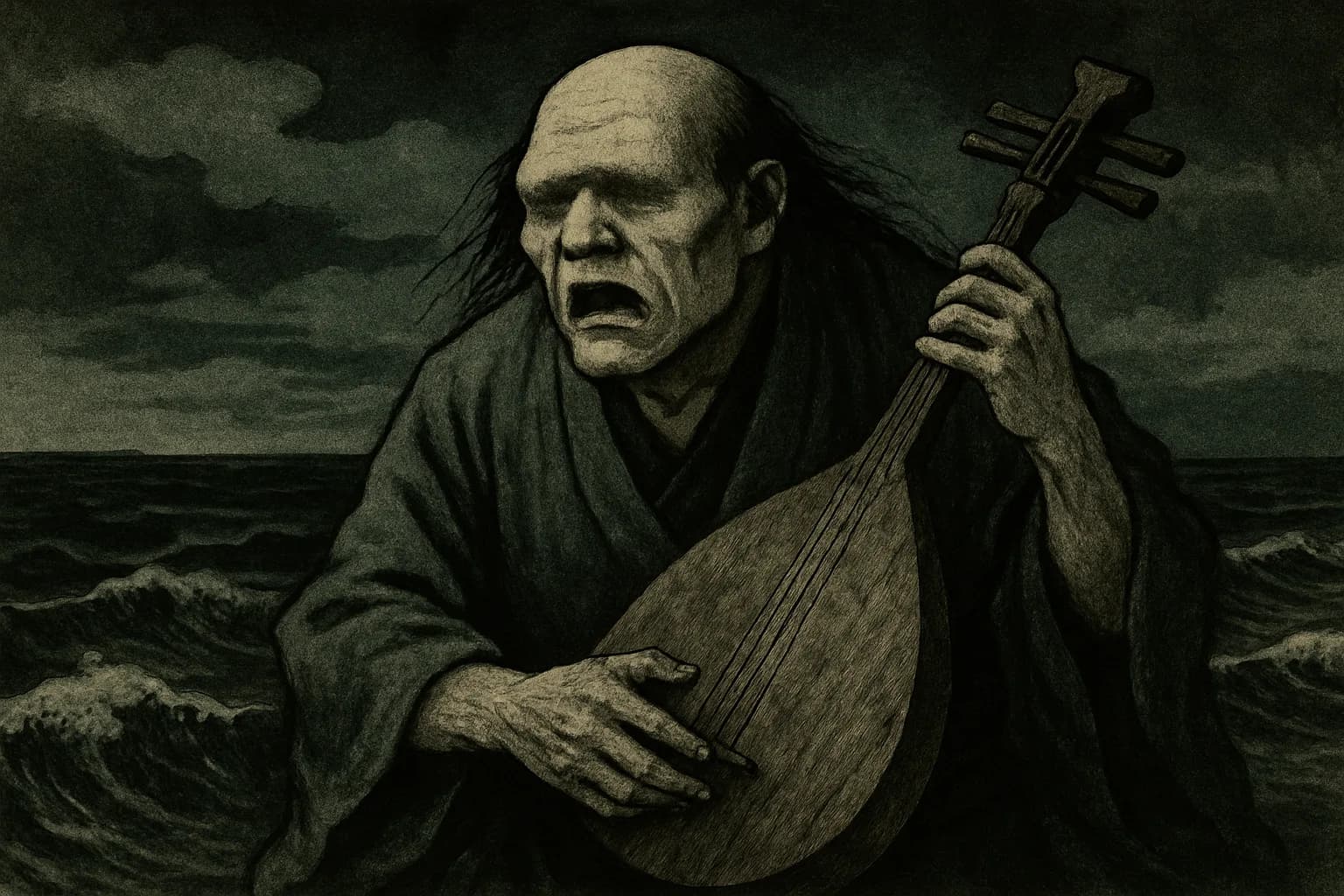
Toriyama Sekien drew Umizato in his 1776 picture-book Gazu Hyakki Yagyō ("The Illustrated Night Parade of a Hundred Demons") as an enormous zatō figure — shaved head, plain traveling robe, a walking stick in hand — standing waist- or chest-deep in rolling waves far from any shore. He carries the trappings of a real Edo-period profession: the zatō were a licensed guild of blind men who worked as musicians, masseurs, and moneylenders, easily recognized on any road by their canes and their close-cropped heads. Sekien simply moved that familiar silhouette out past the breakers and let it grow to the size of a cliff.
A blind giant on a lightless sea
Sekien's own caption plays on a stock worry about the zatō: that a blind traveler, however careful, might lose his way in rough country and wander into a mountain gorge by accident. If that can happen on land, the text reasons, it should happen at sea too — hence a zatō who has drifted onto the ocean and never found his way back. Unable to see the horizon, the shore, or the boats around him, Umizato simply wades on, indifferent to what stands in his path.
That indifference is the danger. Sailors who spotted a huge, dark shape moving through calm water at night had no way to signal it, reason with it, or steer around something so large — and a giant who cannot see a boat is a giant who can capsize one without ever meaning to. Later folklore built the encounter into something closer to a test: Umizato was said to hail passing boats out of the darkness with a question, and answering him — in either direction, yes or no — invited misfortune down on the boat that spoke back. Silence, and hoping he waded on past, was the only real strategy.
A cousin invented for the joke
Sekien didn't stop with one sea-zatō. His books also include Ōzato, "the great zatō," an even larger variant of the same idea — proof that this wasn't a single village's ghost story but a deliberate literary conceit Sekien built out and varied, the way he did with several of his invented yokai. Modern readers sometimes lump Umizato in with older, more diffusely-sourced sea monsters like umibozu, the looming black shape that rises from unnaturally still water, or funayurei, the ghosts of drowned sailors who beg for a bailing ladle before using it to sink you. All three share the same coastline of Edo-period sailor anxiety, but Umizato is the one built explicitly on a pun about blindness and distance rather than on a drowning or a haunting.
Where it comes from
Sekien's four yokai picture books were not simply transcriptions of village folk belief — a number of his creatures, Umizato among them, read as literary extensions of existing folk figures rather than monsters villagers already told stories about before he drew them. That doesn't make Umizato less "real" as a yokai; it makes him a good example of how much of Japan's yokai catalogue was actively composed, not just collected, by Edo-period artists working from a shared cultural vocabulary of blind travelers, mountain hazards, and the specific dread of an unlit, unpredictable sea. The zatō's real-world reputation — a skilled, respected tradesman who was nonetheless the butt of jokes about wandering off course — gave Sekien exactly the shape he needed to stand a hazard up out of the waves.
Umizato today
Umizato never crossed over into the mainstream the way kappa or tengu did; there is no cucumber roll named after him, no mascot version handing out tourist maps. He survives mostly in the place he started: yokai encyclopedias, art-book reproductions of Sekien's four picture books, and the English-language translation Japandemonium Illustrated (Hiroko Yoda and Matt Alt, 2017), which carried his entry — cane, robe, and all — to readers outside Japan for the first time. He remains, in other words, exactly what Sekien drew him as: a curiosity glimpsed once on the page, wading through water no one else can see.