Fishermen on the Bungo Channel watched the water on rainy nights. Sometimes a light rose off the surface, far from any boat but their own. It changed shape depending on who saw it. It went by more than one name. Say the wrong one out loud, and it came closer.
What does it look like?
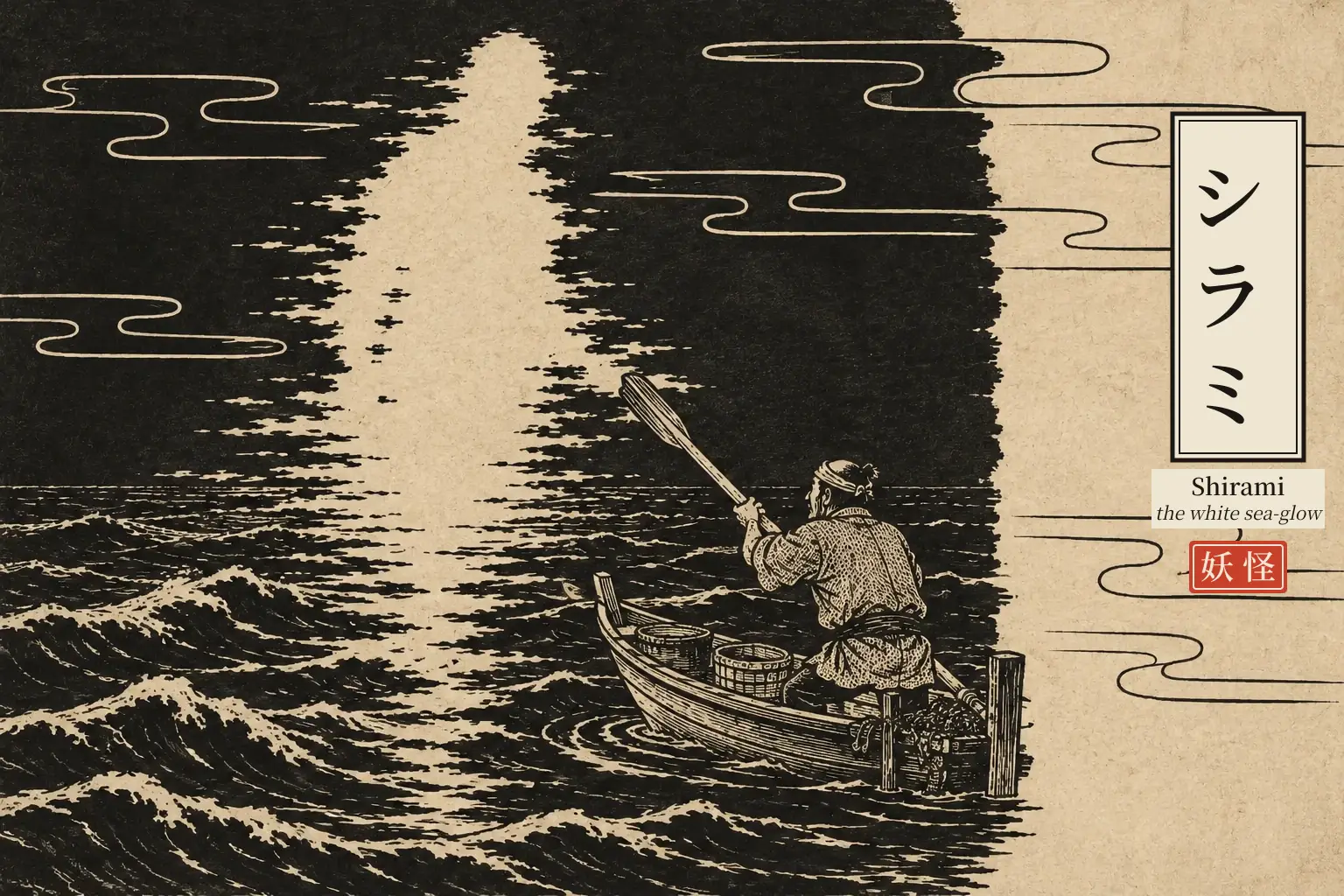
Witnesses described it differently from place to place. Off Uwajima, in Ehime, people saw a pale glow shaped like a standing person. Others saw only a loose cluster of white lights on the water. Further south, near Saiki in Oita, it took a flatter form: a glowing white shape like a mi, a flat winnowing basket. All three descriptions agree on one thing. The light is always white.
Two names, and a warning
Around Uwajima the shirami had a second name: baka. Fishermen used the first name freely. The second one they tried not to say while the light was near. It was believed to hear its own name. Say "baka" out loud, and it would close in and grab the ro — the boat's oar — and refuse to let go. In parts of Kyushu, people called the same light hiki instead.
When it comes, and how to send it off
Shirami showed up on rainy nights, when a boat was already out on the water. It drew close and clung to the boat. Off Saiki, it sometimes slipped under the boat and stopped there. Once that happened, the boat could not move again until it left. Three remedies were passed down for driving it off. One was chanting the Daihannya-kyo, the Great Wisdom sutra. Another was lighting a fire on board. The third was throwing a scorched shellfish shell into the water where the light sat.
Where it comes from
Both regions gave the same explanation for what it was. The shirami was said to be the spirit of a drowned person. Sometimes it was said to be someone who died an unnatural or violent death.
That explanation sits next to a more ordinary one. Fishing communities up and down this coast had another word for a similar glow: the cold light of yakouchu, bioluminescent plankton. In Oita this plankton glow is called "hiki ga tatsu." In Kagawa it is also called hiki — fishermen there described plankton clinging to schools of mullet, called hikizu, glowing red like fireballs on the night sea. What one village called a drowned person's ghost, the next called a glow the sea makes on its own. The shirami sits exactly on that line.
It is not the only named light this part of the coast has kept track of. On the other side of Kyushu, the Yatsushiro Sea has its own famous mystery light, shiranui, reported for generations. Both belong to a wider habit among coastal communities of giving unexplained lights a name, rather than leaving them unlabeled — the same habit that produced the ryuto, a lantern-shaped light reported near shrines and temples elsewhere in Japan.
Shirami today
The clearest modern record of the Uwajima light comes from Mizuki Shigeru. While visiting Uwajima for an NHK program, he interviewed an elderly resident and collected a version of the story under its own name, shirami yuren. His version is bigger and stranger than the local accounts. He described a glowing white mass, shaped like a ball of soul-fire and resembling a tangle of somen noodles, that appeared from nowhere, circled a boat at great speed, and vanished in an instant. The folklorist Murakami Kenji later suggested, in his Nihon Yokai Taijiten, that this might be the same creature Uwajima fishermen had always called shirami. Nobody can test that claim either way. The light itself is long gone before anyone gets close enough to check.