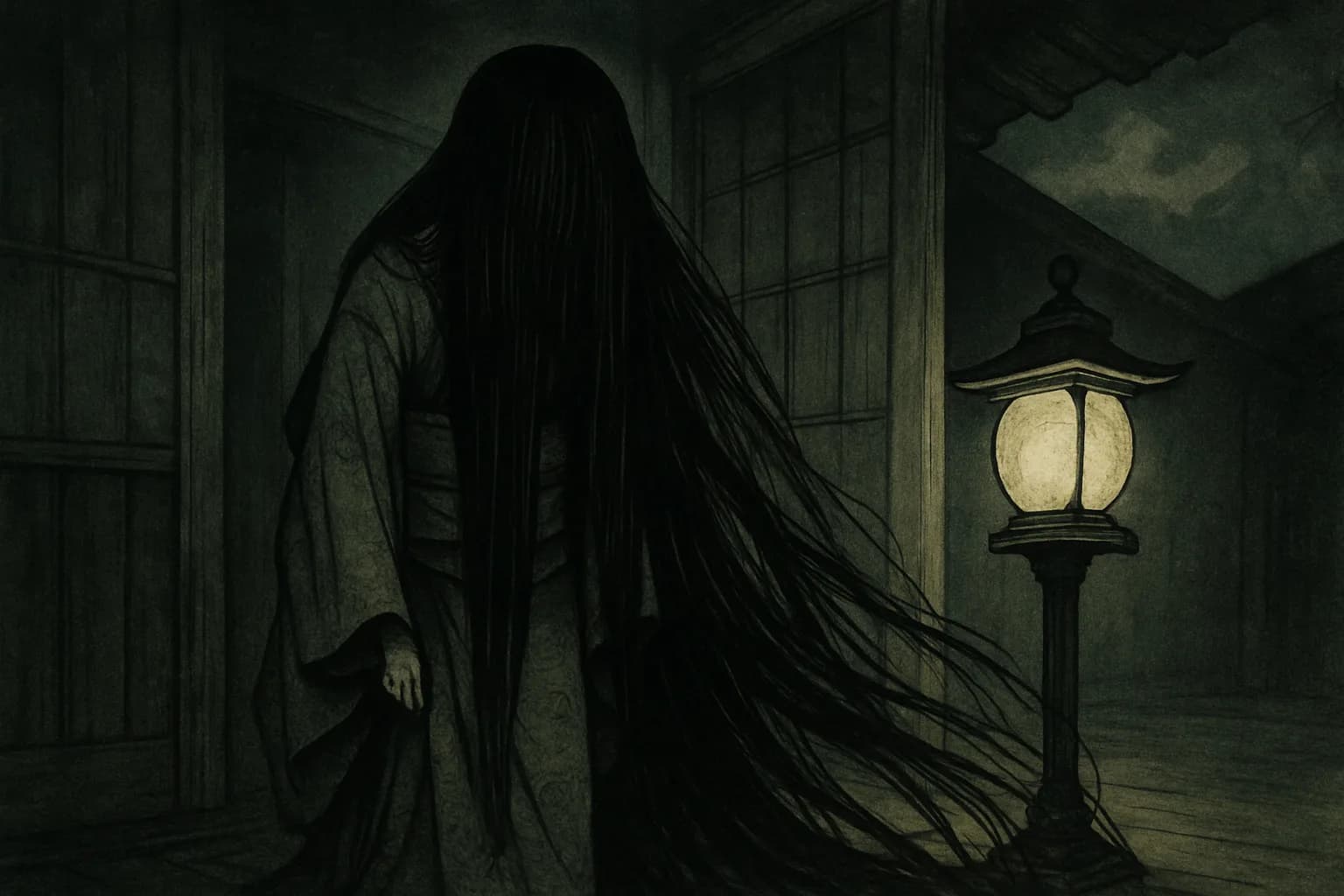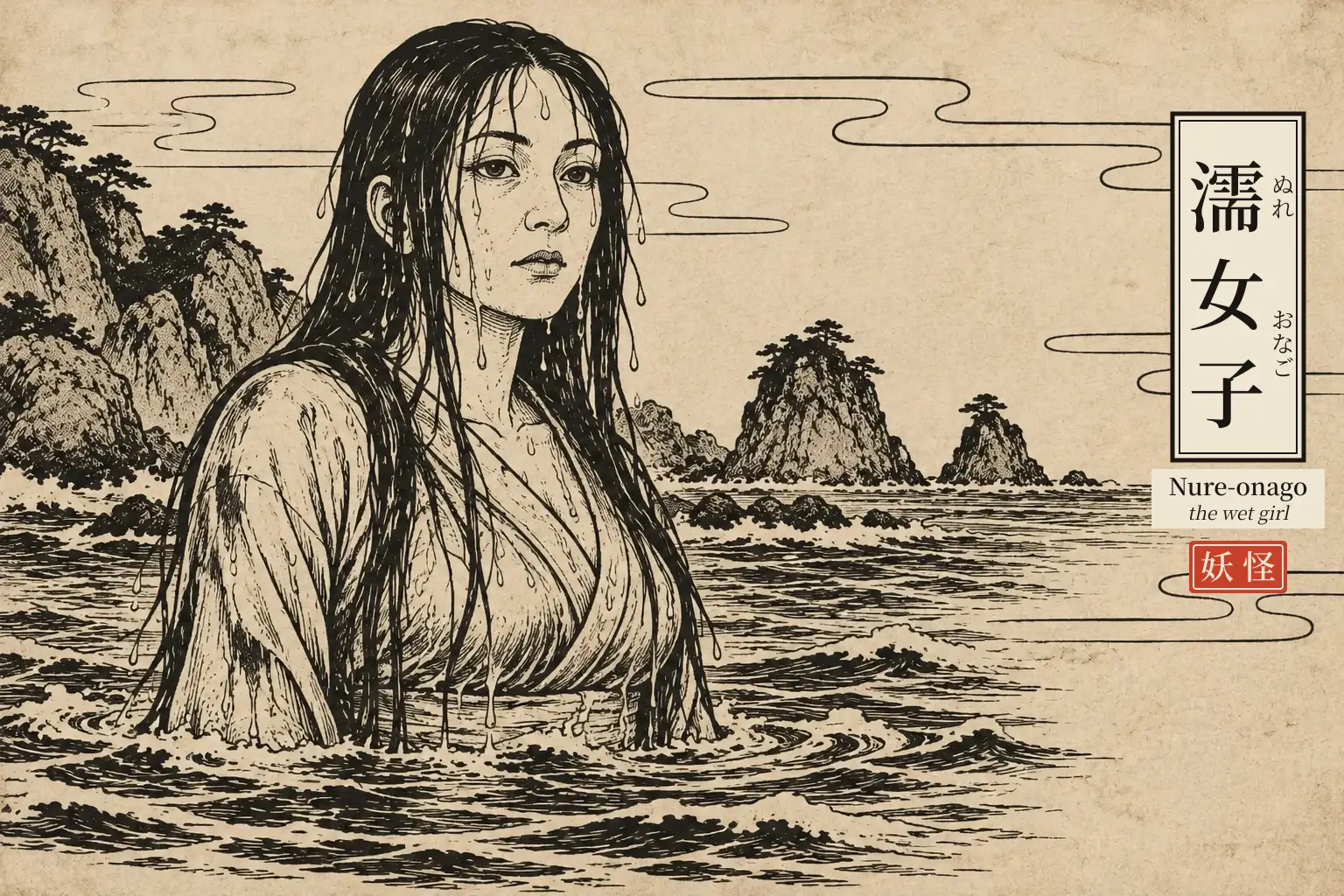
On Nowajima and Futagamijima, two small islands in Ehime's Kutsuna chain, a woman walks out of the sea. Her hair is soaked. She looks at a passer-by, and she smiles. In this corner of Shikoku and parts of Kyushu, smiling back is the one mistake you cannot take back. She is nure-onago, the wet girl, and once you return her smile, she stays with you for life.
What does she look like?
Descriptions change from place to place, but every version keeps the same word: wet.
On Nowajima and Futagamijima she rises straight out of the sea, hair dripping, matching her name exactly. In the Uwa region of Ehime, the story never says she comes from the sea. She simply arrives already soaked, with no explanation given for why.
In Sugata-cho, part of Ozu City in Ehime, she is drenched from head to foot and wrapped in tree leaves. In Nagasaki Prefecture the sea returns to the story. On Iki Island she climbs out of the sea or a swamp, soaked through. In southern Tsushima she appears on rainy nights, just as wet.
Murakami Kenji's Nihon Yōkai Daijiten (2005) groups the Iki and Tsushima versions with a different, related yokai. That yokai is nure-onna, a snake-bodied woman said to haunt the same stretch of coast. Nure-onago herself keeps a human shape in every account — no scales, no tail, just a wet woman or girl.
A smile that never lets go
The one behavior that repeats across every region is the smile.
Nure-onago looks at whoever passes by, and she smiles. If that person smiles back, she attaches herself to them for the rest of their life. No source says what that attachment actually costs. Only that it does not end.
Villagers in Kihoku-cho and the old town of Mima, now part of Uwajima City, kept one piece of advice for the encounter. Call her "yakamashii" — noisy, annoying — and she disappears. It is an odd kind of defense. Not a blade, not a prayer. Just an insult, said out loud.
Where it comes from
No single origin story survives for nure-onago. What survives instead is a map — a scatter of coastal and inland communities, each with its own reason for why she is wet.
That spread suggests the wetness came first, and the explanation came after, village by village. In some tellings she rises from the sea. In the Uwa region, the story never has her rise from the sea at all — she simply arrives already soaked. The one fixed point across every telling is the adjective in her name. Everything else about her — where she comes from, what she wants, even whether the sea is part of her story — was filled in locally.
Harionna, a name Mizuki likely invented
Look for nure-onago elsewhere and a different name sometimes turns up: Harionna, 針女, "needle woman." In this version, a woman with disheveled hair smiles at a man passing by. If he smiles back, she possesses him — the same trap, dressed in different words.
Yokai manga artist Mizuki Shigeru used this name, in his own books, for the Uwajima-region nure-onago. Yokai researcher Murakami Kenji does not think Harionna is an old name at all. In his Nihon Yōkai Daijiten, Murakami writes that Mizuki appears to have coined it himself, drawing out nure-onago's traits under a new label.
So if "Harionna" turns up online as its own ancient, separate yokai, that claim is worth doubting. The sources point to one creature, renamed once, in the twentieth century.