Most yokai are strange animals or haunted objects. An onryo is simpler, and worse: a dead person who stayed angry. The word pairs 怨 (a grudge) with 霊 (a spirit). Japan's history does not leave this entirely vague. For some of its most feared onryo, we even have real names and real dates.
What makes a ghost an onryo?
Any restless spirit can be called a yurei. An onryo is specifically a yurei with a target. It died owing someone a settling of accounts, and it does not stop at haunting one house. It causes plagues, fires, and lightning strikes, and in Sutoku's case, people blamed it for ending an age. Once an onryo is formally pacified, enshrined, and thanked, it earns a gentler name: goryo, "a pacified spirit." The ritual system built around that trade has its own name too, goryo shinko.
The earliest solidly documented case is Fujiwara no Hirotsugu. His vengeful spirit appears in the Shoku Nihongi (completed 797), in the entry recording the monk Genbo's death. The first known government ritual to appease such spirits came later, in 863. It was held at the Shinsenen garden in Kyoto, pacifying six named spirits, and the Nihon Sandai Jitsuroku recorded it.
Sugawara no Michizane, the god who used to be a curse
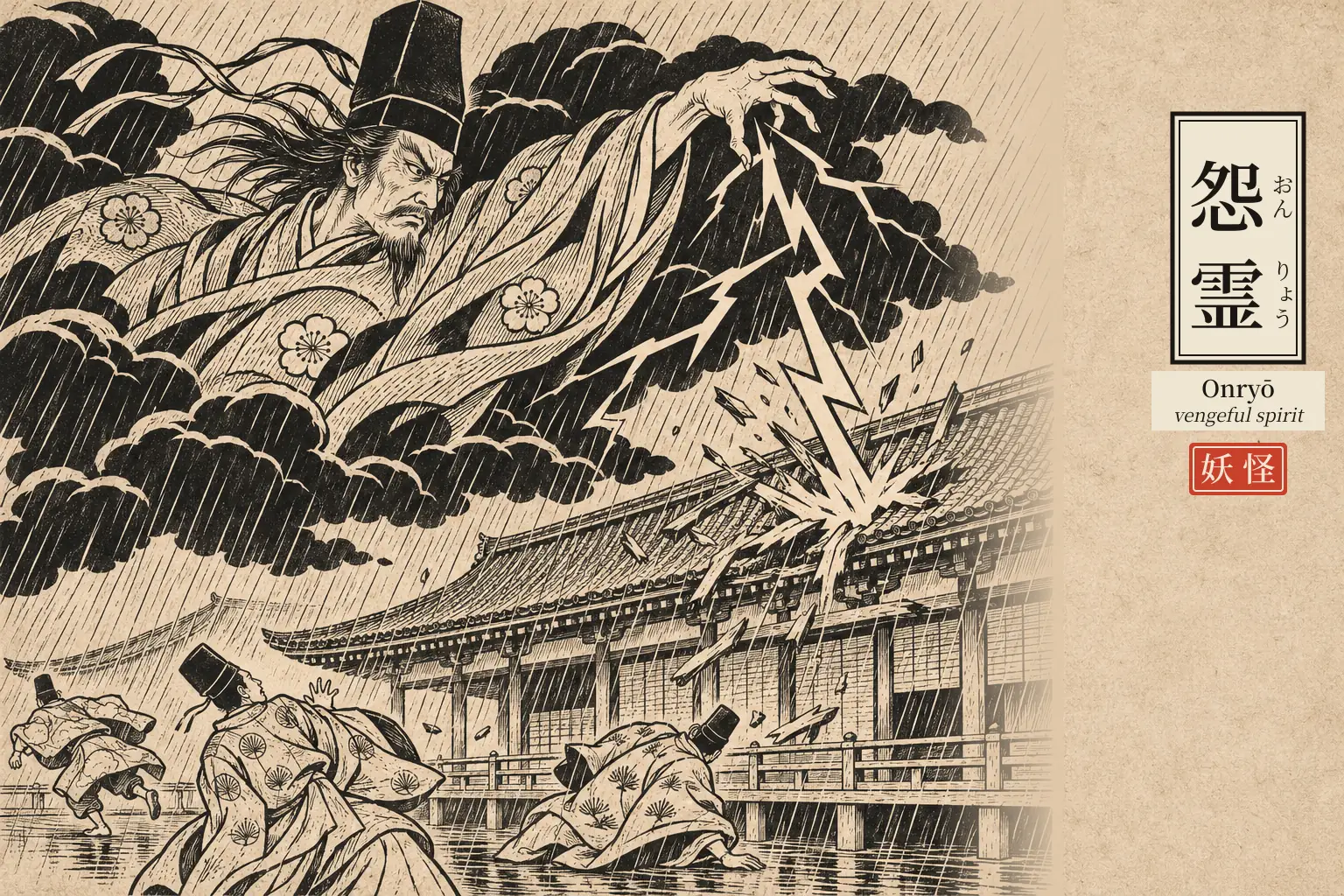
Michizane was a scholar and minister, exiled to Dazaifu, in Kyushu. Then the disasters started. On 24 July 930, lightning struck the Seiryoden hall inside the imperial palace during a drought meeting. It killed three people, including the courtier Fujiwara no Kiyotsura, and injured several more. Emperor Daigo fell ill soon after and died three months later.
Kiyotsura had been the man assigned to keep watch on the exiled Michizane. Rumor spread that Michizane's onryo had killed him. His spirit, people said, had become a thunder god who commanded lightning itself. A medieval picture scroll, the Kitano Tenjin Engi Emaki, still shows that thunder god. It hurls bolts down onto the palace roof.
Kyoto answered the only way it knew how: with a shrine. Kitano Tenmangu was built to enshrine Michizane as a protective deity, Tenman Dai-jizai Tenjin. Dazaifu Tenmangu followed, and then Tenmangu shrines nationwide. The transformation did not stop at "pacified." In 982 a courtier's prayer text already enshrined Michizane as the god of learning. Today he is simply "the god of learning."
Taira no Masakado, the head that would not stay put
Masakado was a Kanto warlord who rebelled against the court and crowned himself "new emperor." He lost. On 25 March 940, an arrow hit him in the forehead, and he died as his revolt was being crushed. His severed head was carried to the capital and put on public display.
Back east, in what is now Tokyo's Otemachi district, his grave mound was said to trouble everyone nearby. The trouble lasted for centuries. In 1307 a wandering priest, Taa Shinkyo, finally gave Masakado a Buddhist name. He raised a memorial stone over the neglected mound. Legend says his head flew back east from the capital afterward. Visitors used to leave small frog figurines at the mound, a pun on kaeru, which means both "frog" and "to return," until a 2020-21 renovation restricted offerings.
The mound itself was once dug up and removed, after the 1923 earthquake, when a plan called for a new building on the site. Officials connected to that plan died in the years that followed, and in 1927 a memorial stone went up instead. After the war, an American bulldozer clearing the land for redevelopment flipped over and killed its driver, and a plan to flatten the site was dropped. The mound, rebuilt and renovated six times since, still sits in the middle of one of the most valuable blocks of real estate in Tokyo.
Emperor Sutoku and a curse no one can quite prove
Sutoku lost the Hogen Rebellion of 1156 to his own brother. He was exiled to Sanuki, on the island of Shikoku. When he died there in 1164, the court would not even grant him a funeral rite. For thirteen years, nothing happened.
Then, starting in 1177, Kyoto's luck turned. A forced monks' protest, a great fire, and a failed plot against the court struck in quick succession. Courtiers' diaries began naming Sutoku's grudge as the cause. By 1184, one courtier argued in writing that Sutoku needed to be enshrined as a god before anything worse happened. His ally Fujiwara no Yorinaga needed the same treatment. The emperor agreed. He tore up the old decree that had branded Sutoku a criminal and gave him back his name.
The Hogen Monogatari records what Sutoku is supposed to have said as he died. He vowed to become the great malevolent spirit of Japan, flipping the order of ruler and subject. A later legend adds that he wrote this oath in his own blood, on five sutras. The historian Yamada Yuji has pointed out a problem with that story. The document surfaced nineteen years after Sutoku's death, and nobody is ever recorded as having actually seen it. Sutoku is enshrined today at Shiramine-gu, near where he died in Kagawa, and at Shiramine Jingu in Kyoto.
Where "the three great onryo" comes from
Michizane, Masakado, and Sutoku are usually grouped today as the "Three Great Onryo of Japan." That grouping feels ancient. It is not. In 1962 the novelist Sato Haruo named a different trio entirely, leaving out both Masakado and Sutoku. In 2000 the yokai researcher Tada Katsumi swapped in Sutoku but left Masakado out again. The historian Yamada Yuji traces the now-familiar trio to Edo-period yomihon novels and kabuki plays. Those stories, not any older record, fixed the lineup. Even so, the convention settled only in the 2000s.
That is the real pattern behind every onryo story here. A sudden, unexplained death gets blamed on a grudge. A string of later disasters confirms it. A shrine goes up, and the grudge becomes a guardian. The men themselves had no say in any of it.
Go deeper
Where Japanese ghosts come from.
- Yūrei: The Japanese Ghost →Zack DavissonWhere Japanese ghosts come from, told through old paintings, kabuki and ghost stories.
- Kwaidan: Stories and Studies of Strange Things →Lafcadio HearnThe classic 1904 collection of Japanese ghost stories that shaped how the West first met kaidan.
Some links are affiliate links; if you buy through them we may earn a small commission at no extra cost to you.