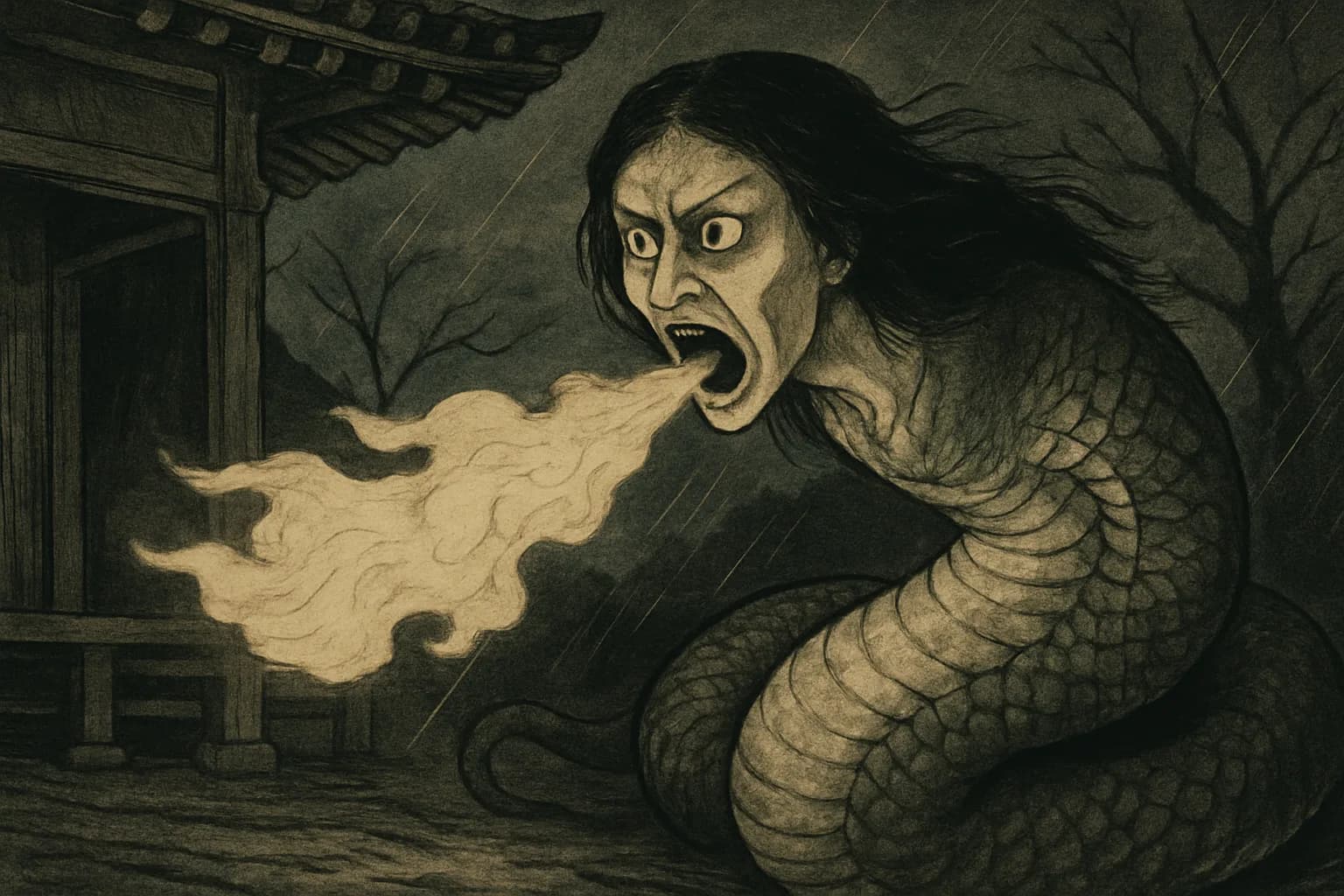
A young monk stops for the night at a widow's house in Kii Province, on his way to worship at Kumano. Her daughter waits on him at dinner, falls for him on the spot, and by morning has decided he will marry her. He tells her, half in jest and wholly in panic, that he will come back for her once his pilgrimage is finished. He never intends to. That single lie is the whole engine of the Kiyohime legend — one of the oldest and most violent revenge stories in Japanese folklore, and the direct ancestor of the hannya mask worn on Noh stages today.
What does she look like?
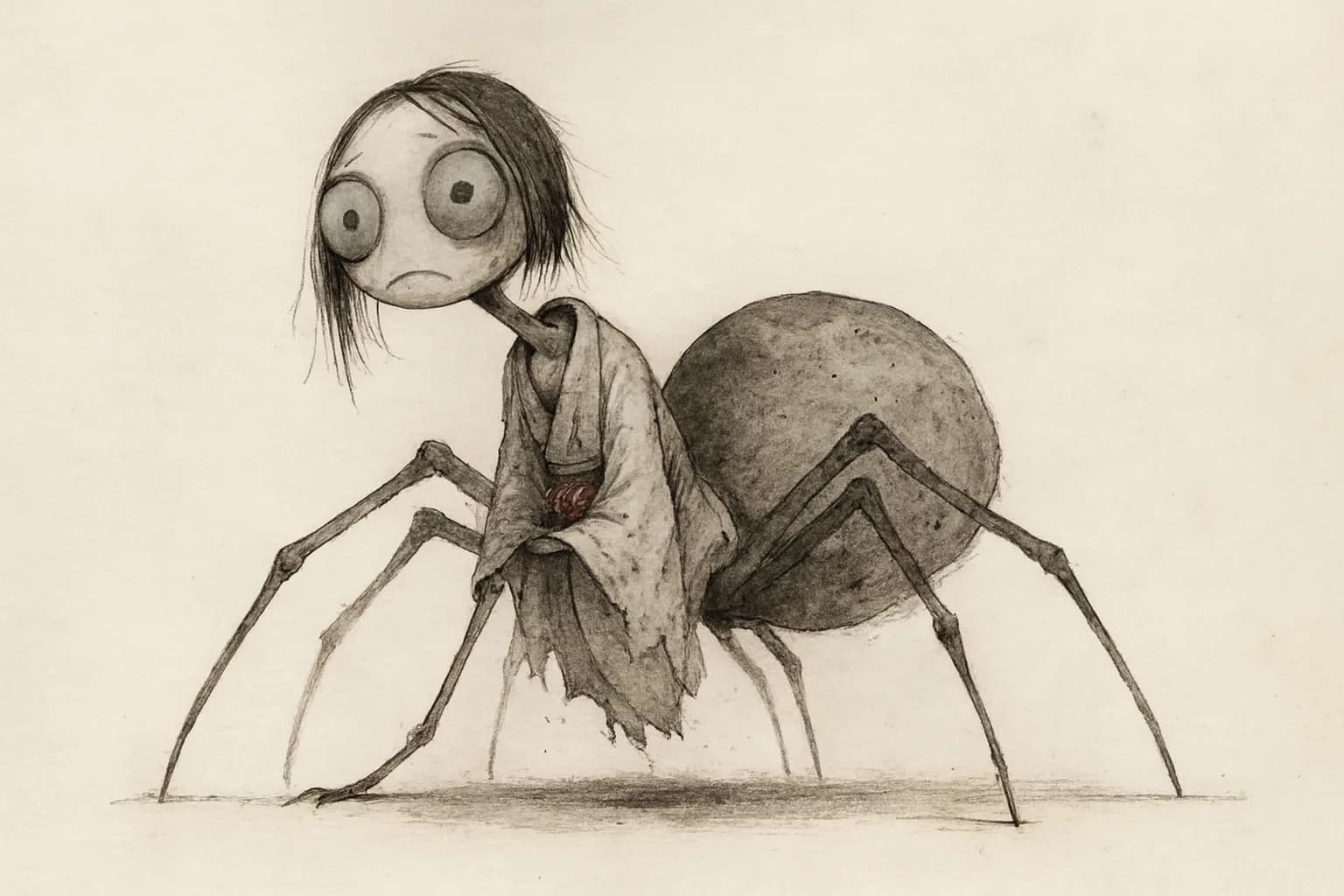
Kiyohime begins the story as an ordinary young woman, sometimes named as the daughter of a local steward in the village of Masago. There is nothing supernatural about her until the moment she realizes she has been deceived. From there, telling to telling, she grows scales down her arms, her eyes go slit-pupiled, and by the time she reaches the banks of the Hidaka River she has become a serpent large enough to swim it in open water, sometimes described breathing fire as she goes. Older picture scrolls draw the transformation in stages rather than all at once — a coiling tail first, then a reptilian face — so a viewer watches her stop being human by degrees, not in a single flash.
The monk who broke a promise
The monk, usually named Anchin, realizes on his return trip that he has to pass back through Masago, and rather than face her, he takes a longer route to avoid the village entirely. Kiyohime finds out anyway. She runs him down on foot and catches up to him at the Hidaka River, where he begs a boatman to ferry him across and then — the detail every version keeps — pays the boatman not to carry her over after him. Refused a boat, she does not turn back. She goes into the water as a woman and comes out the other side as a serpent, and the chase resumes at the same pace as before.
The bell of Dōjōji
Anchin reaches Dōjōji temple ahead of her and begs the monks there to hide him. They lower the temple's massive bronze bell over him and wait. Kiyohime arrives, finds the bell, and wraps herself around it. What happens next is the image the entire legend is remembered for: her serpent body burns with the heat of her own fury until the bronze itself glows and melts, and Anchin dies inside it, boiled or burned depending on the telling. Kiyohime, spent, drowns herself in the river. Some versions add an epilogue in which the head priest of Dōjōji dreams that the two lovers, reborn, are freed from their grudge and finally attain Buddhahood together — a small mercy tacked onto an otherwise merciless story.
Where it comes from
The earliest known version of the tale appears in the Konjaku Monogatarishū, a collection of setsuwa (didactic tales) compiled in the early twelfth century, where it is told plainly as a warning about the danger of a woman's obsessive attachment and a monk's failure to keep his word. By the Muromachi period the story had been reworked into the illustrated hand scroll Dōjōji Engi Emaki, kept at the temple itself, and it was from there that Noh playwrights drew Dōjōji, one of the most demanding plays in the repertoire, in which the actor changes masks onstage as the woman's grief visibly curdles into something inhuman. That mask — the hannya — is Kiyohime's story compressed into a single carved face, worn again centuries later in the Kabuki dance-drama Musume Dōjōji, where an entire hour of choreography stands in for the chase and the bell.
Read as folklore rather than melodrama, the tale sits inside a much older Japanese association between women's jealousy and serpents — a link found in Buddhist sermons long before Kiyohime had a name of her own, using her specifically to give that abstract warning a face and a place: Dōjōji still stands in Wakayama today.
Kiyohime today
Dōjōji's monks still tell the story to visitors much as they always have, unrolling a copy of the old picture scroll and narrating it panel by panel as a kind of sermon — a practice called e-toki that predates the temple's ordinary tourist pamphlets by centuries. The bell she destroyed was eventually recast, brought bad luck to whoever rang it, and was finally sent to a temple in Kyoto, where it is kept but no longer struck. Kiyohime has also crossed into recent pop culture at a distance from her original grimness — she appears as a playable character in the mobile game Fate/Grand Order, one of a long line of Japanese folklore figures the series has adapted directly from historical legend rather than inventing from scratch.