In the Heike Monogatari tradition, one of the strangest disasters to befall a great temple had nothing to do with fire, war, or storms. Overnight, the sutra library of Enryaku-ji, the head temple of the Tendai sect on Mount Hiei, was found in ruins: scrolls shredded, sutra boxes gnawed through, storehouses ransacked, as if by rats with teeth of iron. The story names the culprit as one very specific grudge: Raigō, a priest whose fury outlived his own body and returned as Tesso, the iron rat.
What does it look like?
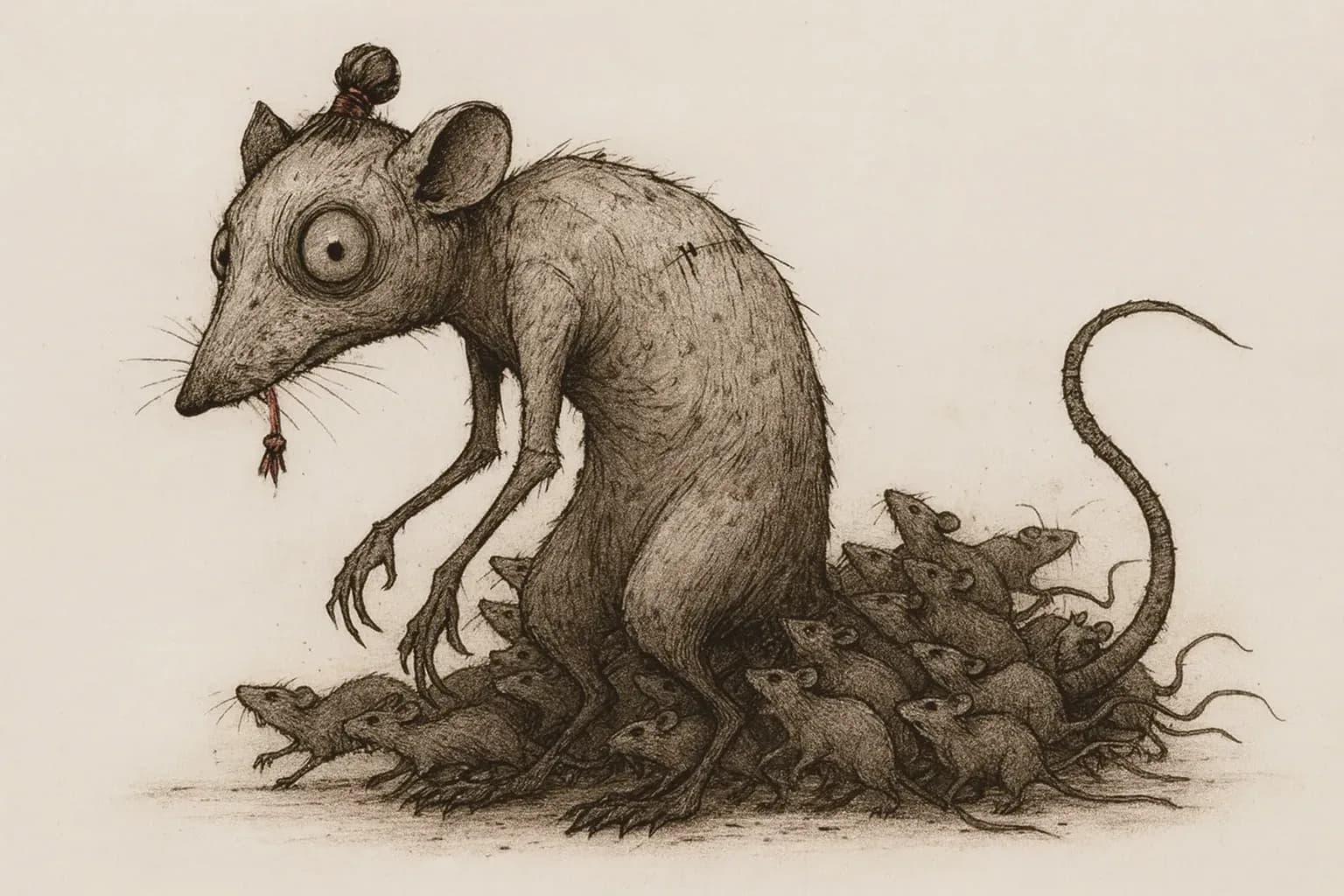
Toriyama Sekien drew Tesso in his 1781 bestiary Konjaku Hyakki Shūi ("Supplement to the Hundred Demons from the Present and the Past") not as a single monstrous rodent but as a horde: an oversized rat, sometimes given the robes and topknot of the priest it had once been, leading a boiling mass of ordinary-sized rats across a temple hall. Their teeth and claws are iron, strong enough to chew through lacquered boxes and heavy wooden pillars, not merely paper — a swarm built to destroy a building, not just infest it.
A prayer, a promise, and a betrayal
The legend begins with Raigō succeeding at exactly what he was asked to do. Emperor Shirakawa, wanting an heir, had him perform prayers for the birth of a prince, and a prince was duly born. In return, Raigō asked for one thing: his own temple, Onjō-ji at Mii-dera in Ōmi Province, should be granted an ordination platform so its monks could be ordained there instead of making the journey to Mount Hiei's Enryaku-ji, which alone held that right within the Tendai sect.
Enryaku-ji's monks fought the request furiously, since a second ordination platform would break their monopoly, and the emperor — unwilling to face down an army of angry monks from Mount Hiei — went back on his word. Raigō is said to have shut himself away, refused all food, and starved himself to death over a hundred days, cursing the broken promise with his last breath.
The rats descend on Mount Hiei
The grudge did not end with Raigō's death. His spirit is said to have transformed into a rat — some versions describe one colossal creature, others thousands appearing at once — and led an assault not on the imperial court but on Enryaku-ji itself, the temple that had blocked him. By morning the sutra library lay in ruins. No exorcism is recorded as having stopped the rats; the temple simply rebuilt what it could and left the rest as a warning about the cost of a broken promise.
Where it comes from
Tesso sits inside a much larger medieval belief in the onryō, the vengeful spirit whose grudge is strong enough to outlast the body, especially when that grudge belongs to someone with real spiritual power. What sets Raigō's story apart is the shape his revenge took: not a ghost haunting a room, but vermin destroying a library — a fittingly bureaucratic punishment aimed at an institution rather than a person. Underneath the supernatural framing sits a real, well-documented history: Onjō-ji and Enryaku-ji, despite belonging to the same Tendai sect, feuded for centuries, at times burning each other's halls to the ground. Tesso is that rivalry with teeth.
Tesso today
Mii-dera still stands in Ōtsu on the shore of Lake Biwa, and still keeps the memory of its feud with Mount Hiei alive through a second legend from the same dispute. In its treasure hall hangs a bronze temple bell, dented and scarred, said to have been dragged up Mount Hiei by the warrior-monk Benkei during a later raid on Mii-dera. When struck, the bell would only groan that it wanted to go back to Mii-dera — until Benkei, enraged, hurled it back down the mountainside himself. Visitors to Mii-dera today can still see the bell, and for a small fee, ring it.