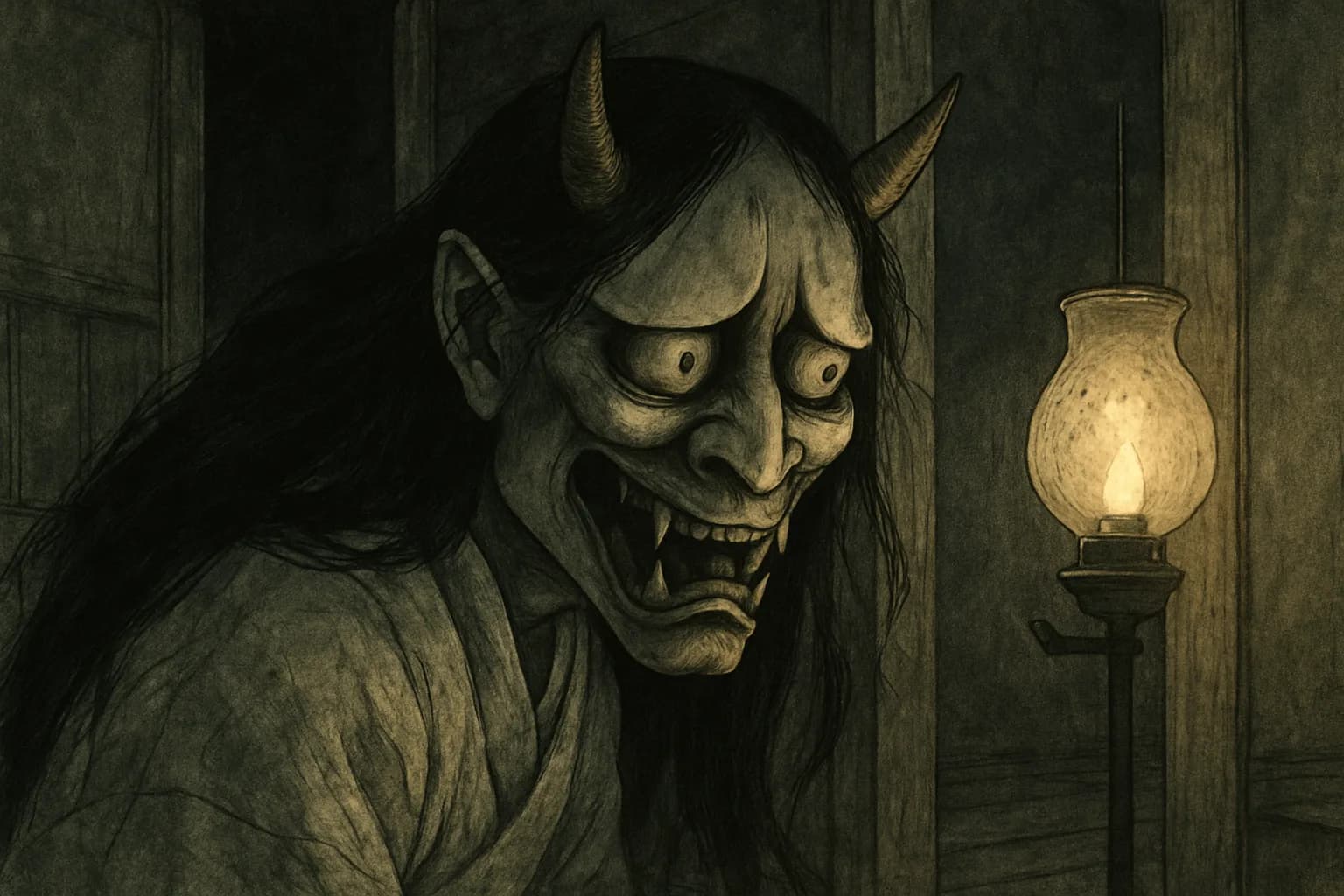
Tilt the mask down, and the carved face seems to weep. Tilt it up, and the same face turns murderous. Noh actors have relied on this trick for centuries: unlike most masks in the repertoire, which read differently depending on the light, the hannya is built to hold two emotions at once, grief and hatred occupying the same fixed features. It is the face of a woman whose sorrow has finished curdling into something else.
What does it look like?
A hannya mask carries two long horns swept back from the forehead, a pair of bulging metallic eyes rimmed in gold leaf, and a mouth split wide enough to show a full row of bared fangs, the corners of the lips pulled back almost to the ears. Noh mask carvers grade the transformation in stages. A namanari mask shows the earliest change — small horns only beginning to emerge through a face still mostly human. The hannya proper marks the middle stage, demon enough to frighten but still recognizably a woman's face beneath the horns. A honnari, sometimes called a ja (serpent) mask, shows the final stage, the face gone entirely inhuman and reptilian. Color carries its own meaning: a pale, white-skinned hannya (shirohannya) marks a woman of noble birth whose rage is tempered by grief, while a red or dark-skinned version (akahannya) marks a lower-ranking or more fully consumed figure, closer to a straightforward demon.
The two plays that made the mask famous
Two Noh dramas carry the hannya into every performance calendar. In Dōjōji, attributed to the Muromachi-period playwright Kanze Nobumitsu, a woman named Kiyohime is spurned by a monk she loves; her grief turns to fury, and she transforms into a serpent to chase him to Dōjōji temple in Kii Province, where he has hidden under the temple's great bell. She coils around the bell and burns him alive with the heat of her own rage. The play stages her transformation live, the actor changing masks onstage as her humanity burns away.
In Aoi no Ue, drawn from the "Aoi" chapter of Murasaki Shikibu's eleventh-century The Tale of Genji, the jealousy belongs to Lady Rokujō, a noblewoman whose wounded pride over Prince Genji's neglect sends her living spirit out to attack his wife, Aoi no Ue, as she lies ill. Rokujō never intends the possession; she barely recognizes her own hatred until she is already wearing the hannya's face. A priest is called in to try to exorcise the spirit, and the play turns on whether prayer can reach a rage that started as love.
A face built to be read twice
Trained Noh performers describe working the hannya with two named tilts: terasu, angling the mask upward so the eyes and fangs catch more light and the face reads as furious, and kumorasu, angling it down into shadow so the same carved features read as sorrowful, even weeping. No paint changes between the two; only the actor's posture and the light do. It is the clearest demonstration in the entire Noh repertoire that a mask's expression is a collaboration between the carver and the performer, not a fixed thing.
Where the name comes from
The word hannya is a genuine Buddhist term, the Japanese rendering of the Sanskrit prajñā, meaning transcendent wisdom — the same term that opens the Heart Sutra. That meaning has nothing to do with jealous women or demons, and mask historians generally treat the name as borrowed rather than descriptive. One tradition, repeated in Noh mask reference works, credits the mask's design to a Muromachi-period Buddhist monk-carver known as Hannya-bō, whose name is said to have simply stuck to the object he made. Whether or not that account is exact in its details, it explains the mismatch between a mask of pure rage and a name that, on its own, means the opposite.
Hannya today
The mask outgrew the stage long ago. Kaneto Shindō's 1964 film Onibaba builds its entire third act around a demon mask, explicitly drawn from the hannya tradition, that a woman puts on to frighten a rival — and then cannot remove. In Japanese tattoo art, the hannya is one of the most requested full-back designs, usually paired with cherry blossoms or a snake to signal that the wearer understands both the beauty and the danger in the same figure. Restaurants and izakaya across Japan still hang a hannya mask by the door, less as a warning than as a nod to a five-hundred-year-old piece of stagecraft that never needed a single word to explain what it meant.