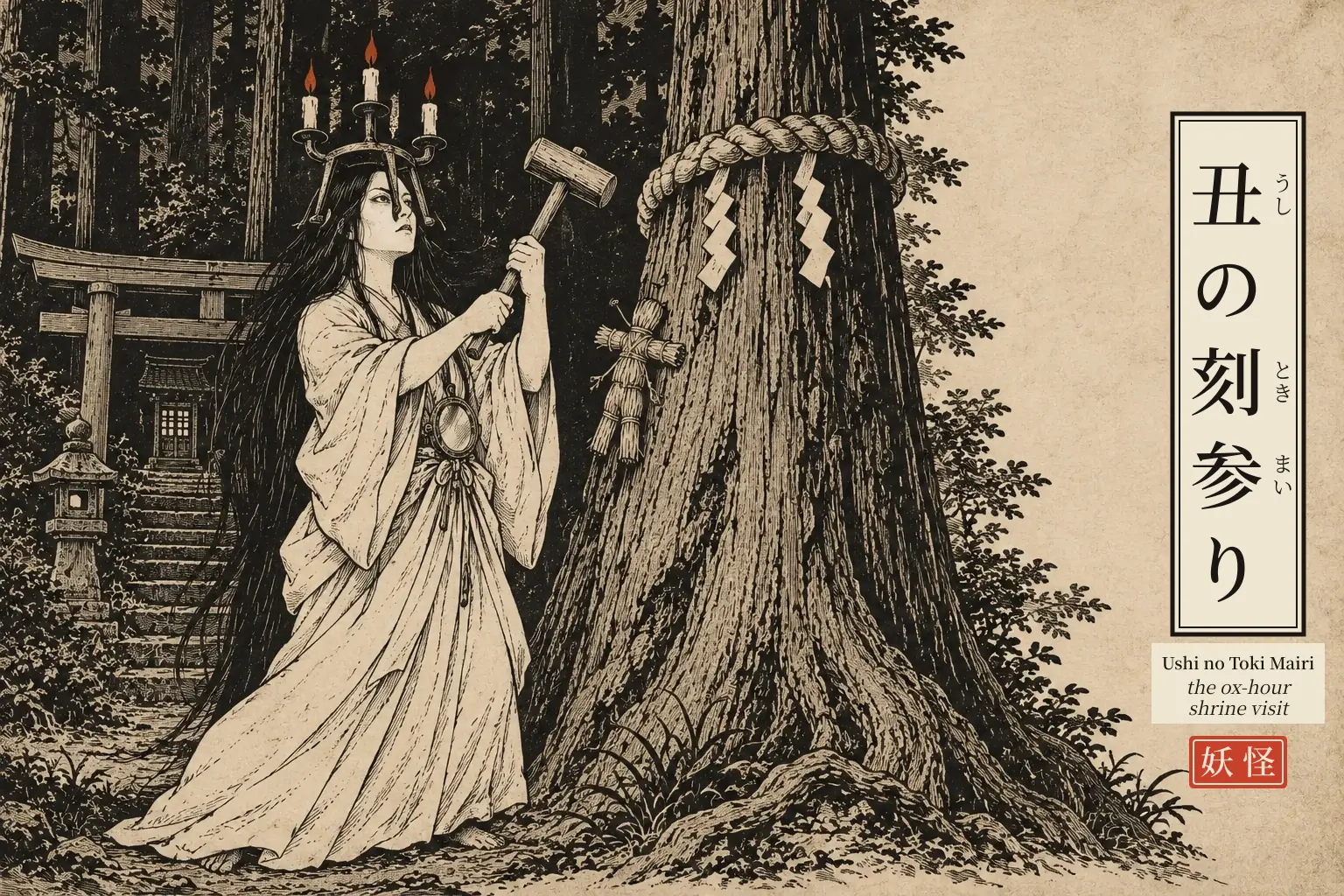
Walk past a shrine at the hour of the ox and you should see nobody. Ushi no toki mairi breaks that rule on purpose. It is a curse, not a creature: a jealous woman, alone, nailing a straw doll to a sacred tree night after night until someone dies. The name just means "the hour-of-the-ox visit." 丑 (ushi, the Ox) names the hour; 参り (mairi) means a shrine visit. Everything frightening about it comes from doing an ordinary act of worship at the one hour nobody is meant to be there.
What does the ritual look like?
The classic Edo-period picture is specific down to the footwear, though sources do not fully agree on it. The woman wears plain white robes. Her hair hangs loose. Her face is caked in white powder, her teeth blackened, her lips painted heavily red. On her head she wears an iron cooking tripod, turned upside down like a crown, with a lit candle burning on each of its three legs. A mirror hangs hidden against her chest. She bites down on a comb. Accounts disagree on her sandals: one calls them tall and single-toothed, another describes a taller two-toothed clog instead. One modern book says single-toothed. Yet its illustration, by Utagawa Toyohiro, shows a two-toothed clog. In both hands she carries a straw doll shaped like the person she hates, and a mallet loaded with nails some five sun long — about six inches.
Toriyama Sekien drew an early version of this scene in 1779, in his Konjaku Gazu Zoku Hyakki. His own caption, though, never mentions a straw doll at all. Sekien's woman hides a mirror on her chest, lights three candles on her head, and visits the shrine at ushi-mitsu-doki, roughly 2:00 to 2:30 a.m. — a narrower window than the two-hour "hour of the ox" itself. She drives a nail into the top of a cedar. Sekien closes his caption with a proverb: cursing someone is like digging two graves. The straw doll seems to be a later addition to a ritual that started out simpler: a nail, a tree, and a grudge.
Seven nights, one witness
The belief runs the same way in most tellings. The woman returns to the shrine every night, hammering a fresh nail into the same tree. The target is said to fall ill in whichever body part the nail struck on the doll. On the seventh night the curse is finished, and the target dies. One rule overrides everything else: if a single other person sees her mid-ritual, the curse fails on the spot. Some versions add a second test. After the final visit, she is supposed to meet a black ox lying across her path and step over it without flinching. Both Sekien's print and a later one by Hokusai show a black ox beside her. Flinch at it, and the curse comes undone.
An Irish-born writer, C. Pfoundes, recorded the same black-ox belief in English in 1875, so the belief was in English print by then.
Where it comes from
Kifune Shrine in Kyoto sits at the center of the legend, and its own tradition may explain why. The shrine's god is said to have descended "on the ox day of the ox month of the ox year, at the hour of the ox," and a prayer made at that exact hour was believed to come true. A wish-granting hour and a curse-casting hour are, mechanically, the same hour. One scholarly reading treats that as the hinge: once the hour was already sacred, it was a short step to using it for harm instead of hope.
The earliest named version we found is not called ushi no toki mairi at all. It is the legend of Hashihime of Uji, set down in the "Sword Chapter" of one manuscript line of the Heike Monogatari. Scholars disagree on how old that manuscript line is, but it predates the Edo-period ritual. A woman, consumed by jealousy, prayed at Kifune Shrine to be turned into a demon so she could kill her rival. An oracle told her to submerge herself in the Uji River for twenty-one days. She tied her hair into five horn-like locks, painted her face and body red, wore an upside-down tripod burning pine on its three legs, and gripped a separate pine torch, lit at both ends, in her mouth. She became an oni and kept killing her rival's relations, until the warrior Watanabe no Tsuna cut off her arm at Ichijo Modoribashi bridge with the sword Higekiri. The onmyoji Abe no Seimei later sealed the severed arm away.
A later, undated Noh play called Kanawa — the word means "iron tripod" — retold her story, and kept the instruction to paint her face red. One of its masks for her is even named Kanawa-onna, "iron-tripod woman." In the play, Seimei spares the woman's unfaithful ex-husband and his new wife by performing his counter-ritual on stand-in effigies, a hat and a wig, instead of on the couple themselves. In both, the woman herself uses no white robe and no straw doll.
Nailing an effigy is older than any of this. The Nihon Shoki records a nobleman cursing two princes with effigies in 587, though no piercing is described that early. An eighth-century wooden figure held by Nara's cultural-properties institute has an iron nail driven straight through its chest. A wooden tablet dug up at the Tatecho site in Matsue, Shimane Prefecture, shows a figure in loose robes. One wooden nail pierces its right chest. Shimane Prefecture says it may have been a curse tablet. It dates from the Nara to Heian periods. One theory says today's form came from joining the shrine visit with onmyōdō effigy rites. Its basic form was complete by the Edo period.
See the original print
Toriyama Sekien drew Ushi no Toki Mairi in Konjaku Gazu Zoku Hyakki (1779). This book has that picture, with its caption in English.
- Japandemonium Illustrated: The Yokai Encyclopedias of Toriyama Sekien →trans. Hiroko Yoda & Matt AltThe complete Edo-period bestiaries that so many of these entries trace back to, in full English translation.
- The Book of Yokai →Michael Dylan FosterThe most readable scholarly introduction to yokai — where they come from, what they mean, and the major creatures.
Some links are affiliate links; if you buy through them we may earn a small commission at no extra cost to you.
Still against the law today
Japanese law treats the ritual itself as harmless. Criminal-law textbooks cite it as a classic example of a funōhan — an "impossible crime" — so nobody is charged with attempted murder for a curse that cannot physically work. But the rest of the act is not protected. Shrine grounds are usually private property, and driving nails into a living tree counts as property damage. In May 2022, straw dolls bearing a photo of Russian President Vladimir Putin, with a note calling for his death, turned up nailed to trees at about ten shrines in Matsudo, Chiba Prefecture. A 72-year-old local man was arrested the following month on suspicion of trespassing and property damage rather than anything to do with the curse. A shrine official told reporters the sacred tree was left with two holes in it. It was thought to be a protest against the invasion of Ukraine.