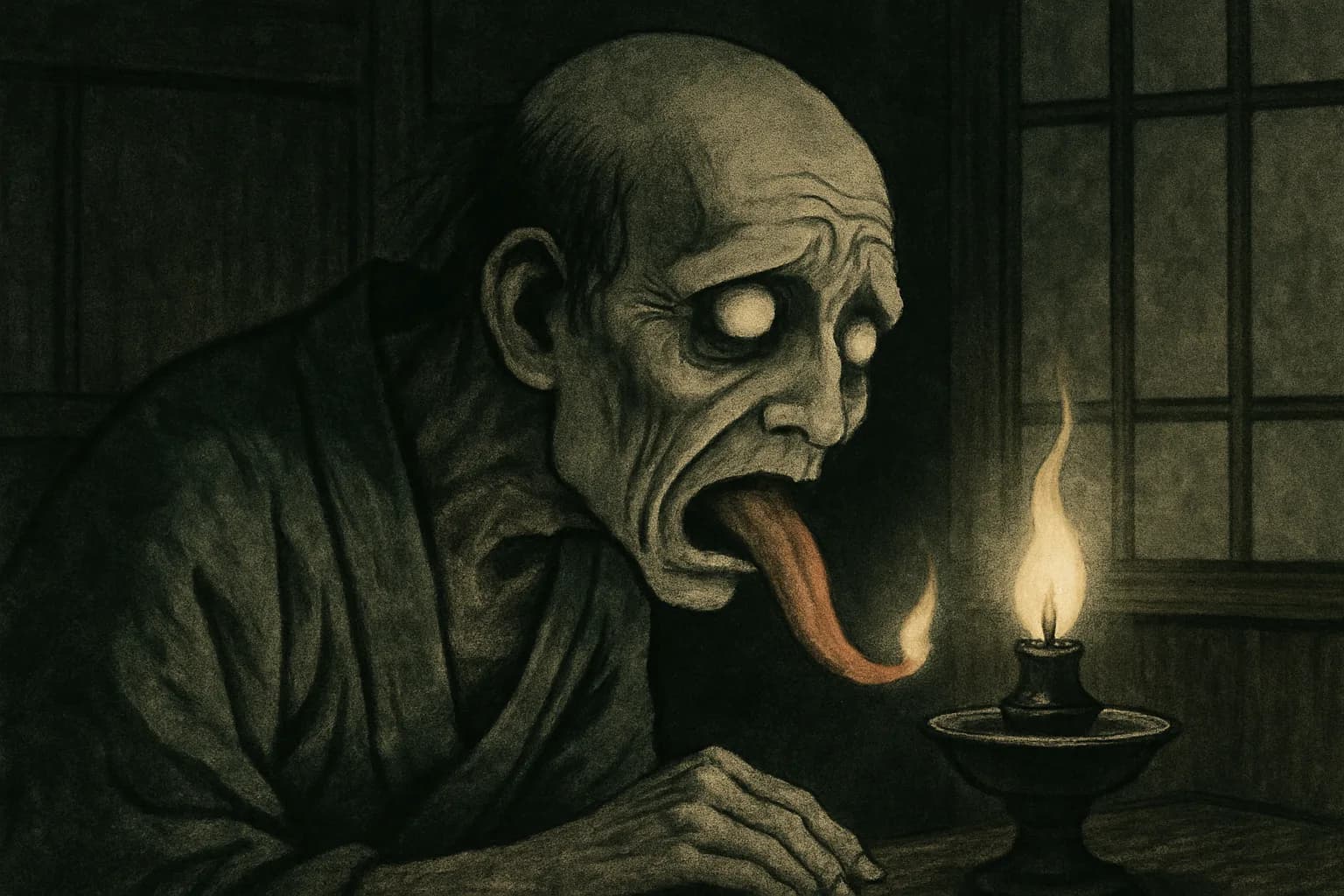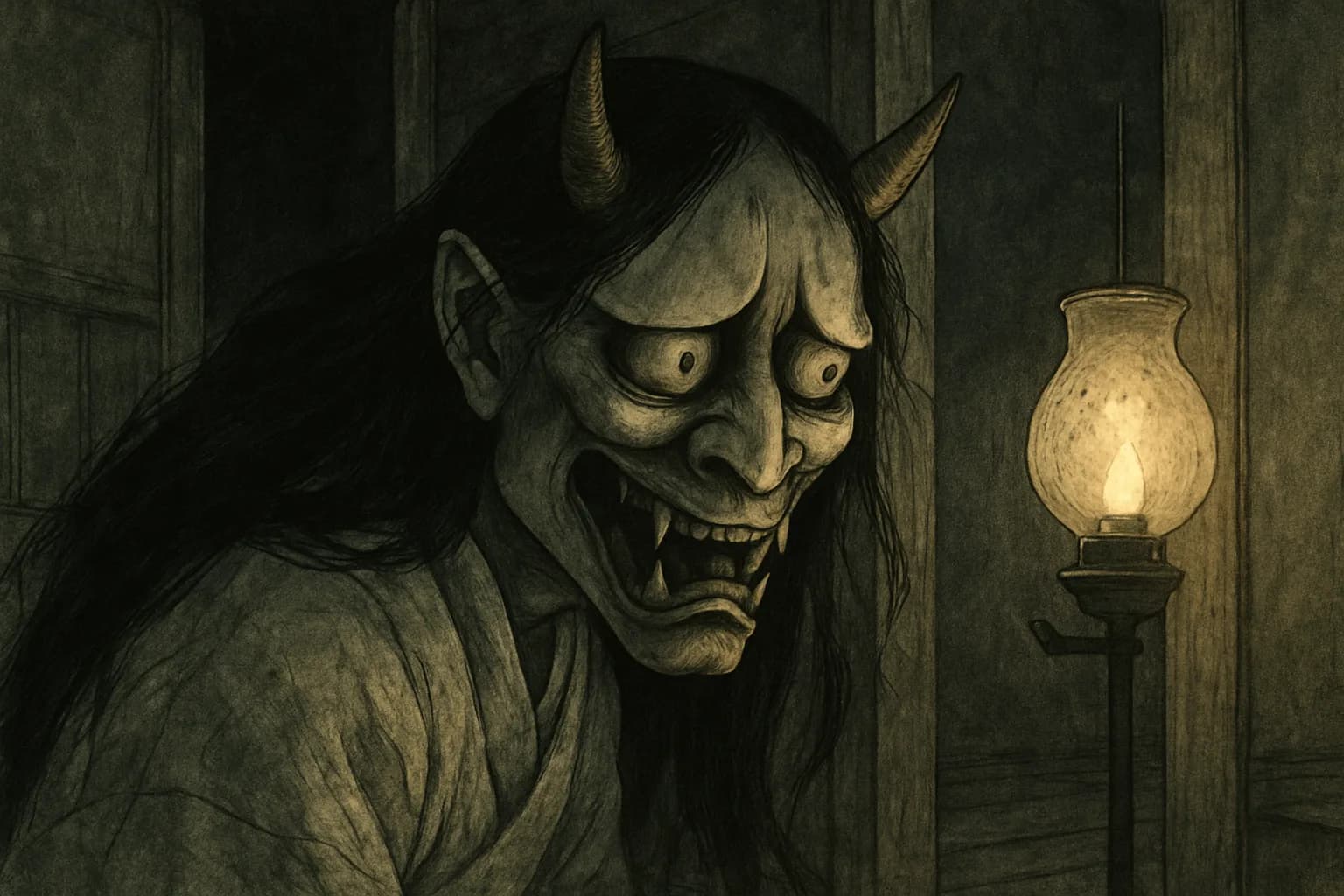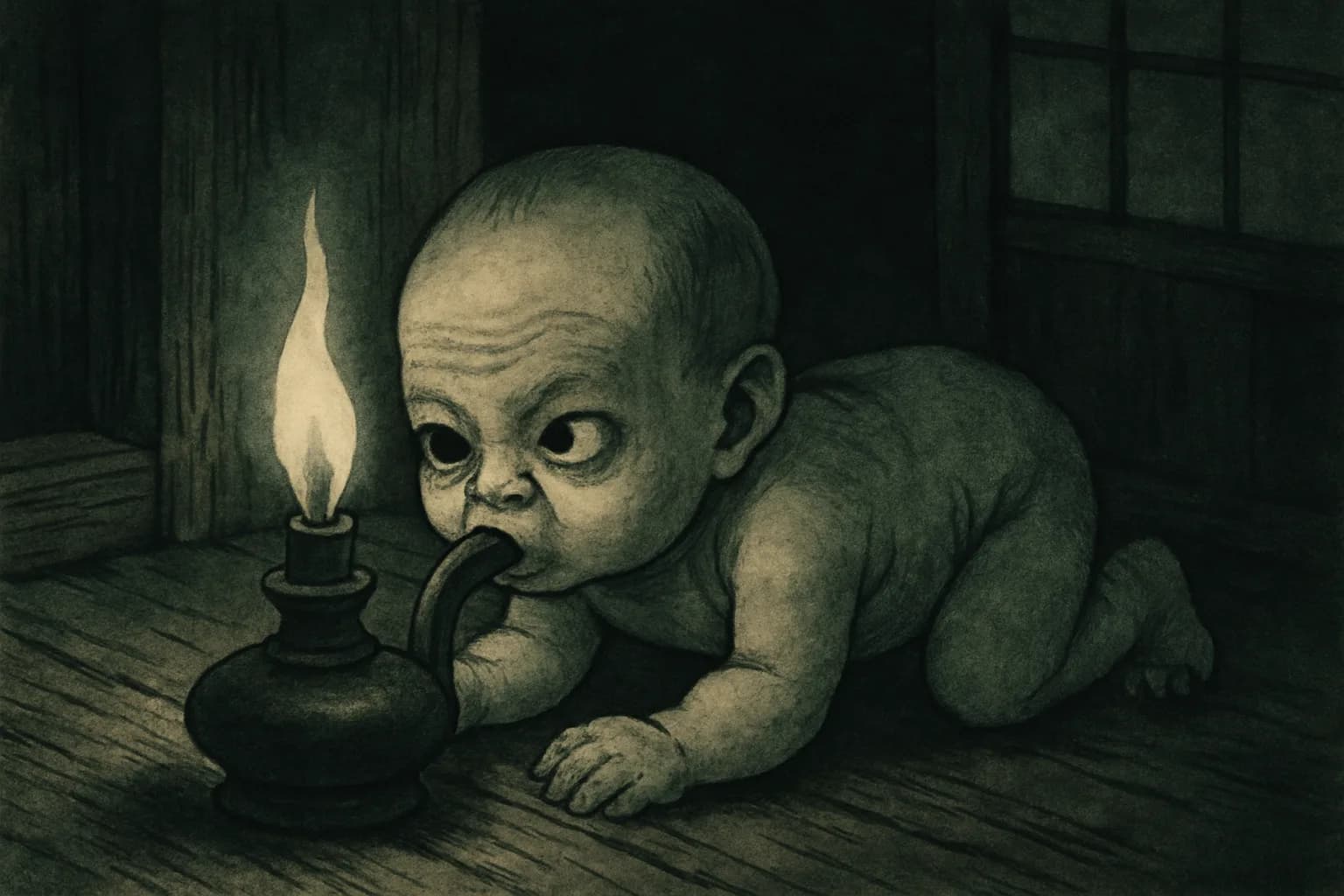
Travelers on the road near Ōtsu, on the shore of Lake Biwa, used to watch for a stray fireball drifting between the houses after dark. It moved low and aimless, the way a lost thing moves, and if it found an open door it would slip inside. What came through the doorway was not fire anymore. It was a baby, sitting up by the andon lamp, tongue working at the oil inside the paper shade.
What does it look like?
Abura-akago (油赤子) means, plainly, "oil baby." Toriyama Sekien drew it exactly as the name suggests: a small child in old-fashioned dress, caught mid-lick at the mouth of a lantern, an ordinary domestic scene made wrong by the fact that infants do not drink lamp oil and this one clearly wants to. Outdoors, before it finds a house, it wears no human shape at all — just a ball of unexplained fire crossing the night sky, one of the many kaika ("mysterious fires") that Edo-period travelers reported and never fully explained.
The oil thief of Hatchō
Sekien's own notes place the story in the Hatchō district of Ōtsu, in Ōmi Province — today's Shiga Prefecture, on Lake Biwa's shore. An oil seller from a nearby village, the story goes, made a habit of stealing from a Jizō statue at the crossroads: the oil left there as a devotional offering, meant to keep the stone bodhisattva's lamp burning, quietly ended up in his own stock instead. He kept at it for years. When he died, his theft did not end with him — his spirit persisted as a wandering fire over the roads he used to walk, and villagers who saw the fireball later found it had let itself into a house and become an infant, still going after oil, this time straight from other people's lamps.
Sekien was not inventing the tale himself; he drew it from an older collection, Shokoku Rijin Dan ("Tales of People from Various Provinces," compiled in the 1740s), and the same "oil-stealing fire" story also turns up in the Edo-period text Honchō Koji Innen Shū. By the time it reached his Konjaku Gazu Zoku Hyakki (1779), the man and the fire and the baby had merged into a single yokai with a tidy, closed loop of a biography: steal from a god, and you spend your afterlife stealing from your neighbors instead.
A family of guilty flames
Abura-akago is not the only Edo yokai built around this exact crime. Ubagabi, an old woman's face burning inside a ball of fire in Kawachi Province, has almost the identical backstory — a shrine attendant who skimmed lamp oil and became the flame she stole from. Line up enough of Sekien's kaika and a pattern shows through the ghost stories: oil was valuable, shrine lamps ran on trust rather than locks, and someone, somewhere, kept getting caught with their hand in the dish.
Where it comes from
There is a plausible, unspooky explanation sitting right next to the folkloric one. Edo-period andon lamps typically burned sardine oil, cheap and pungent, and cats are drawn to that smell the same way they're drawn to any fish. A cat balanced at a lamp's edge, licking at spilled oil in poor light, would throw exactly the wrong silhouette — small, pale, crouched — for a half-asleep household to mistake for an infant. Folklorists have floated this as abura-akago's likely seed: an actual nightly nuisance (a cat raiding the lamp oil) explained after the fact by grafting on a moralizing crime story about a punished thief. The fire in the sky and the baby at the lamp may never have been the same phenomenon at all — just two odd things that got stitched into one story because they happened in the same houses, on the same kind of night.
Abura-akago today
Abura-akago never left Sekien's page for a life as a mascot or a mainstream monster; it stayed a specialist's yokai, the kind that turns up in yokai encyclopedias and in reprints of the hyakki yagyo scrolls rather than on a shop sign. It shares that quiet obscurity with most of the Edo "guilty fire" yokai — remembered today mostly by people tracing Sekien's sources back to Shokoku Rijin Dan, still finding the same small, strange image at the end of the trail: a baby that should not exist, doing something no baby would do, in the dark, by lamplight, on the road out of Ōtsu.