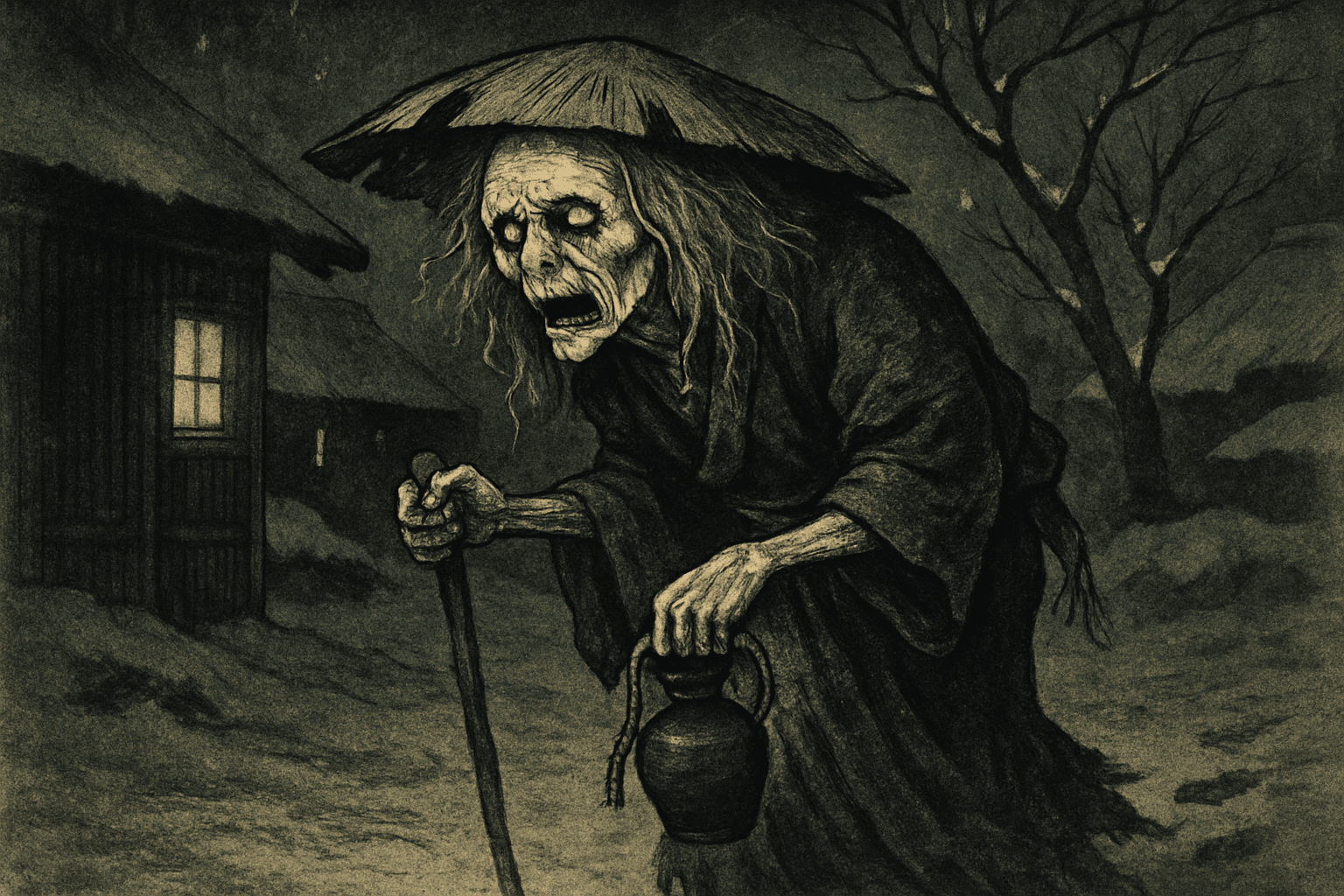
Most yokai in Toriyama Sekien's picture books get a monster's job: haunt a bridge, steal a child, drag a traveler under. Oshiroi-baba's job, according to Sekien himself, is far stranger — she's staff. A servant, specifically, to a minor goddess of cosmetics, and her whole ghastly appearance comes from doing that job badly, or too well, depending on how you read it.
What does she look like?
In the Konjaku Hyakki Shūi (1781), Sekien draws her as an old woman with a severely bent back, a broken umbrella-like hat perched on her head, a walking stick in one hand and a tokkuri — a small sake flask — in the other. Her defining feature is her face: caked in thick, sloppy white powder, applied so heavily and so badly that later writers describe the sight as genuinely frightening on its own, no fangs or claws required. She's ugly rather than monstrous, the kind of figure a child would run from without being able to say exactly why.
A servant, not a predator
Sekien's short accompanying text identifies her as an attendant to Shifun-senjō, a goddess associated with beni and oshiroi — rouge and face powder. That job description does a lot of work: it explains the powder, and it puts her at the bottom of a divine household rather than out hunting on her own. Later folklore treats her the same way. She's said to wander dark streets and roads near snowy mountains toward the end of the year, on cold winter nights, and she rarely bothers people directly. When she does approach someone, it's mundane by yokai standards — she wants makeup, or she wants to buy sake. Writers describe her as hideous and unsettling to look at, but not dangerous. The fear she generates is closer to the shock of a bad surprise than the dread of a real threat.
Where the name might come from
Not every "old woman" yokai starts life the same way, and Oshiroi-baba's origins are genuinely contested rather than settled. Some accounts connect her to yuki-onna, the snow woman — a natural fit for a figure who haunts snowy winter nights. Others tie her instead to yamauba, the mountain hag, grouping her with Japan's broader tradition of frightening old women who live outside ordinary society. Sekien's own goddess-attendant explanation is really a third option laid on top of both, and nothing in the record forces a choice between them.
A separate, older legend adds another thread. A yokai also called oshiroibabā is recorded along the Totsukawa river in Yoshino district, Nara — described as dragging a mirror behind her and making a jingling, jara-jara sound as she moves. Whether this river-hag and Sekien's powder-caked servant are the same figure under one name, or two different old women who happened to collide in the same word, isn't resolved in the sources; Sekien was known for grafting local and literary fragments together into a single picture, and this may be one more case of that.
A gentler story at Hase-dera
Not every version of an "oshiroibaba" is frightening. A record from 1538, in the Muromachi period, ties the name to a much kinder figure at Hase-dera, a temple in Nara: an old woman who, according to the temple's own account, miraculously multiplied rice for the monks working there as painters. The temple kept a small shrine to her afterward, and for a long stretch of its history it was customary to apply fresh powder to her image as part of the temple's ceremonies — an odd, literal echo of the name itself, decades or centuries removed from Sekien's ink-and-paper hag.
Where it comes from
Taken together, "Oshiroi-baba" looks less like one settled legend than a name that several different old-woman stories converged on — a snow spirit, a mountain hag, a river-side apparition with a mirror, and a benefactor spirit at a Nara temple, all answering to some version of the same title. Sekien's Konjaku Hyakki Shūi entry, with its tidy explanation of a goddess and her attendant, reads like his attempt to give one coherent shape to a name that folklore had already scattered in several directions.
She never picked up the modern fame of a kappa or a yuki-onna. No mascot wears her broken hat, and no product is named for her sake jug. What's left is the print: a hunched woman on a snow-dark road, her face a little too white, on her way to buy powder or sake from someone who probably shouldn't sell it to her.