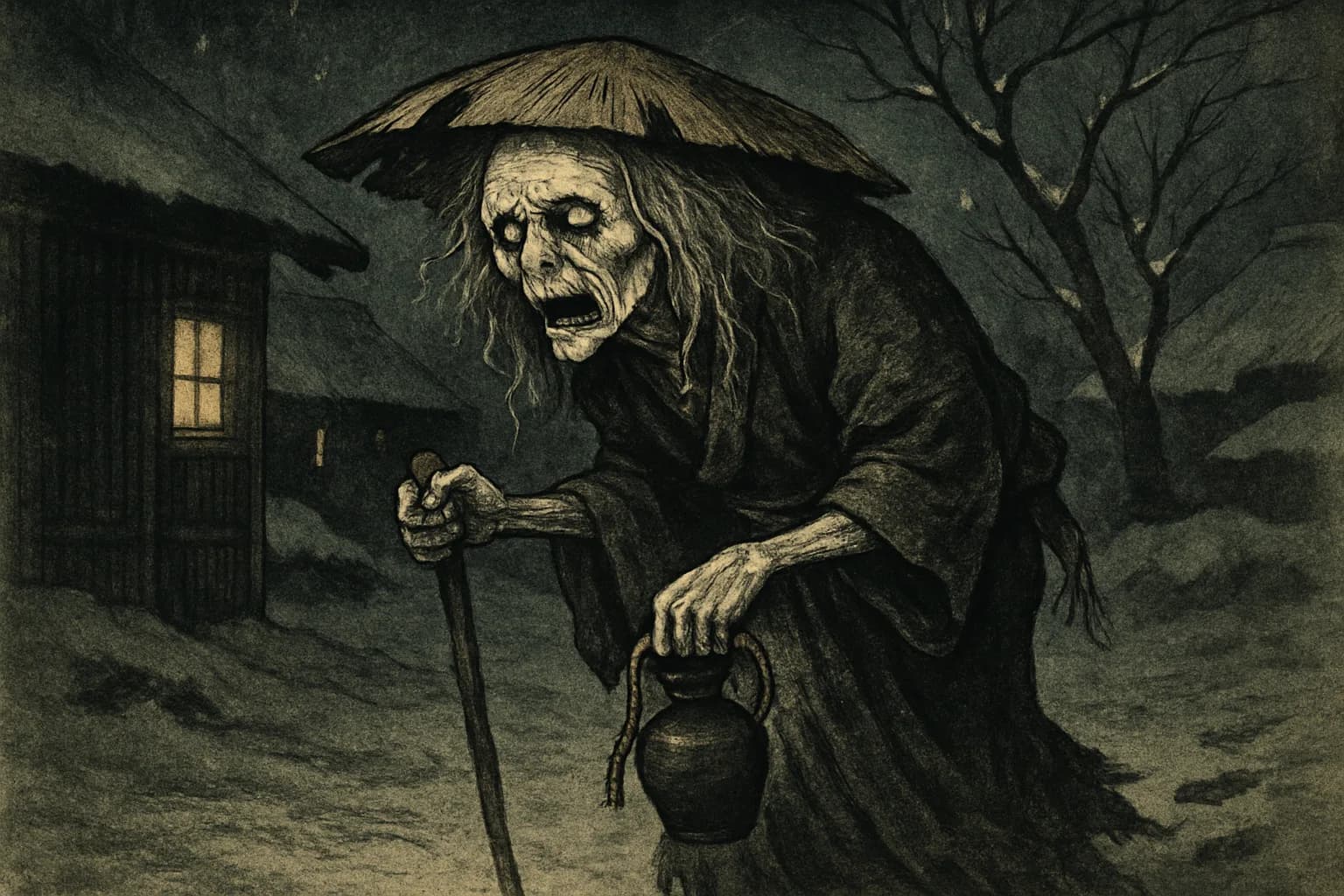
Toriyama Sekien's picture books are full of monsters he plainly invented on the spot, and Jakotsu-baba may be the clearest case of him showing his work. In the entry for her in Konjaku Hyakki Shūi (1781), he doesn't just draw her — he guesses, in a short prose note beside the image, where her strange name might have come from. It's less a ghost story than a scholar's footnote that got loose.
What does she look like?
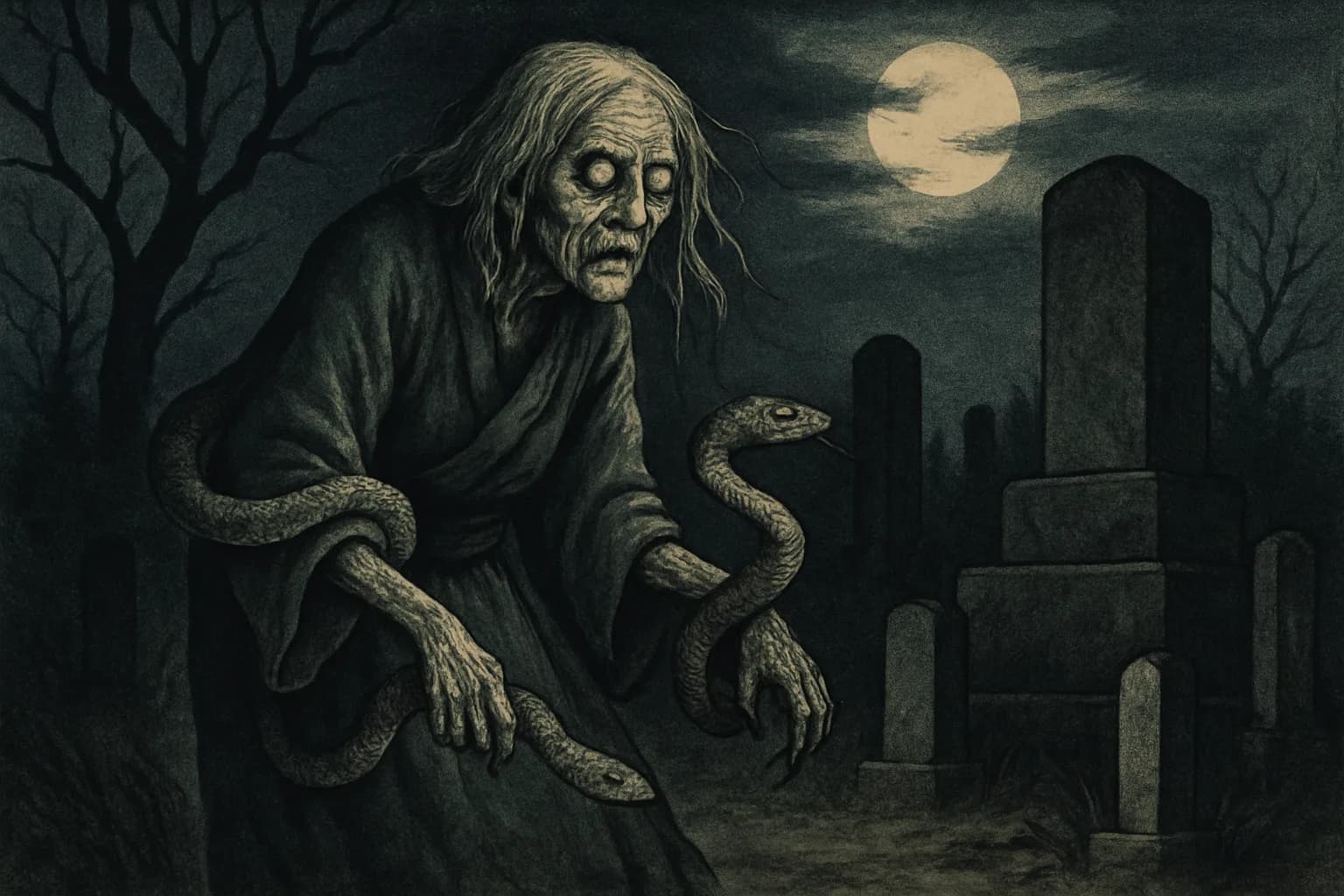
Sekien's Jakotsu-baba is an old woman with a large snake wrapped around her body. There's no shell, no dish, no obvious monstrous feature; she reads as human until you notice the snake, and how calmly she wears it. The blue snake and the red snake come from his caption, not the picture.
A wife at the snake mound
Sekien's note offers two guesses. The first points to Bukan (Wuxian in Chinese), a land in the ancient Chinese geography text Shan Hai Jing. There, he writes, live people who hold a blue snake in the right hand and a red snake in the left. Perhaps, he says, Jakotsu-baba is one of them.
The second guess comes from "a certain theory." She was the wife of a man called Jagoemon of the snake mound. So people called her "Jago-baba," Jago's old woman. Over time, the theory says, that name was misheard as "Jakotsu-baba," the snake-bone hag.
Then Sekien adds one word: mishō, "not known for certain." He offers both ideas as guesses, not facts, and that honesty is part of what makes the entry unusual.
The grave-guarding story came much later. Shōwa-era yokai books made Jagoemon a snake monster sealed in the mound. They cast her as the mound's guardian.
A word before it was a monster
The phrase jakotsu babā did not start with Sekien. It shows up years earlier, in a 1768 kurobon picture book and a 1778 kabuki play, among others, as ordinary slang for a frightening or ill-tempered old woman — closer to an insult than a name. Perhaps Sekien picked up that already-circulating phrase, decided it deserved a face, and reached for the Bukan passage to give a piece of everyday abuse a learned-sounding origin. If that's right, Jakotsu-baba isn't a monster that got a name; she's a name that got a monster, worked backward from a Chinese classic Sekien had clearly been reading closely.
Where it comes from
No version of this story predates Sekien's own book, in either Japanese or Chinese sources, which is part of why the "he made it up" theory has staying power. What isn't in doubt is his source material: the Shan Hai Jing's account of Bukan and its snake-holding people was real and available to an Edo-period reader, and Sekien's habit throughout his four picture-book series was to graft new characters onto exactly this kind of half-remembered continental scholarship. Jakotsu-baba sits at that graft point — a woman as real, within the fiction, as the country he says she came from.
After Sekien
Later writers didn't leave her where Sekien did. Shōwa-era yokai books gave her a fixed backstory as the snake mound's guardian. The folklorist Minakata Kumagusu, in Jūni-shi Kō, suggested a possible link to a charm. It was a spoken name used to keep snakes away.
She never became a household yokai the way the kappa or the fox spirit did. There's no cucumber ritual attached to her, no proverb, no mascot. What survives is the picture — an old woman and the snake wrapped around her — and Sekien's own uncertain footnote trying to explain how she got there.